How Waterfall Delivery Moves Through the SDLC - Systems Development Lifecycle (SDLC) Best Practices
How Waterfall Delivery Moves Through the SDLC
(Chapter 79 of Systems Development Lifecycle (SDLC) Best Practices)
Executive Summary: Chapter Overview
IF4ITThe Bottom Line
Core Concepts
| Concept | Definition & Strategic Role |
|---|---|
| Governing Principle | Waterfall delivery uses planned progression and controlled baselines while still permitting feedback, correction, progressive elaboration, and risk-based iteration. |
| Lifecycle Accountability | Enduring ownership and Release-specific coordination remain explicit. |
| Evidence | Claims and decisions are supported by attributable, current, relevant, and sufficient evidence. |
| Risk-Based Tailoring | Depth changes with context; minimum outcomes and accountability remain. |
Quick Q&A
Question: How does Waterfall move through the SDLC?
Question: Does Waterfall require a dedicated Environment for every phase?
Question: What is the main governance risk in Waterfall execution?
Read More Below
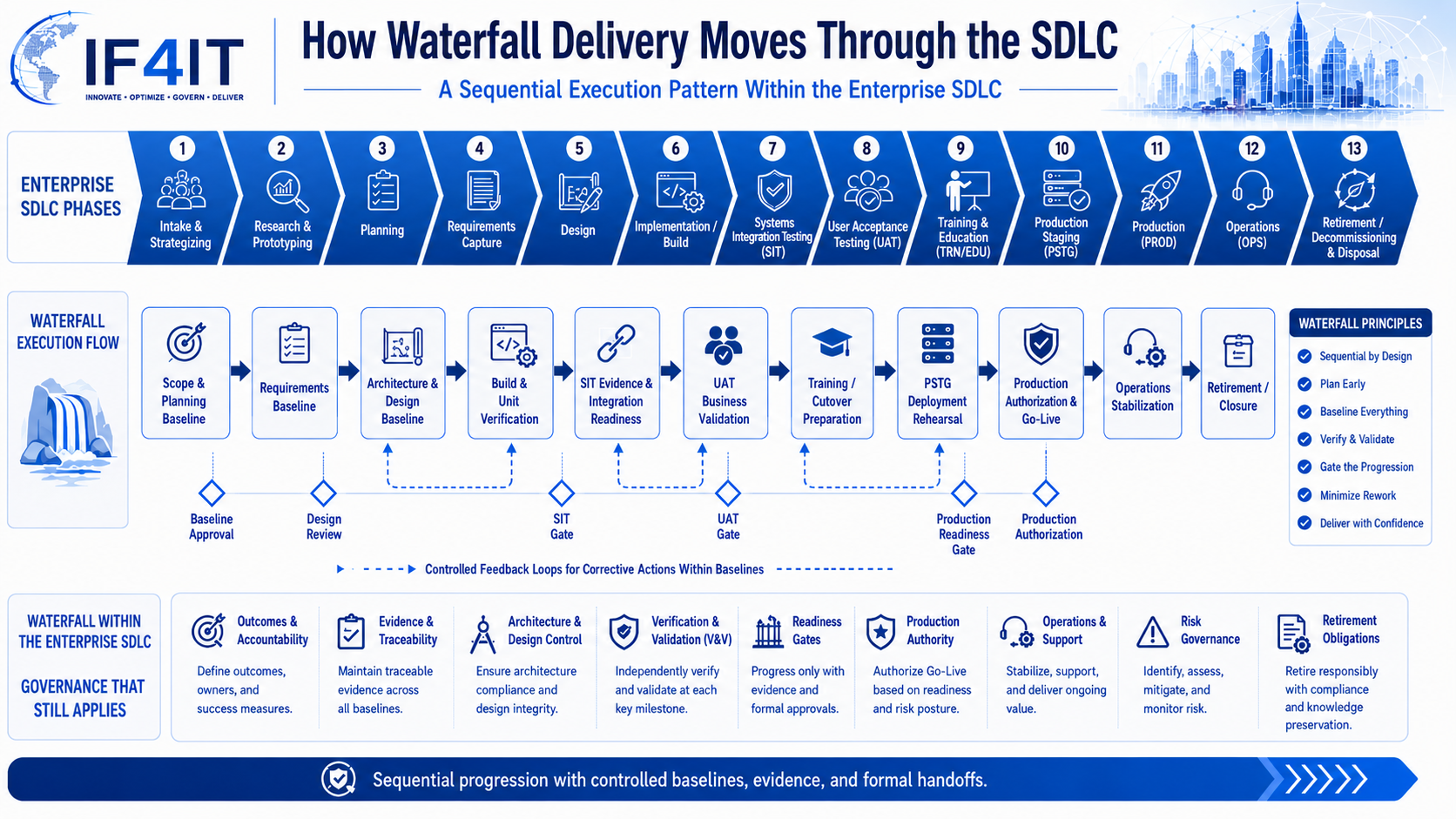
Explains how Waterfall delivery uses comparatively sequential stages, formal baselines, handoffs, and readiness decisions within the Enterprise SDLC.
Governing Principle
Waterfall delivery uses planned progression and controlled baselines while still permitting feedback, correction, progressive elaboration, and risk-based iteration.
Required Lifecycle Treatment
| Area | Required treatment |
|---|---|
| Planning | Define scope, dependencies, phase outputs, baselines, handoffs, evidence, and decision criteria early. |
| Progression | Use comparatively sequential movement where later work depends materially on approved earlier outputs. |
| Change control | Evaluate and authorize material changes to established requirements, Architecture, Design, and Release baselines. |
| Fit | Use where requirements, physical sequencing, regulation, contractual milestones, migration, or irreversible cutover favor planned coordination. |
| Lifecycle coverage | Apply all 13 phases and cross-cutting disciplines, including Operations and Retirement. |
Application Through the SDLC
Apply this discipline from Intake through Retirement. Early phases establish ownership, risk, and evidence needs in the Utilization Profile; Requirements through Build translate the principle into testable conditions; SIT through Staging generate decision-ready evidence in representative Environments; Production and Operations verify and monitor the authorized state; Retirement closes remaining obligations with evidence.
Governance and Evidence
Name accountable owners for the Solution, Release, and applicable discipline, along with evidence producers, reviewers, and a Risk Owner. Scale rigor to actual risk and reversibility, and keep Risks, exceptions, and Technical Debt in authoritative systems rather than narrative status. AI may assist with analysis and drafting but should never independently accept Risk or authorize Production.
Common Antipatterns
Enterprises should avoid assuming Waterfall’s sequential structure prohibits feedback or correction. Waterfall delivery still permits feedback, progressive elaboration, and risk-based iteration within its planned baselines; treating sequential progression as meaning no going back under any circumstances can prevent legitimate correction of a discovered issue from ever happening.
| Antipattern | Why it fails |
|---|---|
| Assuming Waterfall’s sequential structure prohibits feedback or correction | Waterfall still permits feedback and risk-based iteration within its planned baselines; treating sequential progression as absolute can prevent legitimate correction of a discovered issue from happening. |
Connections to Related IF4IT Practices and Inventories
Use Technology Portfolio Management (TPM) Best Practices, the Software Technologies Inventory and Attributes, and IT Operating Environments Best Practices to connect the decisions and responsibilities addressed in this chapter to governed technology choices, platform lifecycle, and environment controls.
Use Agile, Waterfall, or Hybrid: An IF4IT Framework for Choosing Delivery Methodology to select and tailor the delivery approach according to consequence of failure, decomposability, incremental deliverability, and timing constraints.
Apply the Non-Functional Requirements (NFRs) Framework for Software Systems so quality expectations stay connected to validation methods, test evidence, acceptance criteria, readiness gates, and Production assurance.
How to cite this page
When referencing this page in academic work, internal standards, or external publications, include the page title, IF4IT as author and publisher (The International Foundation for Information Technology (IF4IT), LLC), the URL, and your access date.
Example (informal web citation):
The International Foundation for Information Technology (IF4IT), LLC. How Waterfall Delivery Moves Through the SDLC | Systems Development Lifecycle (SDLC) Best Practices. https://if4it.org/best-practices/systems-development-lifecycle-sdlc/how-waterfall-delivery-moves-through-the-sdlc/ (accessed 2026-10-16).
See About Us for content governance and site-wide citation guidance.
Copyright for The International Foundation for Information Technology (IF4IT), LLC: 2008 - Present
Legal Disclaimers