Overview of Systems Development Lifecycle (SDLC) Best Practices - Systems Development Lifecycle (SDLC) Best Practices
Overview of Systems Development Lifecycle (SDLC) Best Practices
(Chapter 1 of Systems Development Lifecycle (SDLC) Best Practices)
Executive Summary: Chapter Overview
IF4ITThe Bottom Line
Core Concepts
| Concept | Definition & Strategic Role |
|---|---|
| Enterprise SDLC | The authoritative lifecycle framework used to govern technology-enabled capabilities across their full useful life. |
| Comprehensive Superset | The complete set of phases and responsibilities from which approved, proportionate paths are selected. |
| Methodology Neutrality | The ability to use Agile, Waterfall, Hybrid, or other delivery methods without removing lifecycle obligations. |
| Cross-Cutting Discipline | A lifecycle concern, such as security or configuration management, that applies across multiple phases. |
Quick Q&A
Question: What is the purpose of the IF4IT SDLC?
Question: Must every Release use every phase identically?
Question: Does the SDLC end at Production?
Read More Below
This chapter introduces the IF4IT Systems Development Lifecycle as an IT management governance framework and enterprise knowledge model for IT leaders, managers, architects, owners, governance functions, suppliers, and delivery practitioners. It explains how the framework directs and controls the complete lifecycle of technology-enabled capabilities, distinguishes it from software-development-only guidance, and summarizes its 13 phases, sourcing applicability, methodology neutrality, risk-based tailoring, maturity progression, cross-cutting disciplines, and relationship to IT Operating Environments.
The IF4IT SDLC as an IT Management Governance Framework
The IF4IT Systems Development Lifecycle (SDLC) is an IT management governance framework for directing and controlling an Asset, Product, Service, System, Application, Solution, or other technology-enabled capability from initial need through research, planning, requirements, design, implementation or acquisition, validation, Production, operations, maintenance, and eventual retirement. It is intended for IT leaders and managers as well as architects, owners, governance functions, suppliers, and delivery practitioners who share accountability for lifecycle outcomes.
The framework extends beyond software construction. It integrates strategic intake, planning, requirements, design, acquisition or build, verification, validation, deployment, operations, improvement, and retirement with decision rights, evidence, assurance, risk management, service ownership, enterprise inventories, and readiness governance. The model is detailed in definition but scalable in implementation, allowing leaders and delivery teams to select an approved, proportionate path without allowing essential work to be omitted informally.
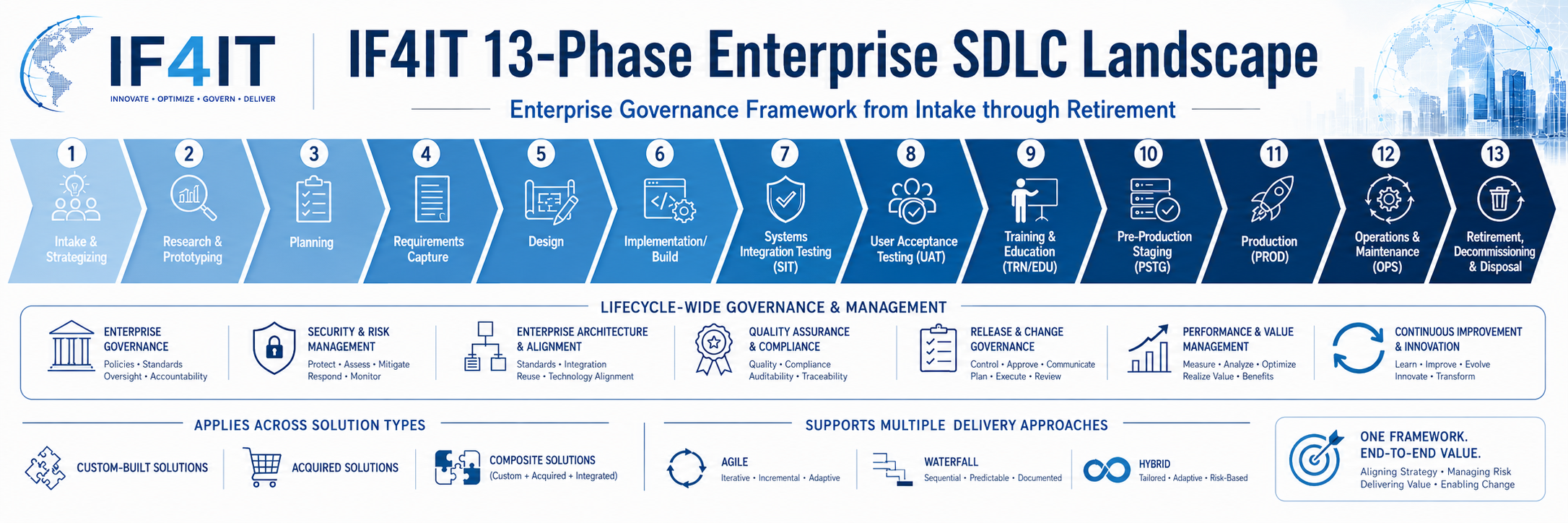
The 13 SDLC Phases
| # | IF4IT SDLC Phase | Primary Purpose |
|---|---|---|
| 1 | Intake & Strategizing | Identify, qualify, align, and authorize the need or opportunity. |
| 2 | Research & Prototyping | Investigate feasibility, alternatives, technologies, risks, and uncertainties. |
| 3 | Planning | Define how work, resources, funding, dependencies, governance, and delivery will be managed. |
| 4 | Requirements Capture | Define and validate business, functional, non-functional, operational, data, security, privacy, and stakeholder requirements. |
| 5 | Design | Translate approved requirements into architecture and detailed Solution designs. |
| 6 | Implementation/Build | Build, acquire, configure, integrate, document, and prepare the Solution. |
| 7 | Systems Integration Testing (SIT) | Verify integrated technical behavior, interfaces, data flows, dependencies, and controls. |
| 8 | User Acceptance Testing (UAT) | Validate that the Solution satisfies intended business and user needs. |
| 9 | Training & Education (TRN/EDU) | Prepare users, administrators, operators, support personnel, and other stakeholders. |
| 10 | Pre-Production Staging (PSTG) | Rehearse migration, cutover, rollback, support, and operational readiness. |
| 11 | Production (PROD) | Deploy or activate the approved Release and complete Production verification and stabilization. |
| 12 | Operations & Maintenance (OPS) | Operate, monitor, support, maintain, secure, improve, and assess the capability. |
| 13 | Retirement, Decommissioning & Disposal | End the capability’s useful life in a controlled, traceable, secure, and compliant manner. |
One SDLC With Different Paths
The SDLC applies to Custom-Built, Acquired, and Composite Solutions. The sourcing model changes activities, evidence, roles, contractual controls, and dependencies within phases; it does not remove lifecycle governance.
Agile, Waterfall, and Hybrid delivery methods can all operate within the SDLC. Methodology changes how work is organized, sequenced, and repeated, not whether essential lifecycle responsibilities exist.
Risk-Based Tailoring and Maturity
The 13 phases are an enterprise superset. Not every Release requires identical activities, artifacts, Environments, evidence, or formality. Applicable obligations should be deliberately tailored through an approved SDLC Path and Utilization Profile.
Crawl maturity uses minimum viable but controlled practices. Walk maturity standardizes and makes them repeatable. Run maturity integrates, automates, measures, and continuously improves them. Limited resources justify simpler mechanisms, not the silent removal of quality, integrity, security, accountability, or risk-management outcomes.
Cross-Cutting Lifecycle Disciplines
| Discipline | Lifecycle Purpose |
|---|---|
| Security and Privacy | Protect the capability, its users, data, and enterprise throughout the lifecycle. |
| Verification, Validation, and Assurance | Demonstrate correctness, suitability for intended use, and trustworthy evidence. |
| Configuration, Baseline, and Technical-Data Management | Control Solution, infrastructure, Environment, artifact, and authoritative-state integrity. |
| Technology Supply-Chain Integrity | Govern suppliers, components, services, provenance, dependencies, supportability, and lifecycle risk. |
| Accessibility and Inclusive Design | Prevent avoidable barriers and support diverse users and operating contexts. |
| Artificial Intelligence and Generative AI Governance | Govern AI-enabled capabilities and responsible generative-AI use in SDLC work. |
| Lifecycle Information Architecture | Structure, identify, link, synchronize, retain, and govern SDLC knowledge and evidence. |
| Conformance and Exception Management | Demonstrate adherence and formally govern deviations, compensating controls, and residual risk. |
Connections to Related IF4IT Practices and Inventories
Connect the decisions and responsibilities addressed in this chapter to enterprise structure, capability ownership, and measurable business outcomes using the IF4IT Enterprise Model, Enterprise Capability Models, and the Capabilities Inventory and Attributes.
How to cite this page
When referencing this page in academic work, internal standards, or external publications, include the page title, IF4IT as author and publisher (The International Foundation for Information Technology (IF4IT), LLC), the URL, and your access date.
Example (informal web citation):
The International Foundation for Information Technology (IF4IT), LLC. Overview of Systems Development Lifecycle (SDLC) Best Practices | Systems Development Lifecycle (SDLC) Best Practices. https://if4it.org/best-practices/systems-development-lifecycle-sdlc/overview-of-systems-development-lifecycle-sdlc-best-practices/ (accessed 2026-10-16).
See About Us for content governance and site-wide citation guidance.
Copyright for The International Foundation for Information Technology (IF4IT), LLC: 2008 - Present
Legal Disclaimers