Plan for Supportability, Obsolescence, Replacement, and Retirement Throughout the SDLC - Systems Development Lifecycle (SDLC) Best Practices
Plan for Supportability, Obsolescence, Replacement, and Retirement Throughout the SDLC
(Chapter 101 of Systems Development Lifecycle (SDLC) Best Practices)
Executive Summary: Chapter Overview
IF4ITThe Bottom Line
Core Concepts
| Concept | Definition & Strategic Role |
|---|---|
| Supportability Plan | The governed approach for sustaining, maintaining, securing, recovering, staffing, and changing a Solution over its required life. |
| Obsolescence Roadmap | The time-based view of support limits, aging dependencies, replacement triggers, decisions, funding, and remediation work. |
| Exit Capability | The technical, contractual, informational, operational, and organizational ability to leave a Product, Service, supplier, or platform. |
| Extended Support | A temporary arrangement that continues defined supplier or internal support beyond the normal support period. |
| Retirement Closure Evidence | Evidence that all required technical, data, access, supplier, financial, operational, and record obligations were completed. |
Quick Q&A
Question: Should every Solution have a supportability plan?
Question: What should trigger an obsolescence decision?
Question: Is replacing the primary Application sufficient for Retirement?
Read More Below
Provides the practical lifecycle model for defining support horizons, monitoring obsolescence, planning upgrades and replacement, preserving exit capability, governing unsupported conditions, and executing complete Retirement.
Best Practice: Establish the Governing Principle for Plan for Supportability, Obsolescence, Replacement, and Retirement Throughout the SDLC
Plan the complete sustainment and exit path for every material Solution and dependency before operational reliance makes change prohibitively expensive or risky.
Benefits: Planning the exit path before a Solution becomes operationally indispensable is what keeps a future migration a planned Release instead of an emergency response to an unsupported platform. This up-front thinking is consistently cheaper than the alternative: discovering the replacement problem only after the original vendor has already announced end of support.
Best Practice: Define Required Lifecycle Treatment for Plan for Supportability, Obsolescence, Replacement, and Retirement Throughout the SDLC
Define the required lifecycle horizon, support model, supplier obligations, internal skills, maintenance and patching responsibilities, upgrade cadence, compatibility requirements, technical-data needs, portability, replacement lead time, funding assumptions, and Retirement criteria. Establish triggers for support review and replacement action, including supplier notices, vulnerability exposure, rising operational cost, skill scarcity, performance limits, regulatory change, and strategic misalignment.
Benefits: Defining concrete triggers for support review — a vulnerability disclosure, rising operational cost, a vendor’s end-of-support notice — turns obsolescence from a vague future worry into something a team can actually monitor and act on. Knowing replacement lead time in advance also prevents a scramble when a supplier’s notice period turns out to be shorter than the enterprise assumed.
Best Practice: Apply Plan for Supportability, Obsolescence, Replacement, and Retirement Throughout the SDLC Throughout the SDLC
Record supportability requirements during Requirements Capture and incorporate modularity, standards, portability, observability, maintainability, and recoverability into Design. Validate installation, upgrade, migration, rollback, recovery, administration, and support procedures before Production. In Operations, maintain an obsolescence roadmap, test replacement assumptions, budget remediation, and monitor leading indicators. For Acquired Solutions, contract for notice, continued support, data export, transition assistance, and deletion. For Composite Solutions, evaluate end-to-end consequences when one component reaches end of life. During Retirement, verify that technology, data, interfaces, access, licenses, suppliers, records, and monitoring have been dispositioned.
Benefits: Designing for modularity and portability at Build time, rather than after a component becomes obsolete, is what makes eventual replacement a contained change instead of a ground-up rebuild. Maintaining an obsolescence roadmap through Operations also means the enterprise sees a coming end-of-support date months in advance instead of discovering it during an outage.
Best Practice: Govern Decisions and Preserve Evidence for Plan for Supportability, Obsolescence, Replacement, and Retirement Throughout the SDLC
Assign an enduring owner for each supportability and obsolescence obligation. Record target dates, trigger conditions, current support state, affected Solutions, dependencies, options, cost, Risk, decision authority, and planned action in authoritative roadmaps and inventories. Treat unsupported technology, deferred upgrades, missing portability, and unplanned lock-in as visible Risks or Technical Debt rather than hidden operational assumptions.
Benefits: Assigning a named owner for each supportability obligation prevents an aging, unsupported dependency from being everyone’s low-priority background risk and therefore no one’s actual responsibility. Recording unplanned lock-in as visible Technical Debt, rather than a hidden operational assumption, means it competes openly for remediation funding instead of being discovered only when the vendor relationship finally breaks down.
Best Practice: Advance Maturity Deliberately for Plan for Supportability, Obsolescence, Replacement, and Retirement Throughout the SDLC
At Crawl maturity, track supportability and obsolescence for the most critical dependencies in a simple manually reviewed list, with target dates noted informally. At Walk maturity, maintain a governed supportability plan for every material Solution and dependency, with defined review triggers and an accountable owner for each obligation. At Run maturity, integrate supportability and obsolescence tracking with the Software Technologies Inventory and supplier systems so approaching support deadlines and emerging risk are flagged automatically well before they become urgent.
Benefits: A simple manually reviewed list focused on critical dependencies at Crawl maturity is enough to catch the most consequential obsolescence risk without requiring dedicated tracking infrastructure. A governed supportability plan with defined triggers at Walk maturity means every material dependency gets the same baseline attention instead of only the ones someone happens to remember. Automated flagging integrated with authoritative inventories at Run maturity surfaces an approaching support deadline early enough for the enterprise to plan a deliberate transition instead of reacting to an emergency.
Best Practice: Avoid Common Antipatterns in Plan for Supportability, Obsolescence, Replacement, and Retirement Throughout the SDLC
Enterprises should avoid treating support expiration as a future problem. Deferring obsolescence planning until a component is already unsupported turns a predictable, plannable lifecycle event into an unplanned emergency with far less negotiating leverage and far higher replacement cost.
| Antipattern | Why it fails |
|---|---|
| Treating support expiration as a future problem | Deferring obsolescence planning until a component is already unsupported turns a predictable lifecycle event into an unplanned emergency with less leverage and higher replacement cost. |
Benefits: Avoiding this antipattern keeps obsolescence visible as a planning input rather than a surprise. It gives the enterprise time to budget, negotiate, and migrate on its own schedule instead of a vendor’s.
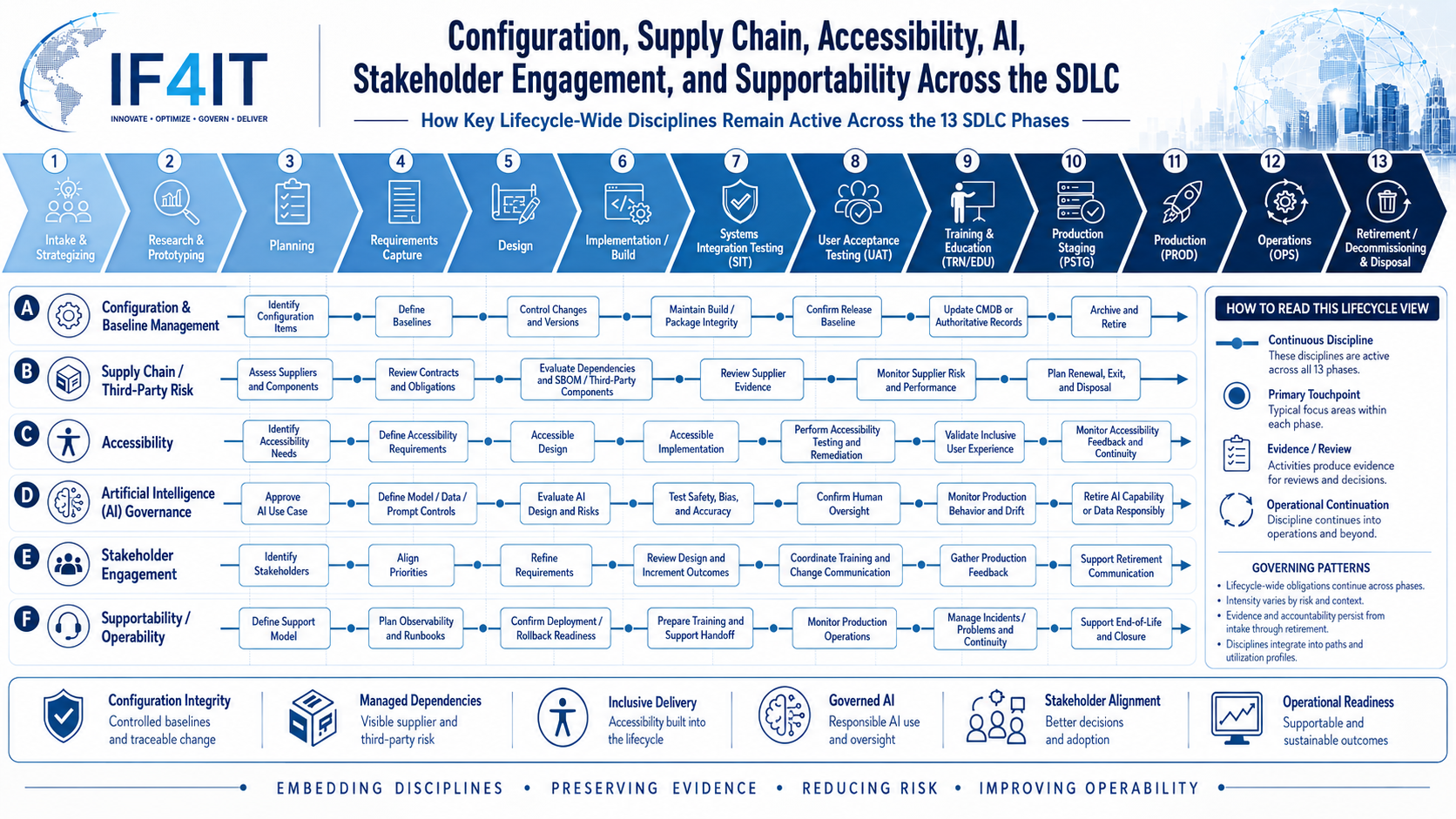
Connections to Related IF4IT Practices and Inventories
Use Technology Portfolio Management (TPM) Best Practices and the Software Technologies Inventory and Attributes to select approved technologies, expose standards exceptions, record configuration baselines, and manage supportability and obsolescence.
Apply Technical Debt Management Best Practices and the Technical Debt Inventory and Attributes to identify, qualify, record, prioritize, remediate, accept, and periodically reassess intentional, inherited, emergent, and deferred lifecycle obligations.
How to cite this page
When referencing this page in academic work, internal standards, or external publications, include the page title, IF4IT as author and publisher (The International Foundation for Information Technology (IF4IT), LLC), the URL, and your access date.
Example (informal web citation):
The International Foundation for Information Technology (IF4IT), LLC. Plan for Supportability, Obsolescence, Replacement, and Retirement Throughout the SDLC | Systems Development Lifecycle (SDLC) Best Practices. https://if4it.org/best-practices/systems-development-lifecycle-sdlc/plan-for-supportability-obsolescence-replacement-and-retirement-throughout-the-sdlc/ (accessed 2026-08-24).
See About Us for content governance and site-wide citation guidance.
Copyright for The International Foundation for Information Technology (IF4IT), LLC: 2008 - Present
Legal Disclaimers