Preserve Required SDLC Evidence Through Operations and Retirement - Systems Development Lifecycle (SDLC) Best Practices
Preserve Required SDLC Evidence Through Operations and Retirement
(Chapter 114 of Systems Development Lifecycle (SDLC) Best Practices)
Executive Summary: Chapter Overview
IF4ITThe Bottom Line
Core Concepts
| Concept | Definition & Strategic Role |
|---|---|
| Evidence Preservation | Evidence preservation is the governed retention of lifecycle evidence together with the context needed to understand what claim, configuration, Release, Environment, period, method, authority, and decision it supports. Preservation concerns meaning and usability, not merely storage. |
| Identification of Evidence With Continuing Lifecycle Value | Continuing evidence may include approved requirements and baselines, Architecture decisions, Build provenance, supplier reports, Security and Privacy assessments, V&V results, acceptance records, Production authorization, deployment records, migration reconciliation, recovery results, exceptions, Risk acceptance, and retirement evidence. |
| Relate Evidence to the Governed Object and State | Evidence should identify the Asset, Product, Service, System, Application, Solution, component, supplier, Release, baseline, version, Environment, data, and time period to which it applies. Evidence detached from configuration and scope may be misleading. |
| Preservation of Decision Context and Limitations | The enterprise should retain the claim, criteria, method, result, findings, assumptions, limitations, conditions, residual uncertainty, assessor or source, and decision authority. A pass status without context is rarely sufficient for future reliance. |
| Retention According to Lifecycle Need and Obligation | Retention should reflect operational life, regulatory and contractual obligations, audit, litigation, support, recovery, supplier dispute, and historical reconstruction. Some evidence should outlive the Release, Project, supplier contract, or active Solution. |
Quick Q&A
Question: Should all SDLC evidence be retained for the life of the Solution?
Question: Does historical test evidence remain valid after a major Product upgrade?
Question: Can a supplier portal be the sole repository for critical evidence?
Read More Below
Required SDLC evidence should remain attributable, accessible, protected, interpretable, and retainable for as long as it supports operational control, audit, regulatory obligations, supplier governance, Risk treatment, Incident and Problem analysis, recovery, change, modernization, or retirement closure. Project or Release completion should not cause the evidence basis for the operated Solution to disappear.
Best Practice: Define Evidence Preservation
Evidence preservation is the governed retention of lifecycle evidence together with the context needed to understand what claim, configuration, Release, Environment, period, method, authority, and decision it supports. Preservation concerns meaning and usability, not merely storage.
Benefits: Preserving the context around evidence — what claim it supports, under what conditions it remains valid — not just the artifact itself, is what actually makes it usable months or years later. Evidence stripped of its context tends to become a file no one can confidently interpret or rely on.
Best Practice: Identify Evidence With Continuing Lifecycle Value
Continuing evidence may include approved requirements and baselines, Architecture decisions, Build provenance, supplier reports, Security and Privacy assessments, V&V results, acceptance records, Production authorization, deployment records, migration reconciliation, recovery results, exceptions, Risk acceptance, and retirement evidence.
Benefits: Deliberately identifying which evidence has continuing value — Build provenance, Security assessments, Risk acceptance records — prevents the common failure where evidence with genuine long-term relevance gets discarded alongside truly disposable working files simply because no one distinguished between them.
Best Practice: Relate Evidence to the Governed Object and State
Evidence should identify the Asset, Product, Service, System, Application, Solution, component, supplier, Release, baseline, version, Environment, data, and time period to which it applies. Evidence detached from configuration and scope may be misleading.
Benefits: Tying evidence to the specific Asset, Release, and Environment it applies to prevents it from being misapplied to a different version or configuration later. Evidence detached from its scope can look relevant to a similar-seeming situation while actually describing something materially different.
Best Practice: Preserve Decision Context and Limitations
The enterprise should retain the claim, criteria, method, result, findings, assumptions, limitations, conditions, residual uncertainty, assessor or source, and decision authority. A pass status without context is rarely sufficient for future reliance.
Benefits: Retaining the assumptions and limitations behind a decision, not just its pass/fail conclusion, means a future reader can judge whether that conclusion still applies to their current question. A bare ‘passed’ status without context gives no way to tell whether it’s still trustworthy.
Best Practice: Define Retention According to Lifecycle Need and Obligation
Retention should reflect operational life, regulatory and contractual obligations, audit, litigation, support, recovery, supplier dispute, and historical reconstruction. Some evidence should outlive the Release, Project, supplier contract, or active Solution.
Benefits: Setting retention periods based on actual regulatory, contractual, and historical-reconstruction needs — rather than a single arbitrary default — means evidence that genuinely needs to outlive the Release or even the Solution itself doesn’t get deleted prematurely alongside routine working files.
Best Practice: Use Controlled and Durable Repositories
Evidence should be stored or referenced through repositories that provide ownership, access control, integrity, versioning, metadata, retention, export, and auditability appropriate to the evidence class. Personal drives, temporary chat, and expiring supplier links should not be sole repositories for material evidence.
Benefits: Storing material evidence in governed repositories, rather than personal drives or expiring supplier links, means it’s still accessible when it’s actually needed — often months after the person who saved it has moved to a different team or the supplier relationship has ended.
Best Practice: Protect Evidence Integrity and Confidentiality
Controls may include immutable storage, signatures or hashes, restricted access, encryption, audit logs, legal hold, and controlled redaction. Protection should preserve the evidentiary value without unnecessarily blocking authorized operational use.
Benefits: Applying immutable storage and access controls to preserved evidence protects its evidentiary value — a record that could have been quietly altered after the fact is far less useful during a dispute or audit than one with a verifiable integrity guarantee.
Best Practice: Maintain Evidence Currentness and Reassessment Triggers
Evidence may remain historically valid while becoming insufficient for the current operating state. Product upgrades, configuration changes, supplier changes, new threats, new data uses, Incidents, and elapsed time may trigger reassessment or new evidence.
Benefits: Recognizing that historically valid evidence can become insufficient as conditions change — a new threat, a supplier change, elapsed time — prevents the enterprise from relying on a technically true but practically outdated conclusion long after the situation it described has shifted.
Best Practice: Apply Transfer Evidence Into Operations
Operational owners should receive access to evidence needed for monitoring, support, Risk treatment, recovery, supplier management, and authorized change. Release closure should verify that continuing conditions, exceptions, deferred obligations, and evidence-refresh responsibilities have durable owners.
Benefits: Giving operational owners direct access to the evidence behind exceptions and deferred obligations at Release closure means Operations doesn’t inherit a Solution without also inheriting the context needed to actually manage its known conditions and risks.
Best Practice: Use Evidence During Incidents and Problems
Preserved evidence can help establish expected behavior, approved state, prior findings, recent changes, supplier obligations, and recovery assumptions. Incident and Problem results should create new evidence and may invalidate prior conclusions.
Benefits: Using preserved evidence to establish expected behavior during an Incident dramatically speeds root-cause analysis, since responders can compare actual behavior against a documented baseline instead of reconstructing what ’normal’ was supposed to look like from memory.
Best Practice: Preserve Evidence Through Modernization and Supplier Transition
Replacement and migration work should retain enough prior evidence to understand legacy behavior, data meaning, control history, unresolved Risk, and closure obligations. Supplier transition should secure required evidence before portal access or contractual rights end.
Benefits: Securing required evidence before a supplier’s portal access or contractual rights end is often a one-time, non-recoverable opportunity. Waiting until a transition is already underway to realize certain evidence is needed usually means it’s already unavailable.
Best Practice: Preserve Retirement and Disposal Evidence
Retirement evidence should demonstrate authorization, dependency removal, data retention or deletion, access revocation, supplier closure, asset disposition, inventory updates, and residual obligations. The evidence should remain available for the required retention period after the technology is removed.
Benefits: Retaining retirement evidence for its full required period after a technology is removed means the enterprise can still demonstrate proper closure — data disposition, access revocation, dependency removal — if a question about the retired capability surfaces well after the fact.
Best Practice: Apply Dispose of Evidence Securely When Obligations End
Evidence should not be retained indefinitely without purpose. When legal, regulatory, contractual, operational, and historical needs end, disposition should be authorized, documented, and performed according to Security, Privacy, Records Management, and supplier obligations.
Benefits: Deliberately disposing of evidence once its legal and operational purpose has genuinely ended — rather than retaining everything indefinitely by default — reduces the enterprise’s exposure and cost without sacrificing anything actually still needed.
Best Practice: Advance Maturity Deliberately for Preserve Required SDLC Evidence Through Operations and Retirement
At Crawl maturity, identify critical evidence, owners, repositories, and retention. At Walk maturity, standardize metadata, configuration links, integrity controls, transfer to Operations, and reassessment triggers. At Run maturity, automate evidence capture, lineage, retention, currentness analysis, and permission-aware retrieval across the lifecycle.
Benefits: Starting with identifying critical evidence and its owners at Crawl maturity establishes the discipline that standardized metadata and integrity controls at Walk maturity depend on. Pursuing automated lineage and permission-aware retrieval at Run maturity before basic preservation practices are solid tends to automate a system with unreliable foundations.
Best Practice: Avoid Common Antipatterns in Preserve Required SDLC Evidence Through Operations and Retirement
Enterprises should avoid storing material evidence only in personal drives or expiring supplier links. Evidence that lives only in an individual’s personal storage or a supplier portal with an expiring access window disappears exactly when it’s needed most — after the Project team has disbanded and someone else needs to understand a decision made long ago.
| Antipattern | Why it fails |
|---|---|
| Storing material evidence only in personal drives or expiring supplier links | Evidence in an individual’s personal storage or a supplier portal with an expiring access window disappears exactly when it’s needed most, after the Project team has disbanded. |
Benefits: Avoiding this antipattern keeps material evidence recoverable long after the individual who created it has moved on. It closes the single most common way genuinely important evidence quietly becomes permanently lost.
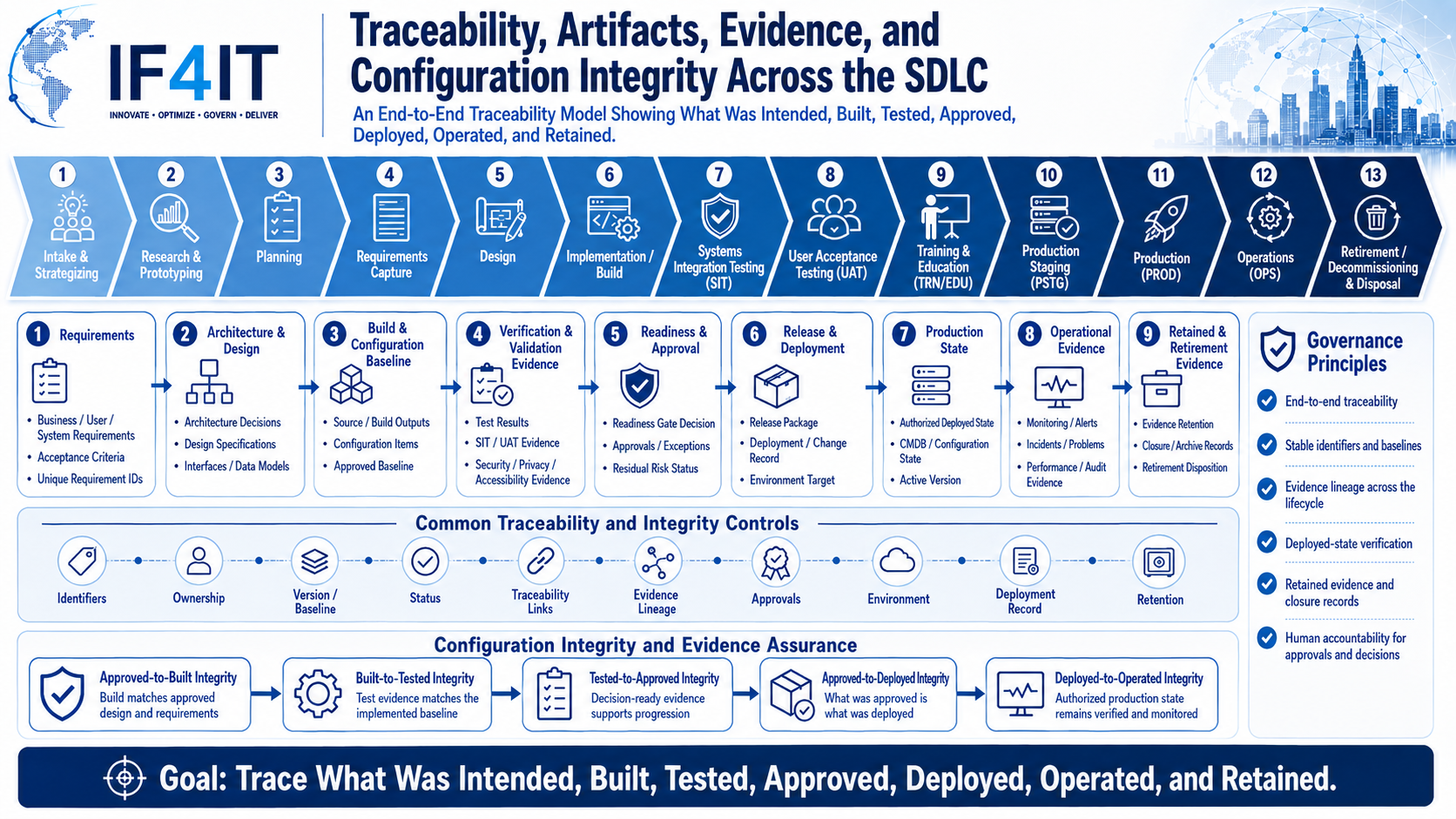
Connections to Related IF4IT Practices and Inventories
Use the IF4IT Enterprise Model and the Data and Information Inventory and Attributes to treat SDLC artifacts, evidence, metadata, and relationships as governed knowledge assets rather than disconnected documents.
Apply Technical Debt Management Best Practices and the Technical Debt Inventory and Attributes to identify, qualify, record, prioritize, remediate, accept, and periodically reassess intentional, inherited, emergent, and deferred lifecycle obligations.
Keep security, privacy, Risk, compliance, audit, and authorization controls integrated throughout this chapter’s decisions so required evidence, exceptions, residual Risk, and accountable approvals remain visible and governed.
How to cite this page
When referencing this page in academic work, internal standards, or external publications, include the page title, IF4IT as author and publisher (The International Foundation for Information Technology (IF4IT), LLC), the URL, and your access date.
Example (informal web citation):
The International Foundation for Information Technology (IF4IT), LLC. Preserve Required SDLC Evidence Through Operations and Retirement | Systems Development Lifecycle (SDLC) Best Practices. https://if4it.org/best-practices/systems-development-lifecycle-sdlc/preserve-required-sdlc-evidence-through-operations-and-retirement/ (accessed 2026-10-16).
See About Us for content governance and site-wide citation guidance.
Copyright for The International Foundation for Information Technology (IF4IT), LLC: 2008 - Present
Legal Disclaimers