Safety Validation Within the SDLC - Systems Development Lifecycle (SDLC) Best Practices
Safety Validation Within the SDLC
(Chapter 138 of Systems Development Lifecycle (SDLC) Best Practices)
Executive Summary: Chapter Overview
IF4ITThe Bottom Line
Core Concepts
| Concept | Definition & Strategic Role |
|---|---|
| Determine Safety Applicability Early | The enterprise should determine during Intake, Research, and Planning whether the Solution can influence human health, physical equipment, transportation, industrial processes, essential services, regulated operations, financial well-being, public safety, or other high-consequence outcomes. Safety applicability should be recorded in the SDLC Utilization Profile. |
| Safety Claims and Acceptance Criteria | Safety requirements should identify the protected interest, hazardous condition, initiating event, exposure, consequence, control, expected behavior, degraded-state behavior, safe-state behavior, validation method, evidence, and acceptance authority. Vague statements such as “the system must be safe” are not testable requirements. |
| Perform Hazard and Risk Analysis | The enterprise should identify hazards, causal pathways, foreseeable misuse, human error, component failure, supplier failure, data error, AI error, loss of communication, environmental conditions, and interaction effects. Analysis should consider severity, likelihood, detectability, controllability, exposure, and uncertainty using enterprise-approved methods. |
| Design for Prevention, Detection, Containment, and Recovery | Safety Design should prioritize elimination of hazards where practical, followed by prevention, fail-safe or safe-state behavior, isolation, redundancy, interlocks, limits, alarms, human confirmation, monitoring, containment, recovery, and clear operating procedures. Administrative warnings alone should not substitute for feasible technical controls. |
| Validation of Human and Operational Factors | Safety Validation should evaluate user roles, workload, training, accessibility, alarm design, handoffs, maintenance, emergency procedures, and the ability of operators to recognize and respond to unsafe conditions. The intended operational context should be represented in scenarios and evidence. |
Quick Q&A
Question: Is Safety Validation required for every Release?
Question: Is Security testing the same as Safety Validation?
Question: Can supplier certification replace enterprise Safety Validation?
Read More Below
Safety Validation is the evidence-based determination that a Solution, Release, component, operating model, or lifecycle outcome will not create unacceptable harm to people, property, the environment, critical operations, or other protected interests under intended use, reasonably foreseeable misuse, failure, degradation, maintenance, and emergency conditions.
Safety is broader than Security, reliability, compliance, or Quality. A secure and reliable Solution may still create unsafe outcomes when its behavior, user interaction, timing, automation, physical effects, or operational dependencies are not adequately controlled.
Best Practice: Determine Safety Applicability Early
The enterprise should determine during Intake, Research, and Planning whether the Solution can influence human health, physical equipment, transportation, industrial processes, essential services, regulated operations, financial well-being, public safety, or other high-consequence outcomes. Safety applicability should be recorded in the SDLC Utilization Profile.
Benefits: Determining safety applicability during Intake, rather than discovering it during Design or later, gives the enterprise time to bring in the right expertise and independence from the start instead of retrofitting safety analysis onto decisions that have already been made.
Best Practice: Define Safety Claims and Acceptance Criteria
Safety requirements should identify the protected interest, hazardous condition, initiating event, exposure, consequence, control, expected behavior, degraded-state behavior, safe-state behavior, validation method, evidence, and acceptance authority. Vague statements such as “the system must be safe” are not testable requirements.
Benefits: Requiring safety requirements to name a specific hazardous condition and testable acceptance criteria — rather than a vague statement like ‘the system must be safe’ — gives Design and Validation something concrete to build and test against instead of an aspiration no one can verify.
Best Practice: Perform Hazard and Risk Analysis
The enterprise should identify hazards, causal pathways, foreseeable misuse, human error, component failure, supplier failure, data error, AI error, loss of communication, environmental conditions, and interaction effects. Analysis should consider severity, likelihood, detectability, controllability, exposure, and uncertainty using enterprise-approved methods.
Benefits: Systematically identifying causal pathways and foreseeable misuse, not just obvious failure modes, is what catches the hazards a narrower review would miss. Many serious safety incidents trace back to a failure mode that was foreseeable but was never formally analyzed.
Best Practice: Design for Prevention, Detection, Containment, and Recovery
Safety Design should prioritize elimination of hazards where practical, followed by prevention, fail-safe or safe-state behavior, isolation, redundancy, interlocks, limits, alarms, human confirmation, monitoring, containment, recovery, and clear operating procedures. Administrative warnings alone should not substitute for feasible technical controls.
Benefits: Prioritizing hazard elimination and technical controls over administrative warnings is what actually reduces risk — a warning label doesn’t stop a hazard from occurring the way an interlock or fail-safe design does. Relying on warnings alone leaves the underlying hazard fully intact.
Best Practice: Validate Human and Operational Factors
Safety Validation should evaluate user roles, workload, training, accessibility, alarm design, handoffs, maintenance, emergency procedures, and the ability of operators to recognize and respond to unsafe conditions. The intended operational context should be represented in scenarios and evidence.
Benefits: Evaluating whether operators can actually recognize and respond to an unsafe condition under real workload and training constraints — not just whether the technical control exists — catches the human-factors gap that a purely technical safety review would miss entirely.
Best Practice: Use Representative and Adverse Scenarios
Validation should include normal operation, peak demand, degraded dependencies, conflicting inputs, stale or incorrect data, loss of power or connectivity, partial failure, recovery, maintenance, emergency operation, and foreseeable misuse. Where live testing could cause harm, the enterprise should use simulation, analysis, controlled environments, formal methods, or staged trials.
Benefits: Testing degraded dependencies, conflicting inputs, and foreseeable misuse — not just normal operation — is what surfaces how a Solution actually behaves in the adverse conditions where safety actually matters most. Using simulation when live testing could cause harm keeps this rigor possible even for high-consequence scenarios.
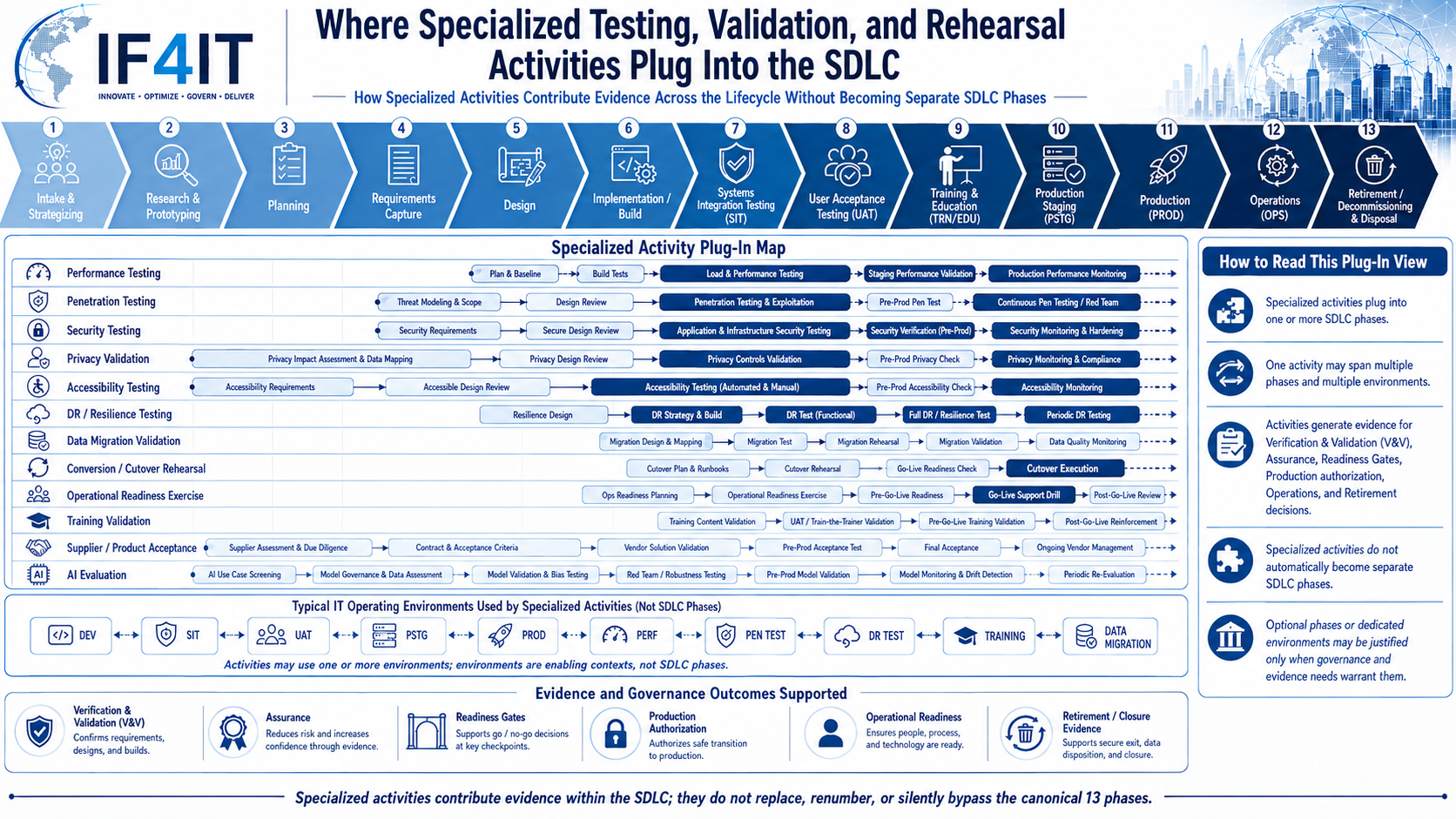
Best Practice: Validate Safety Across the 13 SDLC Phases
Intake and Research establish safety relevance and feasibility. Planning defines expertise, evidence, independence, and authorities. Requirements Capture defines safety obligations. Design addresses hazards and safe behavior. Build implements and traces controls. SIT evaluates integrated behavior. UAT validates intended use and human factors. Training prepares users and responders. PSTG rehearses transition and emergency procedures. Production authorization considers residual Risk. Operations monitors real-world behavior and changes. Retirement removes residual hazards and dependencies.
Benefits: Carrying safety obligations from Requirements through Design, Build, and Training — not concentrating them in one late review — means safety-relevant decisions get made when they’re still cheap to change, and that operators are actually prepared for emergency procedures before they need them.
Best Practice: Require Appropriate Independence
Higher-consequence safety claims may require review, testing, or Assurance by practitioners independent from the designers and implementers. Independence should be proportionate to consequence, uncertainty, regulatory obligation, and conflict of interest.
Benefits: Requiring independent review for higher-consequence safety claims, proportionate to actual severity and conflict of interest, catches the blind spots that the original designers and implementers are the least likely to see in their own work.
Best Practice: Govern Safety Findings and Residual Risk
Safety defects, limitations, assumptions, unresolved hazards, compensating controls, exceptions, and deferred obligations should remain visible to the authorized decision-maker. Only an authorized Risk Owner should accept residual safety Risk, and acceptance should not be used to conceal missing evidence or unperformed validation.
Benefits: Keeping unresolved hazards and compensating controls visible to the authorized decision-maker, and requiring only an authorized Risk Owner to accept residual safety Risk, prevents a safety gap from being quietly absorbed into ‘good enough’ by whoever happens to be closest to the deadline.
Best Practice: Apply Across Solution Types and Delivery Methods
Custom-Built Solutions require direct engineering and evidence of implemented controls. Acquired Solutions require supplier evidence, configuration validation, intended-use assessment, contractual obligations, and change monitoring. Composite Solutions require end-to-end analysis across interfaces and divided responsibilities. Waterfall, Agile, and Hybrid delivery may change cadence, but not the required safety outcomes.
Benefits: Requiring supplier evidence and intended-use assessment for Acquired Solutions, not just internal engineering evidence for Custom-Built ones, closes a real gap — a supplier’s general safety certification says little about whether the enterprise’s specific configuration and use case remain within the conditions that certification actually covers.
Best Practice: Advance Maturity Deliberately for Safety Validation Within the SDLC
At Crawl maturity, identify safety applicability, hazards, minimum controls, owners, tests, and residual Risk. At Walk maturity, use repeatable hazard analysis, traceability, independent review, representative scenarios, and operational monitoring. At Run maturity, integrate continuous safety evidence, simulation, digital models, automated control checks, change-impact analysis, and predictive monitoring while retaining accountable human authority.
Benefits: Starting with identifying safety applicability, hazards, and minimum controls at Crawl maturity establishes the foundation that repeatable hazard analysis and independent review at Walk maturity depend on. Pursuing predictive monitoring and automated control checks at Run maturity before basic hazard identification is solid tends to automate a safety case that was never properly established.
Best Practice: Avoid Common Antipatterns in Safety Validation Within the SDLC
Enterprises should avoid substituting administrative warnings for feasible technical safety controls. A warning label or a procedure reminder does not prevent a hazard the way an interlock, limit, or fail-safe design does, and relying on warnings alone leaves the underlying risk unmitigated.
| Antipattern | Why it fails |
|---|---|
| Substituting administrative warnings for feasible technical safety controls | A warning label or procedure reminder does not prevent a hazard the way an interlock, limit, or fail-safe design does, leaving the underlying risk unmitigated. |
Benefits: Avoiding this antipattern keeps safety Design focused on actually eliminating or controlling hazards, not just disclosing them. It ensures a hazard is addressed at the level of engineering control before the enterprise relies on a human to read and heed a warning.
Connections to Related IF4IT Practices and Inventories
Use Technology Portfolio Management (TPM) Best Practices, the Software Technologies Inventory and Attributes, and IT Operating Environments Best Practices to connect the decisions and responsibilities addressed in this chapter to governed technology choices, platform lifecycle, and environment controls.
Keep security, privacy, Risk, compliance, audit, and authorization controls integrated throughout this chapter’s decisions so required evidence, exceptions, residual Risk, and accountable approvals remain visible and governed.
Ground quality expectations in the Non-Functional Requirements (NFRs) Framework for Software Systems, connecting them to validation methods, test evidence, acceptance criteria, readiness gates, and Production assurance.
How to cite this page
When referencing this page in academic work, internal standards, or external publications, include the page title, IF4IT as author and publisher (The International Foundation for Information Technology (IF4IT), LLC), the URL, and your access date.
Example (informal web citation):
The International Foundation for Information Technology (IF4IT), LLC. Safety Validation Within the SDLC | Systems Development Lifecycle (SDLC) Best Practices. https://if4it.org/best-practices/systems-development-lifecycle-sdlc/safety-validation-within-the-sdlc/ (accessed 2026-10-16).
See About Us for content governance and site-wide citation guidance.
Copyright for The International Foundation for Information Technology (IF4IT), LLC: 2008 - Present
Legal Disclaimers