Select SDLC Phases and IT Operating Environments Based on Risk and Complexity - Systems Development Lifecycle (SDLC) Best Practices
Select SDLC Phases and IT Operating Environments Based on Risk and Complexity
(Chapter 64 of Systems Development Lifecycle (SDLC) Best Practices)
Executive Summary: Chapter Overview
IF4ITThe Bottom Line
Core Concepts
| Concept | Definition & Strategic Role |
|---|---|
| Release Risk | See the chapter discussion and enterprise glossary for the governed meaning and application of this concept. |
| Release Complexity | See the chapter discussion and enterprise glossary for the governed meaning and application of this concept. |
| Phase-Selection Decision | See the chapter discussion and enterprise glossary for the governed meaning and application of this concept. |
| Environment-Selection Decision | See the chapter discussion and enterprise glossary for the governed meaning and application of this concept. |
| Phase Applicability | See the chapter discussion and enterprise glossary for the governed meaning and application of this concept. |
Quick Q&A
Question: Does every applicable phase require a dedicated Environment?
Question: Is a small change always low Risk?
Question: When is Environment selection complete?
Read More Below
This chapter explains how enterprises separately select lifecycle phase applicability and technical Environment use for each Release according to persistent capability context, Release-specific Risk, complexity, sourcing, dependencies, data, operational impact, and applicable obligations.
Best Practice: Apply Phase Selection and Environment Selection Are Separate
An SDLC phase is a governed body of lifecycle work, outcomes, roles, evidence, and progression criteria. An IT Operating Environment is a technical context in which selected Activities occur. A phase may require no dedicated Environment, one phase may use several Environments, and one Environment may support several phases.
Select phases according to the lifecycle outcomes that must be achieved. Select Environments according to the technical contexts and evidence required to achieve and demonstrate those outcomes.
Benefits: Selecting phases based on lifecycle outcomes and Environments based on technical context, as two genuinely separate decisions, avoids the common confusion where a missing Environment is mistaken for an inapplicable phase, or a phase is skipped simply because a matching Environment doesn’t happen to exist.
Best Practice: Distinguish Risk and Complexity
| Dimension | Meaning |
|---|---|
| Release Risk | Uncertainty and potential adverse consequences from scope, implementation, introduction, operation, failure, misuse, dependency, or reversal |
| Release Complexity | Difficulty of understanding, coordinating, implementing, integrating, verifying, validating, deploying, operating, and supporting the Release |
Benefits: Treating Release Risk and Release Complexity as distinct dimensions catches the case that a single combined ‘how hard is this’ judgment would miss — a high-complexity but low-risk integration project needs different treatment than a low-complexity but high-risk data-exposure change, even though both might feel equally daunting.
Best Practice: Apply Evaluate Persistent and Release-Specific Context
Begin with authoritative governed-object context: criticality, data, regulation, Architecture, suppliers, availability, RTO, RPO, standard Environment mapping, support model, Risks, exceptions, and Technical Debt. Then assess current change scope, functional and Architecture impact, data and integration impact, user and operational impact, supplier involvement, novelty, reversibility, Deployment method, urgency, and retirement implications.
Benefits: Starting from the governed object’s persistent context — criticality, RTO, existing Risks — before layering on Release-specific change scope means the assessment accounts for both what the Asset always needs and what this particular change actually introduces, rather than evaluating the Release in isolation from its enduring context.
Best Practice: Apply Evaluate All 13 Phases
| Phase | Core selection question |
|---|---|
| Intake & Strategizing | Is purpose, ownership, value, and authorization needed? |
| Research & Prototyping | Does uncertainty require research, evaluation, experimentation, or proof? |
| Planning | What lifecycle treatment, resources, dependencies, and controls are required? |
| Requirements Capture | What stakeholder and enterprise needs must be defined or confirmed? |
| Design | What Architecture, Solution, configuration, or operational design is required? |
| Implementation/Build | What must be built, configured, acquired, integrated, migrated, or prepared? |
| SIT | What integrated technical behavior must be verified? |
| UAT | What intended use and stakeholder acceptance must be validated? |
| TRN/EDU | Who must be prepared to use, administer, operate, or support the change? |
| PSTG | What transition, migration, rollback, and operational readiness must be rehearsed? |
| PROD | How will Production introduction and verification be governed? |
| OPS | How will stabilization, support, maintenance, post-mortem, and closure occur? |
| Retirement | What capability, data, access, contracts, dependencies, or obligations are ended or transferred? |
Benefits: Working through a specific selection question for each of the 13 phases means phase applicability gets a deliberate answer for every phase, rather than defaulting to whichever phases happen to be habitual for a given delivery methodology regardless of whether they’re actually warranted.
Best Practice: Apply Classify Phase Applicability and Depth
A phase may be Fully Applicable, Applicable at Reduced Depth, Combined, Iterative, Continuous, Inherited, Conditionally Applicable, or Inapplicable. Inapplicability must describe an irrelevant lifecycle outcome, not a missing budget, skill, Environment, or compressed schedule.
Phase depth may be Minimal, Standard, Enhanced, or Intensive according to Risk, complexity, novelty, criticality, sourcing, data, regulation, operational impact, and evidence need.
Benefits: Requiring inapplicability to describe an irrelevant lifecycle outcome, not a missing budget or compressed schedule, prevents schedule pressure from being disguised as a legitimate scoping decision. A phase that’s actually needed doesn’t become unneeded just because there isn’t time for it.
Best Practice: Select Environment Types and Instances
Potential Types include Development, Integration, SIT, UAT, Training, Pre-Production Staging, Performance, Security Testing, Sandbox, Demonstration, Production, and Disaster Recovery. A dedicated Environment is justified when isolation, stable baselines, sensitive-data protection, specialized testing, migration rehearsal, Production-like validation, supplier integration, capacity, or reliable evidence attribution require it.
After selecting a Type, confirm that the actual Instance is available, correctly baselined, sufficiently isolated, appropriately accessed, supplied with suitable data and dependencies, and fit for the intended Activity and evidence claim.
Benefits: Justifying a dedicated Environment by specific needs like sensitive-data protection or migration rehearsal, rather than by habit, means Environment provisioning tracks actual technical requirements instead of accumulating unused, costly Environments that no one can clearly explain the need for.
Best Practice: Assess Environment Fitness and Representativeness
Assess Architecture, versions, configuration, integrations, data structure and volume, network behavior, Security controls, capacity, monitoring, and operational procedures against the claim the Environment must support. Document simulations, stubs, shared dependencies, supplier limitations, and material differences from Production.
Benefits: Assessing an Environment’s actual configuration and data volume against the specific claim it needs to support catches the gap between an Environment that’s nominally the right type and one that’s genuinely representative enough to produce trustworthy evidence.
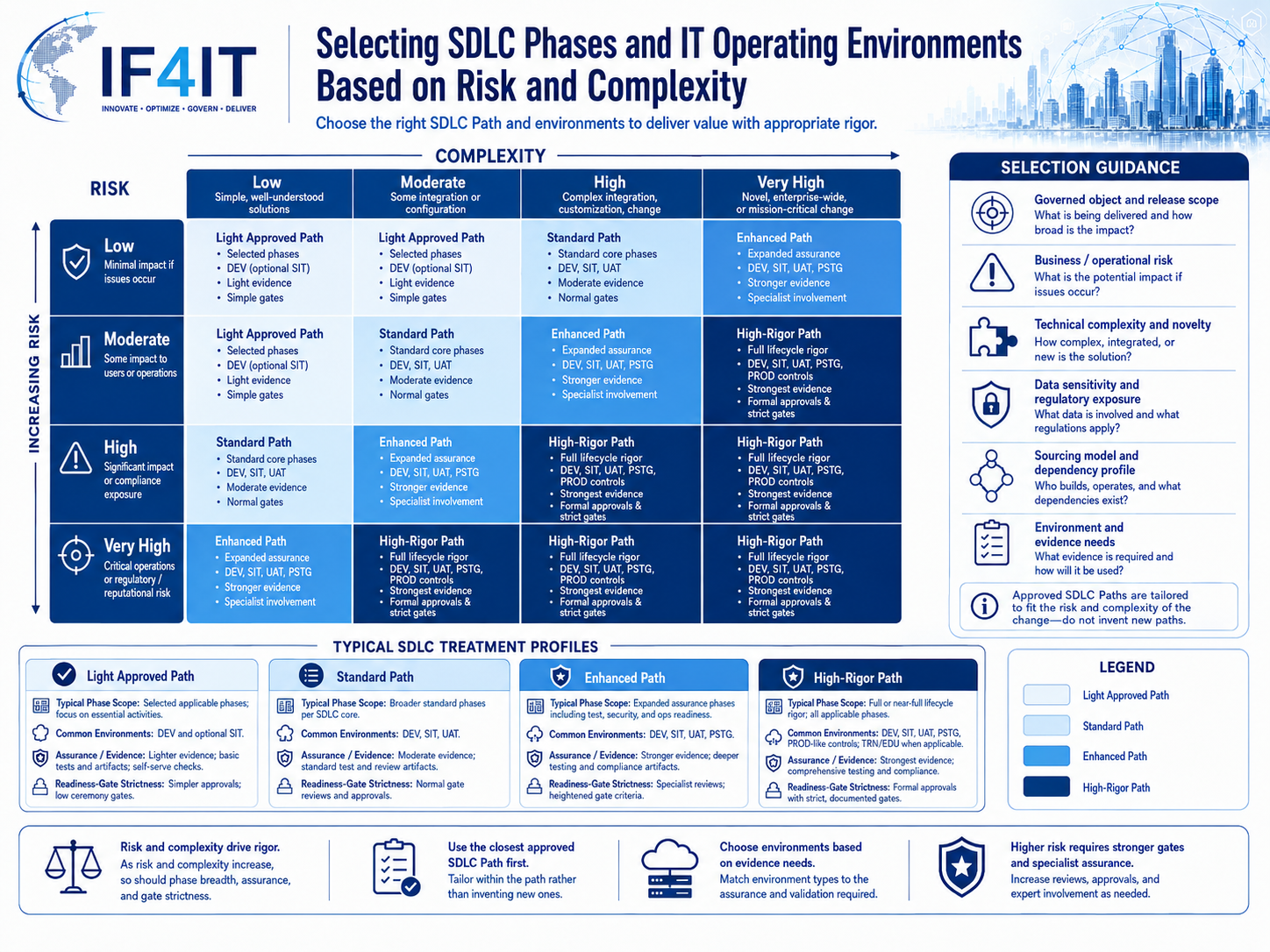
Best Practice: Apply the Risk-Complexity Matrix
| Combination | Typical treatment |
|---|---|
| Low Risk / Low Complexity | Lightweight Path, reduced phase depth, concise Artifacts, inherited or automated evidence, shared or ephemeral Environments, delegated decisions |
| Low Risk / High Complexity | Detailed Planning, dependency mapping, component sequencing, integration coordination, stable baselines, and broad evidence attribution |
| High Risk / Low Complexity | Strong requirements, independent review, precise Verification, restricted access, Production-like configuration, senior authorization, rollback, and monitoring |
| High Risk / High Complexity | Nearly all phases, enhanced depth, multiple controlled Environments, specialist and independent assurance, migration and rollback rehearsal, staged rollout, and extended stabilization |
Benefits: Mapping Risk-Complexity combinations to typical treatment gives teams a concrete, defensible starting point for how much rigor a given Release warrants, rather than each team independently guessing at the appropriate depth for its particular combination of Risk and complexity.
Best Practice: Address Special Cases
Custom-Built work may require Development, component, Integration, SIT, UAT, Performance, Security Testing, PSTG, and Production Environments. Acquired Solutions may rely on supplier tenants and evidence, but missing supplier capability does not remove enterprise outcomes. Composite Solutions require an end-to-end model across internal, cloud, supplier, partner, and simulated components.
Routine changes may use preapproved Paths only while scope, risk, reversibility, and dependencies remain understood. Emergency work may compress timing but must preserve authority, minimum validation, rollback, monitoring, documentation, retrospective completion, and Technical Debt qualification. Retirement may require extraction, migration, archival, dependency removal, access revocation, and evidence Environments.
Benefits: Addressing Custom-Built, Acquired, and Composite Solutions separately means each sourcing model gets guidance actually suited to its own Environment and evidence realities, rather than one generic Environment-selection approach that fits none of them particularly well.
Best Practice: Apply Record and Reassess Decisions
The SDLC Utilization Profile should record Risk, complexity, selected Path, phase applicability and depth, sequencing, Environment Types and Instances, limitations, data, dependencies, baselines, evidence, assurance, Gates, authorities, and reassessment triggers.
Reassess when scope, complexity, data, suppliers, AI, dependencies, Environment suitability, Validation results, Production exposure, regulation, or Technical Debt conditions change.
Benefits: Recording the selected Path and Environment decisions in the Utilization Profile, with explicit reassessment triggers, means a later reviewer can see exactly why a given phase or Environment choice was made and whether it still holds, instead of having to infer the original reasoning after the fact.
Best Practice: Advance Maturity Deliberately for Select SDLC Phases and IT Operating Environments Based on Risk and Complexity
At Crawl maturity, assess risk and complexity through a short, manually completed checklist reviewed by the Release Owner, sufficient to make a defensible phase and Environment selection. At Walk maturity, apply the published Risk-Complexity Matrix consistently, with assessments recorded in the Utilization Profile and reviewed against similar prior Releases. At Run maturity, generate an initial risk-complexity assessment automatically from Solution characteristics and historical outcomes, with an accountable owner confirming or overriding the recommendation before it becomes the Release’s selected treatment.
Benefits: A short manual checklist at Crawl maturity is enough to make a defensible selection without requiring assessment infrastructure the enterprise doesn’t yet need. Consistently applying the published matrix at Walk maturity means similar Releases receive genuinely comparable treatment instead of each assessor reasoning from scratch. Automating the initial assessment at Run maturity accelerates routine selection while keeping a human owner accountable for confirming it, rather than letting an algorithm silently become the actual decision-maker.
Best Practice: Avoid Common Antipatterns in Select SDLC Phases and IT Operating Environments Based on Risk and Complexity
Enterprises should avoid phase- and Environment-selection practices that substitute delivery methodology, Project size, labels, or prior decisions for an explicit assessment of lifecycle outcomes, Risk, complexity, and evidence needs. Phase applicability should be determined independently from the availability of matching IT Operating Environments. Environment suitability should be confirmed using the actual Instance, baseline, access, data, dependencies, controls, capacity, and evidence claim. Selections should be reassessed whenever material Release conditions change.
| Antipattern | Why it fails |
|---|---|
| Selecting phases by delivery methodology alone | Methodology does not determine outcome applicability. |
| Requiring every Release to use all phases and Environments | Creates unnecessary effort and weak adoption. |
| Removing phases because matching Environments do not exist | Confuses lifecycle work with technical context. |
| Assuming an Environment is suitable because of its label | Ignores baseline, data, dependencies, and evidence. |
| Classifying small changes as low Risk automatically | Overlooks severe consequences. |
| Reusing prior selections without reassessment | Carries forward obsolete assumptions. |
Benefits: Avoiding these antipatterns produces lifecycle treatment that is proportionate without becoming arbitrary or incomplete. It prevents unnecessary phase and Environment use for low-risk work while preserving required outcomes for high-consequence changes. It also improves Environment fitness, evidence reliability, defensible Risk decisions, regulatory assurance, and the accuracy of the SDLC Utilization Profile when scope or operating conditions change.
Example
A low-risk intranet change affects no sensitive data, has one integration, and can be reversed quickly; it uses focused Build, test, approval, and PROD controls. A customer portal Release processes personal data, affects thousands of users, and depends on several integrations; it requires SIT, UAT, security testing, PSTG, and formal readiness review. A payment-platform replacement has regulatory exposure, complex recovery, and high business impact; it also requires prototyping, migration rehearsal, resilience testing, and executive risk oversight. Phase and environment selection follows risk and complexity rather than project size alone.
Connections to Related IF4IT Practices and Inventories
Apply IT Operating Environments Best Practices to govern environment purpose, progression, segregation, readiness, promotion, and evidence, and use the Software Technologies Inventory and Attributes to identify the deployed technology baseline. Use Application Portfolio Management (APM) Best Practices and the Applications Inventory and Attributes to place this SDLC decision in the context of application ownership, portfolio value, lifecycle state, and dependencies.
Use Release Management guidance alongside IT Operating Environments Best Practices and Agile, Waterfall, or Hybrid: An IF4IT Framework for Choosing Delivery Methodology to govern how Release scope, environment progression, deployment evidence, cutover, rollback, and closure are actually managed.
Weave security, privacy, Risk, compliance, audit, and authorization controls through the decisions and responsibilities addressed in this chapter so evidence, exceptions, residual Risk, and accountable approvals stay visible and governed.
How to cite this page
When referencing this page in academic work, internal standards, or external publications, include the page title, IF4IT as author and publisher (The International Foundation for Information Technology (IF4IT), LLC), the URL, and your access date.
Example (informal web citation):
The International Foundation for Information Technology (IF4IT), LLC. Select SDLC Phases and IT Operating Environments Based on Risk and Complexity | Systems Development Lifecycle (SDLC) Best Practices. https://if4it.org/best-practices/systems-development-lifecycle-sdlc/select-sdlc-phases-and-it-operating-environments-based-on-risk-and-complexity/ (accessed 2026-10-16).
See About Us for content governance and site-wide citation guidance.
Copyright for The International Foundation for Information Technology (IF4IT), LLC: 2008 - Present
Legal Disclaimers