Service Owner Responsibilities Across the SDLC - Systems Development Lifecycle (SDLC) Best Practices
Service Owner Responsibilities Across the SDLC
(Chapter 39 of Systems Development Lifecycle (SDLC) Best Practices)
Executive Summary: Chapter Overview
IF4ITThe Bottom Line
Core Concepts
| Concept | Definition & Strategic Role |
|---|---|
| the Service and Its Consumers | The Service Owner should maintain the Service purpose, consumers, outcomes, boundaries, Service offerings, hours, channels, dependencies, data, support model, criticality, and relationship to Products, Assets, Systems, Applications, suppliers, and business processes. |
| Service Requirements and Levels | The Service Owner should define availability, performance, capacity, support, continuity, recovery, Security, Privacy, accessibility, data, maintenance, communication, and experience expectations. Service Level Objectives and Agreements should be measurable and aligned with actual business need. |
| Participate in Design and Release Decisions | The Service Owner should ensure that new and changed Solutions can be operated, monitored, supported, recovered, maintained, scaled, secured, and funded. Release scope and timing should consider service windows, consumer impact, supplier readiness, support coverage, and rollback or continuity options. |
| Own Operational Readiness | The Service Owner should ensure that ownership, staffing, monitoring, alerting, Incident and Problem processes, access, runbooks, support knowledge, escalation, supplier contacts, capacity, backup, recovery, maintenance, and communication are ready before Production authorization. |
| Monitor Service Outcomes | The Service Owner should monitor availability, performance, capacity, errors, Incidents, Problems, consumer experience, support demand, recovery, Security, supplier performance, cost, and achievement of Service objectives. Measures should drive improvement rather than merely report activity. |
Quick Q&A
Question: Is the Service Owner the same as the Product Owner?
Question: Does the Service Owner authorize every Production Release?
Question: Does a supplier own the enterprise Service when it provides the underlying SaaS or managed Service?
Read More Below
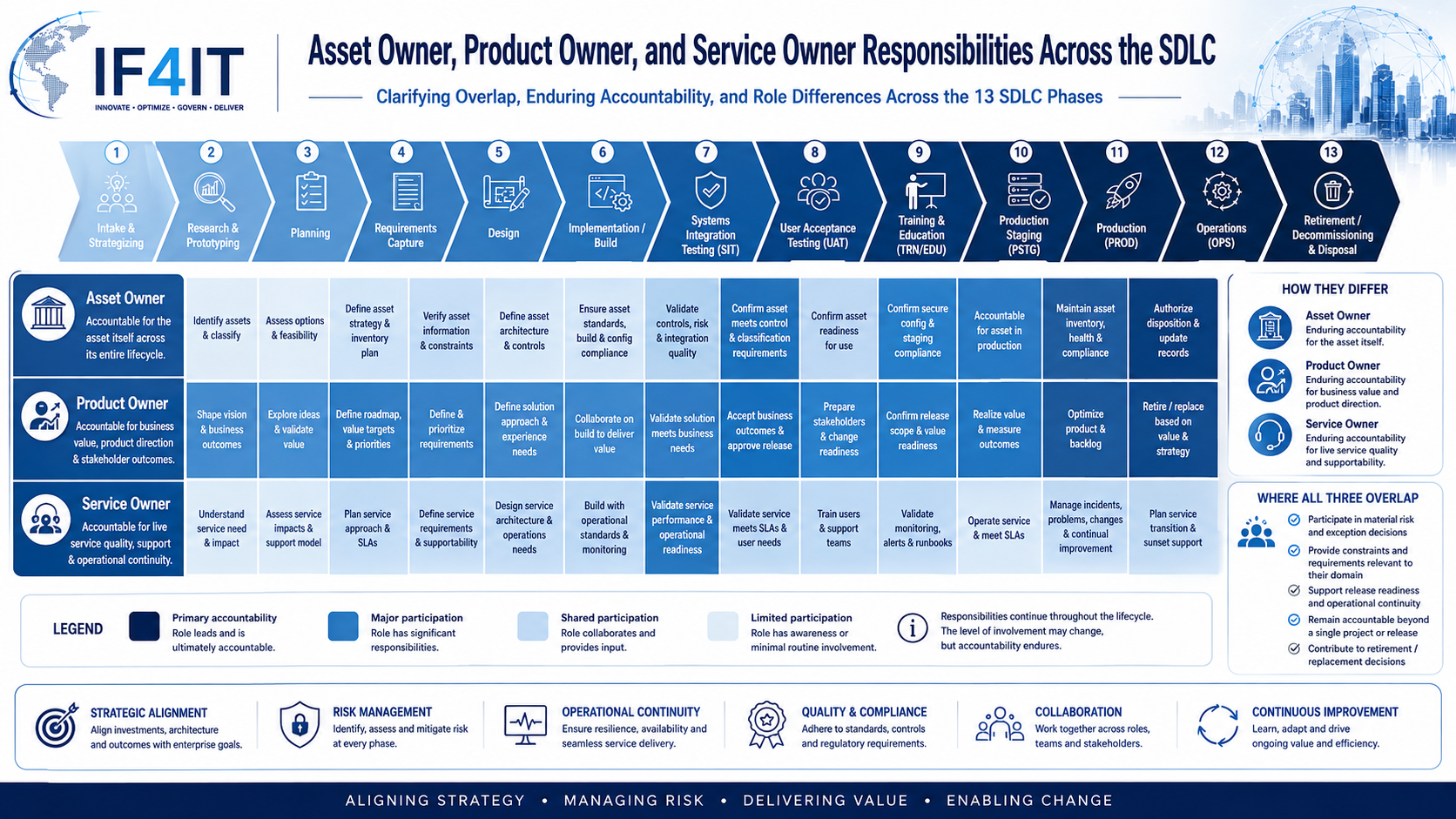
A Service Owner is the accountable enterprise role for the continuing delivery, performance, supportability, resilience, cost, risk, stakeholder experience, and lifecycle management of a Service. A Service may be business-facing, customer-facing, technical, platform, shared, or supplier-enabled.
Best Practice: Define the Service and Its Consumers
The Service Owner should maintain the Service purpose, consumers, outcomes, boundaries, Service offerings, hours, channels, dependencies, data, support model, criticality, and relationship to Products, Assets, Systems, Applications, suppliers, and business processes.
Benefits: Maintaining a clear definition of the Service’s boundaries and consumers prevents ambiguity about what the Service Owner is actually accountable for versus what belongs to an adjacent Product, Asset, or System. Without this clarity, gaps in ownership tend to surface only during an Incident, when it’s already too late to matter.
Best Practice: Define Service Requirements and Levels
The Service Owner should define availability, performance, capacity, support, continuity, recovery, Security, Privacy, accessibility, data, maintenance, communication, and experience expectations. Service Level Objectives and Agreements should be measurable and aligned with actual business need.
Benefits: Setting Service Level Objectives that reflect actual business need, rather than a generic availability target, means the Service is measured against what actually matters to its consumers instead of an arbitrary number that doesn’t connect to real operational consequence.
Best Practice: Apply Participate in Design and Release Decisions
The Service Owner should ensure that new and changed Solutions can be operated, monitored, supported, recovered, maintained, scaled, secured, and funded. Release scope and timing should consider service windows, consumer impact, supplier readiness, support coverage, and rollback or continuity options.
Benefits: Ensuring a new Solution can actually be operated, monitored, and funded before its Release ships prevents delivery teams from handing Operations a capability that looks complete but has no realistic support plan behind it.
Best Practice: Apply Own Operational Readiness
The Service Owner should ensure that ownership, staffing, monitoring, alerting, Incident and Problem processes, access, runbooks, support knowledge, escalation, supplier contacts, capacity, backup, recovery, maintenance, and communication are ready before Production authorization.
Benefits: Confirming staffing, runbooks, and escalation paths are ready before Production authorization — not assumed to be ready — is what actually determines whether the first Incident after go-live gets a competent response or a scramble to figure out who’s responsible.
Best Practice: Monitor Service Outcomes
The Service Owner should monitor availability, performance, capacity, errors, Incidents, Problems, consumer experience, support demand, recovery, Security, supplier performance, cost, and achievement of Service objectives. Measures should drive improvement rather than merely report activity.
Benefits: Using availability and performance measures to drive improvement, rather than simply reporting activity, is what turns monitoring data into action. A dashboard full of green metrics that never changes anyone’s priorities isn’t actually improving the Service.
Best Practice: Govern Service Risk and Continuity
The Service Owner should understand critical dependencies, failure modes, recovery objectives, continuity plans, supplier commitments, exceptions, deferred obligations, and residual uncertainty. Recovery exercises should validate the complete Service, not only individual components.
Benefits: Validating recovery exercises against the complete Service, not just individual components, catches the integration and dependency failures that a component-by-component test would miss. A Service can pass every individual recovery test and still fail as a whole if the components don’t recover together correctly.
Best Practice: Coordinate Incidents, Problems, and Known Errors
The Service Owner should ensure that material Incidents receive accountable coordination, stakeholder communication, restoration, evidence preservation, and follow-up. Problem findings and Known Errors should influence Release priorities, Technical Debt, documentation, monitoring, and operating procedures.
Benefits: Feeding Problem findings and Known Errors back into Release priorities and monitoring means the same Incident doesn’t keep recurring because its root cause was fixed operationally but never addressed in the underlying Solution.
Best Practice: Manage Supplier and Shared-Service Dependencies
The Service Owner should monitor contracts, performance, support, Product changes, subprocessors, end-of-support, continuity, evidence, and exit. Shared responsibility should be explicit across enterprise teams and suppliers.
Benefits: Monitoring supplier subprocessors and end-of-support timelines directly, rather than assuming the supplier will proactively flag changes, catches shared-dependency risk before it becomes an unplanned Service disruption the enterprise didn’t see coming.
Best Practice: Plan Service Evolution and Retirement
The Service Owner should plan modernization, consolidation, replacement, transition, and Retirement before supportability or cost becomes unacceptable. Retirement should address consumers, data, interfaces, operational procedures, support channels, contracts, and continuity.
Benefits: Planning modernization and Retirement before cost or supportability becomes unacceptable turns an eventual Service transition into a managed Release instead of a forced response to a Service that’s already failing its consumers.
Best Practice: Advance Maturity Deliberately for Service Owner Responsibilities Across the SDLC
At Crawl maturity, define the Service, owner, consumers, support, monitoring, dependencies, and recovery. At Walk maturity, integrate Service requirements, operational readiness, supplier governance, outcome metrics, and continual improvement. At Run maturity, use real-time service health, automated evidence, predictive capacity and reliability analysis, and continuous consumer feedback while retaining accountable decisions.
Benefits: Starting with a clearly defined Service, owner, and basic recovery plan at Crawl maturity establishes the foundation that integrated supplier governance and outcome metrics at Walk maturity depend on. Pursuing real-time predictive reliability analysis at Run maturity before the fundamentals are solid tends to generate forecasts built on an incomplete picture of the Service.
Best Practice: Avoid Common Antipatterns in Service Owner Responsibilities Across the SDLC
Enterprises should avoid treating Service ownership as ending at the enterprise’s own system boundary. A Service frequently depends on supplier and shared-platform components, so a Service Owner who only monitors internally controlled infrastructure can miss the supplier-side failures and dependencies that actually determine the Service’s real-world reliability.
| Antipattern | Why it fails |
|---|---|
| Treating Service ownership as ending at the enterprise’s own system boundary | A Service frequently depends on supplier and shared-platform components, so monitoring only internally controlled infrastructure misses the dependencies that actually determine real-world reliability. |
Benefits: Avoiding this antipattern keeps Service ownership scoped to what consumers actually experience, not just to what the enterprise directly controls. It surfaces supplier-side risk before it becomes an unplanned disruption the Service Owner never saw coming.
Connections to Related IF4IT Practices and Inventories
Use Application Portfolio Management (APM) Best Practices and the Applications Inventory and Attributes to clarify enduring ownership, lifecycle accountability, value, cost, risk, and dependency information.
Use Service Management Best Practices and Service Catalog Best Practices to connect lifecycle decisions to service ownership, operational readiness, support obligations, service levels, and continual improvement.
Connect this practice to Release Management guidance, IT Operating Environments Best Practices, and Agile, Waterfall, or Hybrid: An IF4IT Framework for Choosing Delivery Methodology, which together govern Release scope, environment progression, deployment evidence, cutover, rollback, and closure.
How to cite this page
When referencing this page in academic work, internal standards, or external publications, include the page title, IF4IT as author and publisher (The International Foundation for Information Technology (IF4IT), LLC), the URL, and your access date.
Example (informal web citation):
The International Foundation for Information Technology (IF4IT), LLC. Service Owner Responsibilities Across the SDLC | Systems Development Lifecycle (SDLC) Best Practices. https://if4it.org/best-practices/systems-development-lifecycle-sdlc/service-owner-responsibilities-across-the-sdlc/ (accessed 2026-10-16).
See About Us for content governance and site-wide citation guidance.
Copyright for The International Foundation for Information Technology (IF4IT), LLC: 2008 - Present
Legal Disclaimers