Tailor and Mature the SDLC Without Compromising Required Outcomes - Systems Development Lifecycle (SDLC) Best Practices
Tailor and Mature the SDLC Without Compromising Required Outcomes
(Chapter 47 of Systems Development Lifecycle (SDLC) Best Practices)
Executive Summary: Chapter Overview
IF4ITThe Bottom Line
Core Concepts
| Concept | Definition & Strategic Role |
|---|---|
| Canonical Tailoring and Maturation Definitions | SDLC tailoring is the governed selection, adjustment, combination, sequencing, scaling, or implementation of approved phases, Activities, roles, Artifacts, evidence, Environments, and decisions for a specific governed scope. SDLC maturation improves the underlying enterprise capabilities so they become more consistent, reusable, integrated, automated, measurable, adaptable, and effective. |
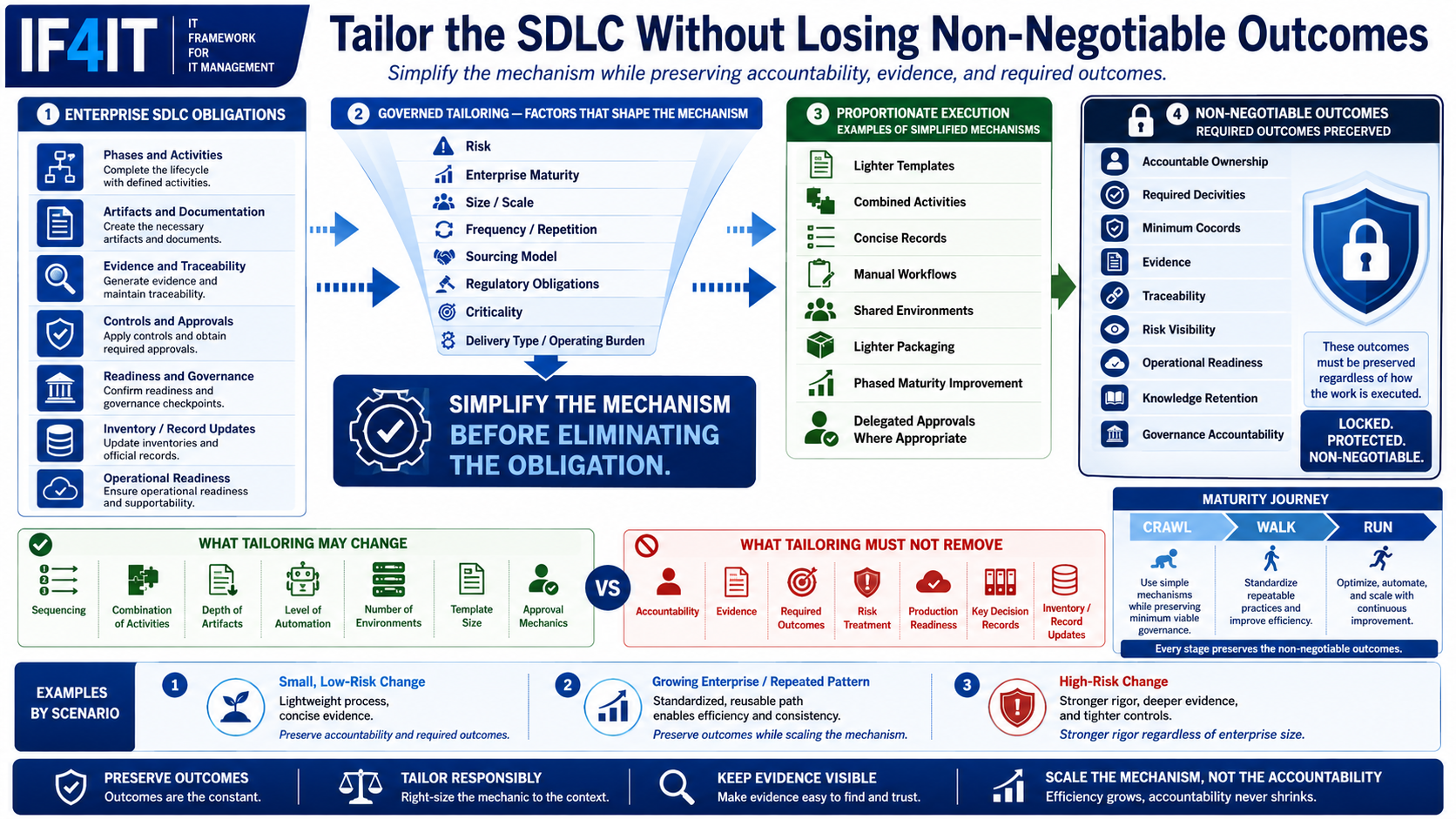
| Simplify the Mechanism Before Eliminating the Obligation | Tailoring may replace a long document with a structured record, combine reviews, use inherited or automated evidence, share an Environment, or delegate authority. It should not silently eliminate ownership, requirements, validation, Production readiness, operational support, documentation, authoritative-record updates, Technical Debt Management, or controlled retirement. |
| Approved Paths and Utilization Profiles | Publish reusable SDLC Paths for recurring categories of work and record Release-specific application through the SDLC Utilization Profile. Tailor phase depth, Activities, roles, Artifacts, evidence, Gates, Environments, sourcing responsibilities, and delivery-method implementation according to context, while distinguishing tailoring from alternative methods, exceptions, and nonconformance. |
| Reassess and Improve | Tailoring is a continuing lifecycle decision and should be reassessed when scope, risk, Architecture, data, suppliers, AI use, or operational exposure changes. Use Gate results, rework, Incidents, Technical Debt, support burden, documentation quality, and post-mortems to improve Paths and mature the enterprise SDLC. |
Quick Q&A
Question: Is tailoring the same as an SDLC exception?
Question: Can a lightweight Release produce less documentation?
Read More Below
This chapter explains how enterprises can tailor Release-specific lifecycle mechanisms and mature enterprise capabilities without weakening essential outcomes, accountability, evidence, knowledge, or enduring obligations.
Best Practice: Apply Canonical Tailoring and Maturation Definitions
SDLC tailoring is the governed selection, adjustment, combination, sequencing, scaling, or implementation of approved phases, Activities, roles, Artifacts, evidence, Environments, and decisions for a specific governed scope. SDLC maturation improves the underlying enterprise capabilities so they become more consistent, reusable, integrated, automated, measurable, adaptable, and effective.
Benefits: Distinguishing tailoring, which selects an approved implementation, from maturation, which improves underlying capabilities, prevents these two related but different activities from being confused. A Release can be well-tailored using an immature process, or poorly tailored using a highly mature one — conflating the two obscures which problem actually needs fixing.
Best Practice: Apply Simplify the Mechanism Before Eliminating the Obligation
Tailoring may replace a long document with a structured record, combine reviews, use inherited or automated evidence, share an Environment, or delegate authority. It should not silently eliminate ownership, requirements, validation, Production readiness, operational support, documentation, authoritative-record updates, Technical Debt Management, or controlled retirement.
Benefits: Replacing a long document with a structured record, rather than eliminating the underlying requirement it served, is what keeps tailoring genuinely lightweight rather than genuinely under-governed. The obligation still exists; only the mechanism for satisfying it has become simpler.
Best Practice: Use Approved Paths and Utilization Profiles
Publish reusable SDLC Paths for recurring categories of work and record Release-specific application through the SDLC Utilization Profile. Tailor phase depth, Activities, roles, Artifacts, evidence, Gates, Environments, sourcing responsibilities, and delivery-method implementation according to context, while distinguishing tailoring from alternative methods, exceptions, and nonconformance.
Benefits: Publishing reusable Paths for recurring work categories, with Release-specific application recorded in the Utilization Profile, means most tailoring decisions can select from a proven starting point instead of every Release independently negotiating its own lifecycle depth from scratch.
Best Practice: Apply Reassess and Improve
Tailoring is a continuing lifecycle decision and should be reassessed when scope, risk, Architecture, data, suppliers, AI use, or operational exposure changes. Use Gate results, rework, Incidents, Technical Debt, support burden, documentation quality, and post-mortems to improve Paths and mature the enterprise SDLC.
**Benefits:**Treating tailoring as a continuing decision, reassessed as scope or Risk changes, means a Release’s lifecycle treatment stays matched to its actual current circumstances instead of remaining frozen at whatever was decided during initial Planning, even after conditions have materially shifted.
Example
A low-risk portal enhancement reuses an approved design pattern and therefore omits a formal Research and Prototyping phase. The Release still has an accountable owner, approved requirements, security and privacy review, traceability, focused SIT and UAT, production-readiness evidence, rollback instructions, and updated operational documentation. The tailoring decision is recorded in the Utilization Profile and approved before work proceeds. The enterprise reduces unnecessary effort without removing the outcomes needed to control risk, support operations, and demonstrate accountability.
Best Practice: Advance Maturity Deliberately for Tailor and Mature the SDLC Without Compromising Required Outcomes
At Crawl maturity, maturation focuses on establishing the essential ownership, evidence, and outcomes a Release needs, using whatever simple mechanism gets that done. At Walk maturity, maturation standardizes those mechanisms into reusable Paths and repeatable evidence practices that reduce the effort each new Release has to spend rebuilding from scratch. At Run maturity, maturation integrates and automates the mechanisms that have already proven stable, freeing practitioner attention for the judgment calls that genuinely require it.
Benefits: Focusing Crawl-level maturation on establishing essentials keeps the enterprise from prematurely investing in standardization before it knows what actually needs to be repeated. Standardizing proven mechanisms at Walk maturity is what turns individual Release effort into reusable enterprise capability. Automating only what’s already stable at Run maturity keeps automation from encoding a process the enterprise hasn’t yet confirmed is actually correct.
Best Practice: Avoid Common Antipatterns in Tailor and Mature the SDLC Without Compromising Required Outcomes
Enterprises should avoid treating tailoring as informal permission to skip obligations rather than a governed way to satisfy them differently. Misuse occurs when a team declares Activities, evidence, approvals, testing, operational readiness, documentation, or inventory updates unnecessary without demonstrating how the underlying outcome will still be met — often behind phrases such as “Agile does not require documentation” or “this is only a small change.”
| Antipattern | Why it fails |
|---|---|
| Using SDLC tailoring as an excuse to remove accountability | Required outcomes and decision accountability disappear behind informal tailoring, weakening traceability, evidence, and residual-Risk visibility, and creating disputed accountability and unmanaged operational exposure. |
Benefits: Avoiding this antipattern preserves the distinction between legitimate tailoring — which changes how an outcome is satisfied — and quiet removal of the outcome itself. It keeps ownership, evidence, and Risk acceptance explicit and defensible even when mechanisms are simplified.
Connections to Related IF4IT Practices and Inventories
Use the Capabilities Inventory and Attributes and the IF4IT Enterprise Model to evaluate whether delivered and operated outcomes actually improve the intended enterprise capabilities and value streams. Use Application Portfolio Management (APM) Best Practices and the Applications Inventory and Attributes to place this SDLC decision in the context of application ownership, portfolio value, lifecycle state, and dependencies.
For Tailor and Mature the SDLC Without Compromising Required Outcomes, IT leaders and managers should establish explicit decision rights, accountable ownership, proportional controls, evidence expectations, performance measures, and continuous-improvement feedback tied to enterprise value.
Ground quality expectations in the Non-Functional Requirements (NFRs) Framework for Software Systems, connecting them to validation methods, test evidence, acceptance criteria, readiness gates, and Production assurance.
How to cite this page
When referencing this page in academic work, internal standards, or external publications, include the page title, IF4IT as author and publisher (The International Foundation for Information Technology (IF4IT), LLC), the URL, and your access date.
Example (informal web citation):
The International Foundation for Information Technology (IF4IT), LLC. Tailor and Mature the SDLC Without Compromising Required Outcomes | Systems Development Lifecycle (SDLC) Best Practices. https://if4it.org/best-practices/systems-development-lifecycle-sdlc/tailor-and-mature-the-sdlc-without-compromising-required-outcomes/ (accessed 2026-10-16).
See About Us for content governance and site-wide citation guidance.
Copyright for The International Foundation for Information Technology (IF4IT), LLC: 2008 - Present
Legal Disclaimers