Tailor the SDLC for Each Asset, Product, Service, and Release - Systems Development Lifecycle (SDLC) Best Practices
Tailor the SDLC for Each Asset, Product, Service, and Release
(Chapter 61 of Systems Development Lifecycle (SDLC) Best Practices)
Executive Summary: Chapter Overview
IF4ITThe Bottom Line
Core Concepts
| Concept | Definition & Strategic Role |
|---|---|
| Governed-Object Lifecycle Model | See the chapter discussion and enterprise glossary for the governed meaning and application of this concept. |
| Enduring Tailoring | See the chapter discussion and enterprise glossary for the governed meaning and application of this concept. |
| Release-Specific Tailoring | See the chapter discussion and enterprise glossary for the governed meaning and application of this concept. |
| SDLC Path | See the chapter discussion and enterprise glossary for the governed meaning and application of this concept. |
| SDLC Utilization Profile | See the chapter discussion and enterprise glossary for the governed meaning and application of this concept. |
Quick Q&A
Question: Why must tailoring consider both the governed object and the Release?
Question: May every team create its own lifecycle?
Question: When must tailoring be reassessed?
Read More Below
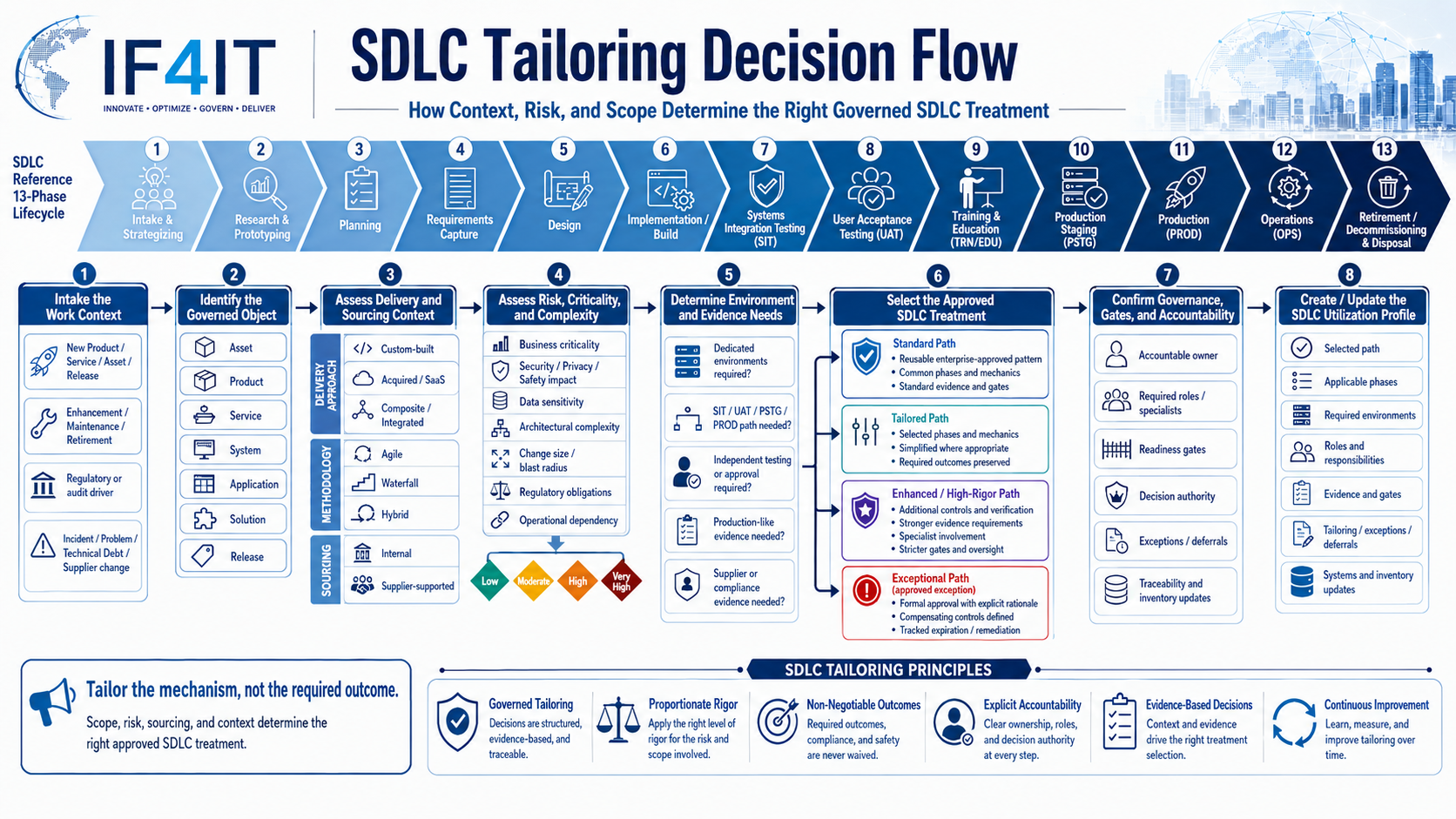
This chapter explains how one Enterprise SDLC governance model is applied through context-specific lifecycle implementations for enduring Assets, Products, Services, Systems, Applications, and Solutions and for each bounded Release.
Best Practice: Apply Enduring Capability Context and Release Context
An enduring governed capability may exist for years and receive many Releases. Persistent characteristics include ownership, criticality, regulation, data, Architecture, suppliers, support, recovery, Environment mappings, Risks, exceptions, Technical Debt, and retirement strategy. Each Release also has its own scope, urgency, novelty, dependencies, risk, and target date.
Effective tailoring combines persistent capability context with the bounded change context of the Release.
Benefits: Combining a governed object’s persistent characteristics with each Release’s own specific scope and urgency means tailoring decisions account for both what the Asset always needs and what this particular change actually requires, rather than treating every Release identically regardless of the enduring capability behind it.
Best Practice: Distinguish the Related Models
| Model | Purpose |
|---|---|
| Enterprise SDLC | Defines enterprise-wide terminology, phases, outcomes, governance, and minimum obligations |
| Standard SDLC Path | Provides a reusable lifecycle configuration for a recurring class of work |
| Governed-object lifecycle model | Defines enduring characteristics and default treatment for a particular capability |
| SDLC Utilization Profile | Records how the SDLC applies to a specific Release or scope |
| Exception record | Authorizes a departure from an applicable requirement |
| Release record | Maintains authoritative Release identity, relationships, state, and closure |
Benefits: Keeping the Enterprise SDLC, a Standard Path, and a Release-specific Utilization Profile as distinct models means practitioners know exactly which document to consult for which question, instead of one all-purpose document trying to answer everything at every level of specificity.
Best Practice: Govern Tailoring Factors
| Factor | Illustrative considerations |
|---|---|
| Purpose and criticality | Value, intended outcomes, consequence of failure |
| Risk and reversibility | Exposure, uncertainty, rollback, residual Risk |
| Complexity and novelty | Components, teams, suppliers, integrations, new technology |
| Sourcing | Custom-Built, Acquired, Composite, SaaS, managed service, open source |
| Data and exposure | Classification, volume, Privacy, Internet exposure, privileged access |
| Regulation and specialist obligations | Legal, regulatory, Security, accessibility, safety, AI governance |
| Operations and recovery | Support, availability, RTO, RPO, monitoring, continuity |
| Lifecycle state | New, growing, mature, modernizing, or retiring |
| Delivery frequency | High-frequency automation versus low-frequency manual governance |
| Technical Debt | Inherited, created, remediated, transferred, or closed debt |
**Benefits:**Naming explicit factors like sourcing model and data exposure as tailoring inputs gives teams a concrete, defensible basis for their tailoring decisions, rather than an informal judgment call that’s hard to explain or reproduce consistently across similar Releases.
Best Practice: Select and Tailor an Approved Path
Begin with the closest approved SDLC Path. Tailor phase applicability, phase depth, sequencing, overlap, iteration, Activities, roles, Artifacts, documentation, evidence, assurance, Readiness Gates, IT Operating Environments, and enterprise-record updates.
Minimum non-negotiable outcomes remain intact. Tailoring selects an approved implementation; an alternative method satisfies the requirement differently; an exception authorizes a departure; nonconformance lacks valid authorization.
Benefits: Starting from the closest approved Path and tailoring from there, rather than starting from scratch, means every Release inherits a proven foundation instead of reinventing lifecycle treatment independently and potentially missing something the approved Path already accounts for.
Best Practice: Tailor Across Governed Object Types
Asset tailoring emphasizes custody, condition, technology, cost, supportability, maintenance, and retirement. Product tailoring emphasizes strategy, users, roadmap, value, Release cadence, and continuing evolution. Service tailoring emphasizes consumers, Service Levels, availability, support, continuity, and end-to-end dependencies. System, Application, and Solution tailoring should use the boundary at which lifecycle outcomes and enterprise consequences must be understood.
Benefits: Recognizing that Asset tailoring emphasizes custody and cost while Product tailoring emphasizes roadmap and value means each governed object type gets tailoring guidance actually suited to what matters for it, instead of one generic tailoring approach applied uniformly regardless of what’s actually being governed.
Best Practice: Preserve Knowledge, Records, and Technical Debt
Every tailored Release should publish new or improved enduring documentation through the Enterprise Document Repository, update affected authoritative inventories and systems of record, and govern qualified Technical Debt Items in the enterprise Technical Debt Inventory or Registry.
A lightweight Release may produce concise knowledge, but it should not produce local, inaccessible, ownerless, or disposable knowledge.
Benefits: Requiring even a lightweight Release to publish enduring documentation and update authoritative systems prevents ’lightweight’ from becoming a euphemism for ‘undocumented.’ Concise knowledge is fine; disposable, ownerless knowledge that disappears with the delivery team is not.
Best Practice: Apply Record and Reassess Tailoring
The SDLC Utilization Profile should identify governed objects, Release, selected Path, factors, phase applicability, depth, sequencing, Activities, roles, Artifacts, evidence, Environments, Gates, record updates, tailoring, alternatives, exceptions, and reassessment triggers.
Reassess when scope, criticality, data, suppliers, AI use, Architecture, Production exposure, Environment suitability, regulation, validation results, or Technical Debt conditions change.
Benefits: Recording tailoring decisions in the Utilization Profile and reassessing them when scope or Risk materially changes means a tailoring choice made early in the Release stays valid, or gets deliberately revisited, instead of silently becoming stale as circumstances evolve.
Best Practice: Measure and Improve
Analyze Path adoption, profile completeness, Gate failures, rework, escaped Defects, Incidents, evidence deficiencies, documentation completion, inventory accuracy, Technical Debt creation, and effort by Path. Recurring tailoring patterns should improve standard Paths, governed-object lifecycle models, templates, and automation.
Benefits: Analyzing recurring tailoring patterns across many Releases is what reveals when a standard Path itself needs updating, rather than each team independently discovering and working around the same Path limitation Release after Release without anyone connecting the dots.
Best Practice: Advance Maturity Deliberately for Tailor the SDLC for Each Asset, Product, Service, and Release
At Crawl maturity, tailoring decisions are made informally by whoever is closest to the Release, with minimal documented rationale beyond a brief note in the Utilization Profile. At Walk maturity, tailoring follows published factors and criteria consistently applied across similar Releases, with decisions traceable to the governing rule that authorized them. At Run maturity, tailoring recommendations are generated from Solution characteristics and historical Path performance, with an accountable owner confirming rather than constructing each decision from scratch.
Benefits: Allowing informal tailoring decisions at Crawl maturity keeps the mechanism lightweight while the enterprise is still learning which factors actually matter. Requiring traceable, criteria-based tailoring at Walk maturity is what makes similar Releases receive genuinely consistent treatment instead of depending on who happened to make the call. Generating tailoring recommendations from historical performance at Run maturity accelerates routine decisions while still keeping a human owner accountable for confirming them.
Best Practice: Avoid Common Antipatterns in Tailor the SDLC for Each Asset, Product, Service, and Release
Enterprises should avoid tailoring practices that either impose unnecessary lifecycle effort or silently remove required governance outcomes. Tailoring should be based on the characteristics, risks, sourcing model, dependencies, operational context, and Release scope of the governed work. It should use approved enterprise Paths and decision criteria rather than allowing each team to invent a separate lifecycle. Lightweight treatment may simplify mechanisms, but it must not conceal Technical Debt, eliminate accountability, or weaken required evidence and readiness decisions.
| Antipattern | Why it fails |
|---|---|
| Applying one identical lifecycle to every governed object | Overburdens low-risk work while under-governing complex, high-risk, acquired, regulated, or composite Solutions, since uniformity of mechanism is mistaken for consistency of governance. |
| Allowing each team to invent its own SDLC | Destroys enterprise consistency and traceability. |
| Tailoring only by Project size | Ignores risk, data, sourcing, dependencies, and operations. |
| Tailoring only once for the Product | Misses Release-specific scope and risk. |
| Tailoring only for the Release | Ignores enduring capability obligations. |
| Using a lightweight Path to hide Technical Debt | Transfers recurring burden without governed ownership. |
Benefits: Avoiding these antipatterns allows the enterprise to apply proportionate lifecycle governance without sacrificing consistency, traceability, accountability, or minimum outcomes. It reduces unnecessary effort for low-risk work, prevents teams from creating incompatible local lifecycles, and ensures that Product-level obligations and Release-specific risks are both addressed. It also makes tailoring decisions easier to explain, approve, reassess, measure, and defend.
Example
An emergency security patch uses an accelerated path with focused impact analysis, targeted testing, expedited risk approval, deployment evidence, and post-deployment review. A SaaS workflow configuration uses supplier documentation, configuration review, UAT, security validation, and tenant-change controls. A new regulated claims platform uses the full set of applicable architecture, requirements, testing, regulatory, migration, resilience, and readiness activities. Tailoring reflects the Asset, Product, Service, Release, and risk profile while preserving minimum enterprise outcomes.
Connections to Related IF4IT Practices and Inventories
Use Application Portfolio Management (APM) Best Practices and the Applications Inventory and Attributes to clarify enduring ownership, lifecycle accountability, value, cost, risk, and dependency information.
Use Service Management Best Practices and Service Catalog Best Practices to connect lifecycle decisions to service ownership, operational readiness, support obligations, service levels, and continual improvement.
Use Agile, Waterfall, or Hybrid: An IF4IT Framework for Choosing Delivery Methodology to select and tailor the delivery approach according to consequence of failure, decomposability, incremental deliverability, and timing constraints.
How to cite this page
When referencing this page in academic work, internal standards, or external publications, include the page title, IF4IT as author and publisher (The International Foundation for Information Technology (IF4IT), LLC), the URL, and your access date.
Example (informal web citation):
The International Foundation for Information Technology (IF4IT), LLC. Tailor the SDLC for Each Asset, Product, Service, and Release | Systems Development Lifecycle (SDLC) Best Practices. https://if4it.org/best-practices/systems-development-lifecycle-sdlc/tailor-the-sdlc-for-each-asset-product-service-and-release/ (accessed 2026-10-16).
See About Us for content governance and site-wide citation guidance.
Copyright for The International Foundation for Information Technology (IF4IT), LLC: 2008 - Present
Legal Disclaimers