What Is an SDLC Phase? - Systems Development Lifecycle (SDLC) Best Practices
What Is an SDLC Phase?
(Chapter 8 of Systems Development Lifecycle (SDLC) Best Practices)
Executive Summary: Chapter Overview
IF4ITThe Bottom Line
Core Concepts
| Concept | Definition & Strategic Role |
|---|---|
| SDLC Phase | A governed lifecycle segment organized around a distinct purpose and expected outcomes. |
| Entry Criteria | Conditions that should be satisfied before governed phase work begins. |
| Exit Criteria | Conditions that should be satisfied before the phase is considered complete or progression is authorized. |
| Phase Outcome | The substantive result that justifies the phase’s existence and supports lifecycle progression. |
Quick Q&A
Question: Is an SDLC Phase the same as an organizational department?
Question: Can activities recur across phases?
Question: Does tailoring allow a team to skip phase outcomes without explanation?
Read More Below
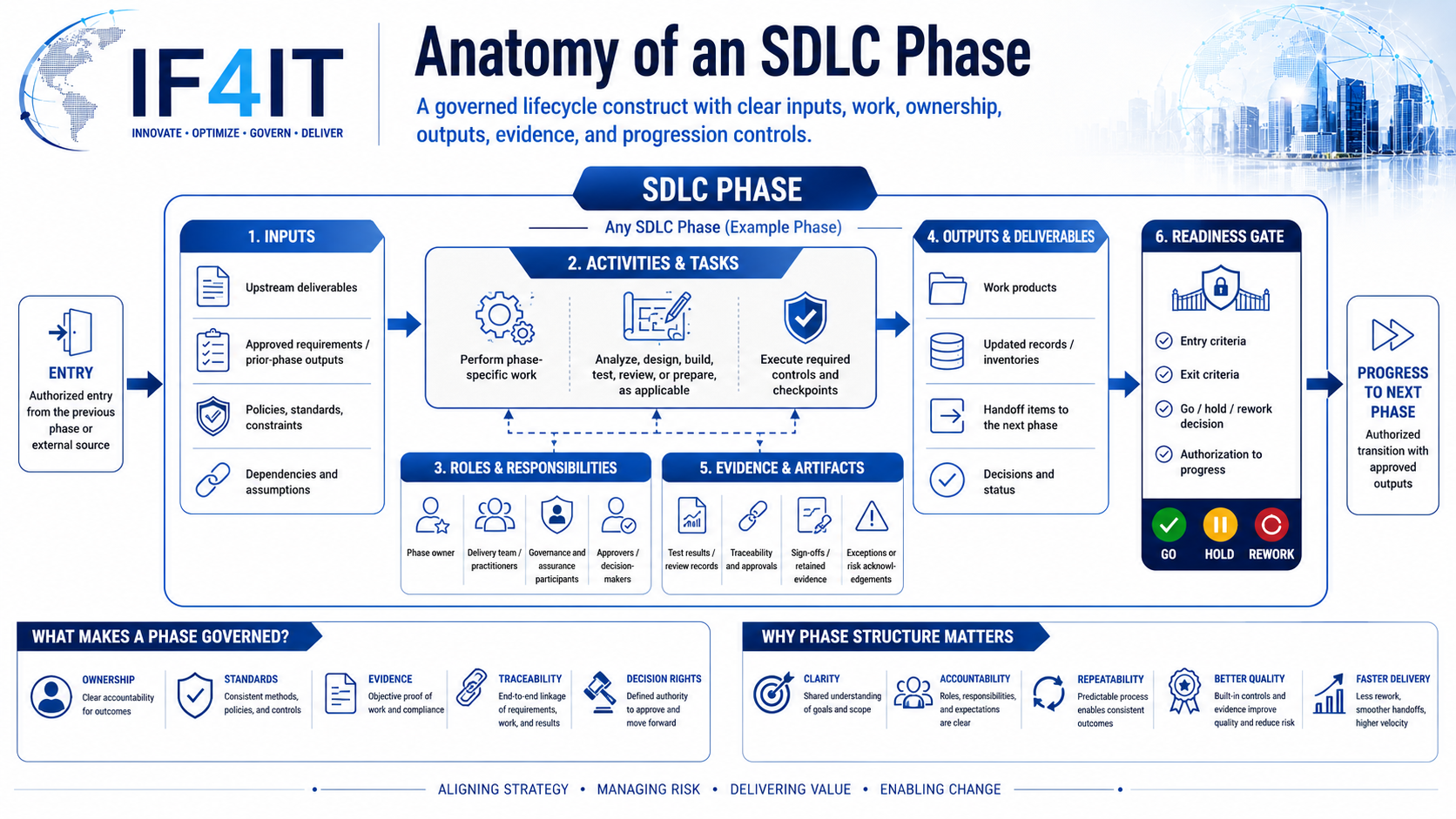
This chapter defines an SDLC Phase as a governed lifecycle segment organized around a distinct purpose, outcomes, work, roles, inputs, outputs, evidence, decisions, entry criteria, and exit criteria.
Canonical Definition
An SDLC Phase is a governed segment of the Systems Development Lifecycle that groups related lifecycle responsibilities around a distinct purpose, expected outcomes, required work, roles, inputs, outputs, evidence, decisions, entry criteria, and exit criteria.
Why Organize Work Into Phases
Phases separate materially different lifecycle concerns, organize knowledge, expose missing work, define ownership, support decisions, improve traceability, align evidence, plan resources and cost, connect Releases to Environments, and enable meaningful measurement.
A phase should be evaluated by the outcomes it achieves, not merely by whether meetings occurred or artifacts were submitted.
Required Phase Elements
| Phase Element | Purpose |
|---|---|
| Definition and Purpose | Establish the phase meaning and reason for existence. |
| Applicability and Entry Criteria | Identify when the phase applies and what must be true before work begins. |
| Inputs, Activities, Roles, and Stakeholders | Define the information, work, accountability, participation, and engagement needed. |
| Cross-Cutting Considerations and Environments | Integrate lifecycle-wide obligations and identify applicable technical settings. |
| Outputs, Artifacts, and Evidence | Define the results and proof needed to support readiness. |
| Inventory Updates, Gates, and Exit Criteria | Keep authoritative records current and define completion and progression decisions. |
| Metrics and Antipatterns | Support performance analysis and prevent recurring failure patterns. |
Phase Behavior and Tailoring
Activities may overlap, recur, or span phases under Agile, Waterfall, and Hybrid delivery. A phase is not a fixed calendar period or departmental handoff.
Tailoring may change activity depth, artifact formality, assurance independence, Environments, gates, automation, and evidence. It should not silently remove ownership, risk consideration, appropriate verification and validation, operational readiness, or safe retirement.
Common Antipatterns
Enterprises should avoid treating a phase as a fixed calendar period or departmental handoff. Activities may overlap, recur, or span phases under different delivery methods; treating a phase as a rigid calendar block or a transfer point between departments misses that a phase is organized around outcomes and responsibilities, not a fixed sequence of dates or a handoff between teams.
| Antipattern | Why it fails |
|---|---|
| Treating a phase as a fixed calendar period or departmental handoff | A phase is organized around outcomes and responsibilities, not a fixed sequence of dates or a handoff between teams; activities may overlap, recur, or span phases under different delivery methods. |
Connections to Related IF4IT Practices and Inventories
Connect the decisions and responsibilities addressed in this chapter to enterprise structure, capability ownership, and measurable business outcomes using the IF4IT Enterprise Model, Enterprise Capability Models, and the Capabilities Inventory and Attributes.
How to cite this page
When referencing this page in academic work, internal standards, or external publications, include the page title, IF4IT as author and publisher (The International Foundation for Information Technology (IF4IT), LLC), the URL, and your access date.
Example (informal web citation):
The International Foundation for Information Technology (IF4IT), LLC. What Is an SDLC Phase? | Systems Development Lifecycle (SDLC) Best Practices. https://if4it.org/best-practices/systems-development-lifecycle-sdlc/what-is-an-sdlc-phase/ (accessed 2026-10-16).
See About Us for content governance and site-wide citation guidance.
Copyright for The International Foundation for Information Technology (IF4IT), LLC: 2008 - Present
Legal Disclaimers