What Is an SDLC Utilization Profile? - Systems Development Lifecycle (SDLC) Best Practices
What Is an SDLC Utilization Profile?
(Chapter 10 of Systems Development Lifecycle (SDLC) Best Practices)
Executive Summary: Chapter Overview
IF4ITThe Bottom Line
Core Concepts
| Concept | Definition & Strategic Role |
|---|---|
| SDLC Utilization Profile | The approved record that applies and tailors an SDLC Path to a specific governed scope. |
| Profile Anchor | The Asset, Product, Service, Solution, Release, or work class at which lifecycle accountability is recorded. |
| Deferred Maturity Capability | A capability implemented through a simpler current mechanism with an explicit improvement target. |
| Enterprise-Record Obligation | A required creation or update in an authoritative inventory, repository, or operational system. |
Quick Q&A
Question: Why is an SDLC Path not enough?
Question: Who owns the Profile?
Question: Does an approved Profile prove conformance?
Read More Below
This chapter defines the SDLC Utilization Profile as the approved, version-controlled record that applies an enterprise SDLC Path to a specific governed scope and documents exact lifecycle selections, ownership, risk, maturity, tailoring, evidence, and enterprise-record obligations.
Canonical Definition
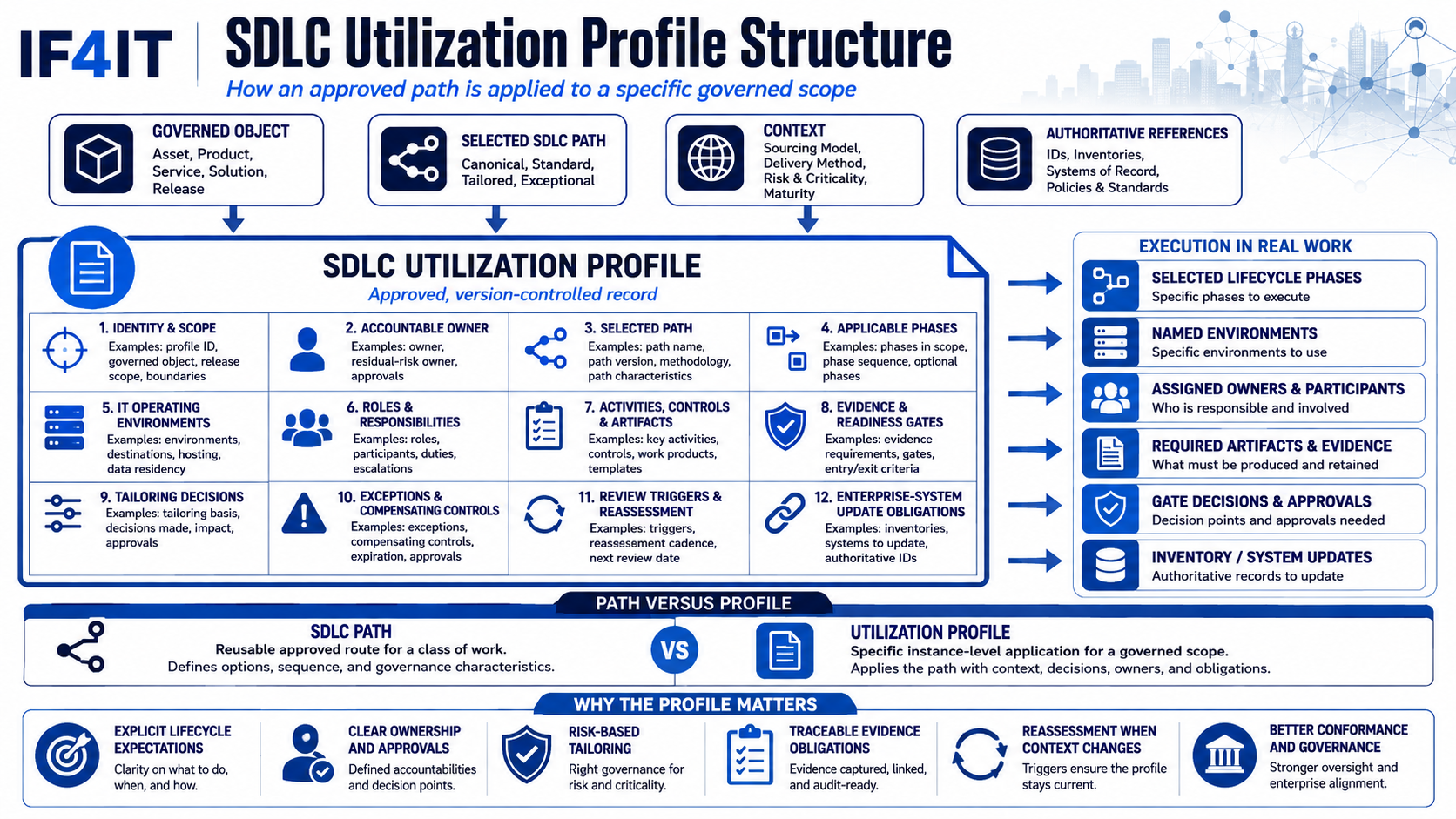
An SDLC Utilization Profile is an approved, version-controlled record that defines how a specific Asset, Product, Service, Solution, Release, or class of work will use the enterprise Systems Development Lifecycle, including its selected SDLC Path, applicable phases, IT Operating Environments, activities, roles, controls, artifacts, evidence, maturity level, tailoring decisions, exceptions, and enterprise-record update obligations.
Path Versus Utilization Profile
| SDLC Path | SDLC Utilization Profile |
|---|---|
| Defines a reusable lifecycle route. | Applies the route to a specific governed scope. |
| May be used by many Assets or Releases. | Is associated with a named Asset, Product, Service, Solution, Release, or work class. |
| Defines normal phases, controls, and evidence. | Records exact selections, tailoring, owners, obligations, and exceptions. |
| Changes relatively infrequently. | Changes when the governed scope or risk changes. |
Profile Content
A profile should identify the governed object, accountable owner, selected path, sourcing model, delivery methodology, risk and criticality, applicable phases, Environments, activities, roles, controls, artifacts, evidence, gates, maturity, tailoring, exceptions, compensating controls, residual-risk owner, review triggers, and required enterprise-system updates.
The profile should reference authoritative identifiers and systems rather than duplicate all inventory data. It defines expectations; execution records and evidence demonstrate what actually occurred.
Ownership, Review, and Reuse
An Asset Owner, Product Owner, Service Owner, or formally designated owner remains accountable even when preparation is delegated. Additional approvals may be required from Architecture, Security, Privacy, Operations, Risk, Data, Procurement, or Compliance.
A default Product or Service profile may be inherited by routine Releases, while a material Release may require a supplemental profile. Review triggers include risk changes, new regulated data, artificial-intelligence introduction, major architecture or supplier changes, incidents, repeated exceptions, support end dates, and retirement.
Example
A supplier-developed payment integration has an SDLC Utilization Profile that selects Planning, Requirements Capture, Design, Implementation/Build, SIT, UAT, PSTG, PROD, OPS, and Retirement. It identifies the supplier as responsible for component testing and the enterprise as responsible for integration and acceptance testing. Research and Prototyping is omitted because the product is already proven, and the approved rationale is recorded. The profile also names required environments, evidence, readiness gates, decision authorities, and the owner responsible for keeping the profile current throughout the Release.
Common Antipatterns
Enterprises should avoid duplicating inventory data into the profile instead of referencing authoritative systems. A profile that copies configuration details, supplier data, or Environment specifics directly into itself becomes a second, competing record that inevitably drifts out of sync with the authoritative source; referencing stable identifiers instead keeps the profile accurate without requiring anyone to remember to update two places.
| Antipattern | Why it fails |
|---|---|
| Duplicating inventory data into the profile instead of referencing authoritative systems | A profile that copies configuration or supplier data directly into itself becomes a second, competing record that drifts out of sync with the authoritative source. |
Connections to Related IF4IT Practices and Inventories
Apply the IF4IT Enterprise Model, Enterprise Capability Models, and the Capabilities Inventory and Attributes so this chapter’s decisions and responsibilities stay tied to enterprise structure, capability ownership, and measurable business outcomes.
How to cite this page
When referencing this page in academic work, internal standards, or external publications, include the page title, IF4IT as author and publisher (The International Foundation for Information Technology (IF4IT), LLC), the URL, and your access date.
Example (informal web citation):
The International Foundation for Information Technology (IF4IT), LLC. What Is an SDLC Utilization Profile? | Systems Development Lifecycle (SDLC) Best Practices. https://if4it.org/best-practices/systems-development-lifecycle-sdlc/what-is-an-sdlc-utilization-profile/ (accessed 2026-10-16).
See About Us for content governance and site-wide citation guidance.
Copyright for The International Foundation for Information Technology (IF4IT), LLC: 2008 - Present
Legal Disclaimers