What Is Systems Development Lifecycle (SDLC) Management? - Systems Development Lifecycle (SDLC) Best Practices
What Is Systems Development Lifecycle (SDLC) Management?
(Chapter 7 of Systems Development Lifecycle (SDLC) Best Practices)
Executive Summary: Chapter Overview
IF4ITThe Bottom Line
Core Concepts
| Concept | Definition & Strategic Role |
|---|---|
| SDLC Management | The enterprise discipline that governs and improves the lifecycle framework. |
| Lifecycle Governance | The assignment of ownership, decision rights, mandatory outcomes, conformance expectations, and change authority. |
| Lifecycle Knowledge Asset | The maintained body of policies, standards, guidance, templates, examples, roles, mappings, and evidence expectations that makes the SDLC usable. |
Quick Q&A
Question: How is SDLC Management different from the SDLC?
Question: Must one specific department own SDLC Management?
Question: Is SDLC Management mainly document control?
Read More Below
This chapter defines SDLC Management as the continuing enterprise discipline responsible for defining, governing, publishing, tailoring, applying, integrating, measuring, maintaining, and improving the SDLC.
Canonical Definition
Systems Development Lifecycle (SDLC) Management is the enterprise discipline responsible for defining, governing, publishing, tailoring, applying, integrating, measuring, maintaining, and continuously improving the Systems Development Lifecycle and its related phases, paths, roles, knowledge assets, controls, evidence, and decision mechanisms.
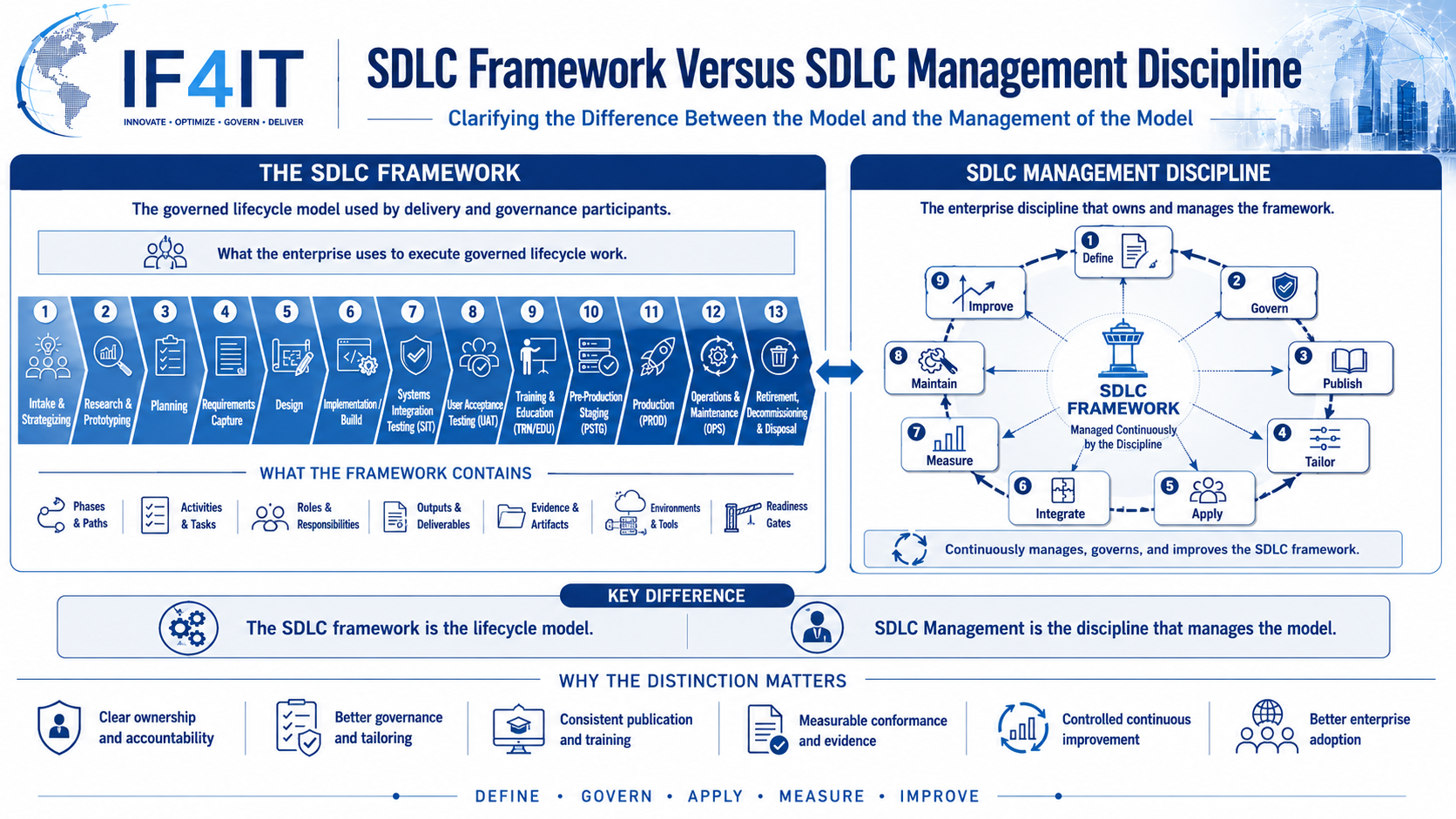
SDLC Versus SDLC Management
| Concept | Meaning |
|---|---|
| Systems Development Lifecycle | The governed lifecycle framework through which technology-enabled capabilities are conceived, developed or acquired, validated, operated, and retired. |
| SDLC Management | The discipline that creates, governs, publishes, applies, measures, maintains, and improves the lifecycle framework. |
Scope of the Discipline
SDLC Management includes lifecycle-model ownership, governance, tailoring, knowledge publication, role definition, evidence expectations, Environment mappings, integration with specialist disciplines, conformance, exception management, maturity, measurement, maintenance, and improvement.
The enterprise should assign one accountable owner or governance function with sufficient authority and cross-functional participation. Organizational placement may vary, but fragmented ownership without clear accountability should be avoided.
Crawl-Walk-Run SDLC Management
| Maturity Stage | Characteristics |
|---|---|
| Crawl | Identified owner, published lifecycle, basic paths, minimum controls, lightweight templates, manual governance, and documented deferrals. |
| Walk | Standard phase guidance, Utilization Profiles, recurring conformance reviews, integrated inventories, metrics, formal exceptions, and consistent training. |
| Run | Integrated workflow, automated evidence, policy checks, metadata synchronization, continuous conformance monitoring, analytics, and evidence-based optimization. |
Common Antipatterns
Enterprises should avoid conflating the SDLC itself with the discipline that manages it. The SDLC is the governed lifecycle framework; SDLC Management is the separate discipline that creates, governs, and improves that framework. Treating the two as the same thing obscures who is actually accountable for maintaining and evolving the lifecycle model itself, as distinct from who executes work within it.
| Antipattern | Why it fails |
|---|---|
| Conflating the SDLC itself with the discipline that manages it | The SDLC is the governed lifecycle framework; SDLC Management is the discipline that creates and improves it. Conflating the two obscures who is accountable for evolving the model versus executing within it. |
Connections to Related IF4IT Practices and Inventories
Align SDLC governance with the IF4IT Enterprise Model, Enterprise Capability Models, and the Enterprise Architecture Value Model so lifecycle decisions remain connected to business architecture, enterprise outcomes, and accountable management practices.
For What Is Systems Development Lifecycle (SDLC) Management?, IT leaders and managers should establish explicit decision rights, accountable ownership, proportional controls, evidence expectations, performance measures, and continuous-improvement feedback tied to enterprise value.
How to cite this page
When referencing this page in academic work, internal standards, or external publications, include the page title, IF4IT as author and publisher (The International Foundation for Information Technology (IF4IT), LLC), the URL, and your access date.
Example (informal web citation):
The International Foundation for Information Technology (IF4IT), LLC. What Is Systems Development Lifecycle (SDLC) Management? | Systems Development Lifecycle (SDLC) Best Practices. https://if4it.org/best-practices/systems-development-lifecycle-sdlc/what-is-systems-development-lifecycle-sdlc-management/ (accessed 2026-10-16).
See About Us for content governance and site-wide citation guidance.
Copyright for The International Foundation for Information Technology (IF4IT), LLC: 2008 - Present
Legal Disclaimers