Which SDLC Phases Correspond to IT Operating Environments? - Systems Development Lifecycle (SDLC) Best Practices
Which SDLC Phases Correspond to IT Operating Environments?
(Chapter 18 of Systems Development Lifecycle (SDLC) Best Practices)
Executive Summary: Chapter Overview
IF4ITThe Bottom Line
Core Concepts
| Concept | Definition & Strategic Role |
|---|---|
| Environment Type | A controlled category of recurring technical context. |
| Environment Instance | A specific implemented Environment. |
| Environment Evidence | Results attributable to the Environment state that produced them. |
Quick Q&A
Question: Is UAT an Environment or a phase?
Question: Does every phase need an Environment?
Read More Below
This chapter maps common IT Operating Environment Types to the SDLC phases and Activities they support while preserving the distinction between lifecycle work and technical contexts.
Phase and Environment Are Different
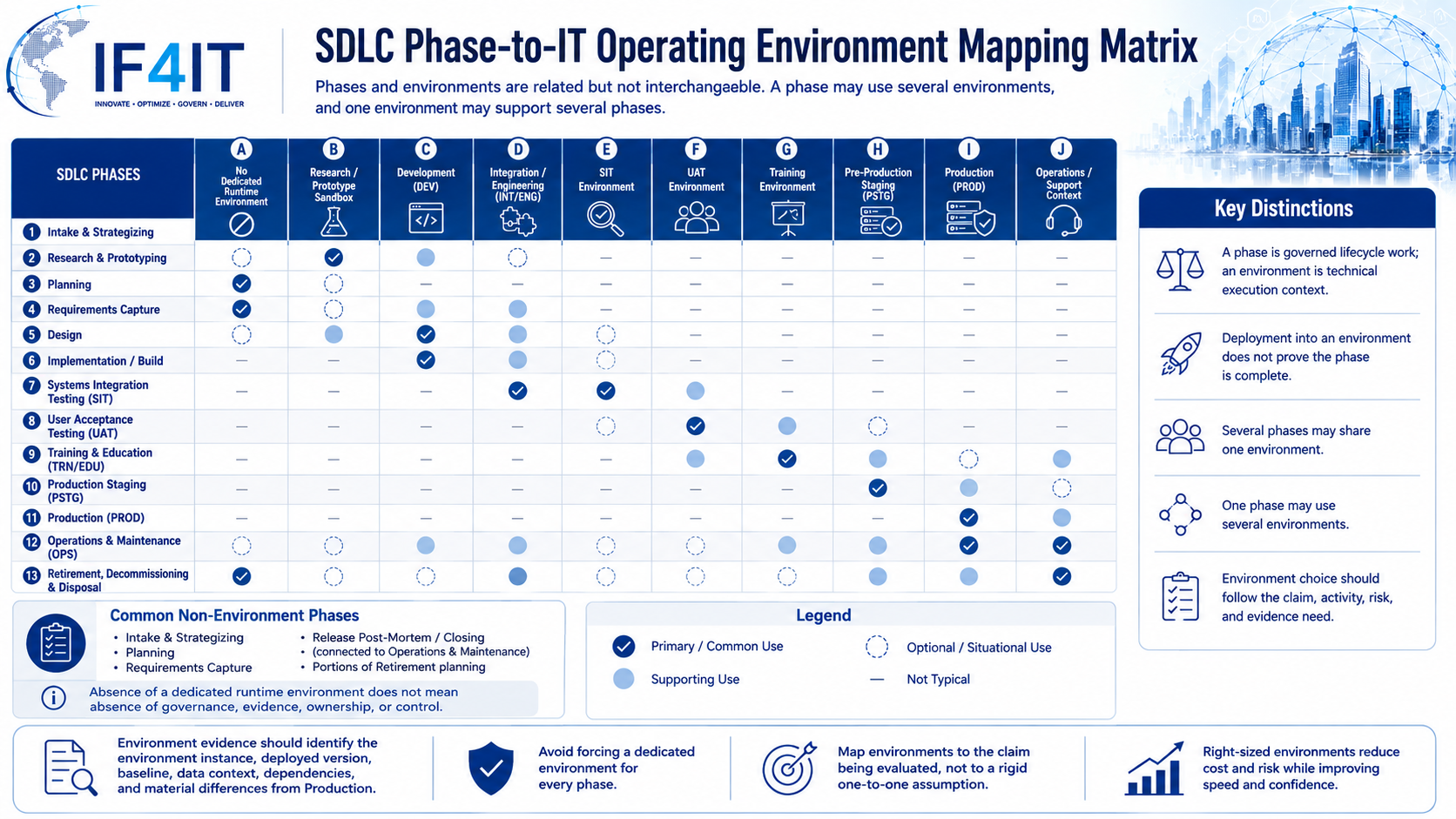
An SDLC phase is a governed body of work and outcomes. An IT Operating Environment is a technical context in which technology, configuration, data, integrations, and controls execute or are evaluated. A phase may use several Environments, and an Environment may support several phases.
Common Relationships
| SDLC phase or activity | Common Environment Types |
|---|---|
| Research & Prototyping | Sandbox, research, prototype, or demonstration |
| Implementation/Build | Development or engineering |
| Systems Integration Testing | Integration and SIT |
| User Acceptance Testing | UAT or supplier acceptance tenant |
| Training & Education | Training, simulation, or sanitized shared Environment |
| Pre-Production Staging | PSTG or Production-like staging |
| Production and OPS | Production, support, diagnostic, and Disaster Recovery |
Environment Evidence
Evidence produced in an Environment should identify the Environment Instance, deployed version, configuration baseline, data context, dependencies, and material differences from Production. Deployment into an Environment does not prove the corresponding phase is complete.
Connections to Related IF4IT Practices and Inventories
Apply IT Operating Environments Best Practices to govern environment purpose, progression, segregation, readiness, promotion, and evidence, and use the Software Technologies Inventory and Attributes to identify the deployed technology baseline.
Release scope, environment progression, deployment evidence, cutover, rollback, and closure are governed through Release Management guidance, IT Operating Environments Best Practices, and Agile, Waterfall, or Hybrid: An IF4IT Framework for Choosing Delivery Methodology.
How to cite this page
When referencing this page in academic work, internal standards, or external publications, include the page title, IF4IT as author and publisher (The International Foundation for Information Technology (IF4IT), LLC), the URL, and your access date.
Example (informal web citation):
The International Foundation for Information Technology (IF4IT), LLC. Which SDLC Phases Correspond to IT Operating Environments? | Systems Development Lifecycle (SDLC) Best Practices. https://if4it.org/best-practices/systems-development-lifecycle-sdlc/which-sdlc-phases-correspond-to-it-operating-environments/ (accessed 2026-10-16).
See About Us for content governance and site-wide citation guidance.
Copyright for The International Foundation for Information Technology (IF4IT), LLC: 2008 - Present
Legal Disclaimers