Why Enterprises Need a Clearly Defined Systems Development Lifecycle (SDLC) - Systems Development Lifecycle (SDLC) Best Practices
Why Enterprises Need a Clearly Defined Systems Development Lifecycle (SDLC)
(Chapter 2 of Systems Development Lifecycle (SDLC) Best Practices)
Executive Summary: Chapter Overview
IF4ITThe Bottom Line
Core Concepts
| Concept | Definition & Strategic Role |
|---|---|
| Authoritative Enterprise SDLC | The single governed lifecycle framework from which standard and tailored paths are derived. |
| Lifecycle Obligation | A required outcome, responsibility, control, or evidence need that exists regardless of whether it is explicitly documented. |
| Publication | The controlled availability of lifecycle guidance through an accessible enterprise knowledge location. |
Quick Q&A
Question: Why is an informal SDLC insufficient?
Question: Does a defined SDLC require identical procedures for all work?
Question: Why must the SDLC be published?
Read More Below
This chapter explains why an enterprise should define, govern, publish, and use an authoritative SDLC instead of relying on tribal knowledge, inconsistent team practices, methodology labels, supplier processes, or individual judgment.
The SDLC as an Enterprise Operating Capability
Every enterprise should define and publish a governed SDLC so practitioners understand what work is expected, when it should occur, who is accountable, what evidence is required, and how readiness decisions are made.
Without a clearly defined SDLC, lifecycle obligations do not disappear. They become inconsistent, implicit, delayed, duplicated, or forgotten. A defined SDLC creates the authoritative framework from which proportionate paths may be tailored.
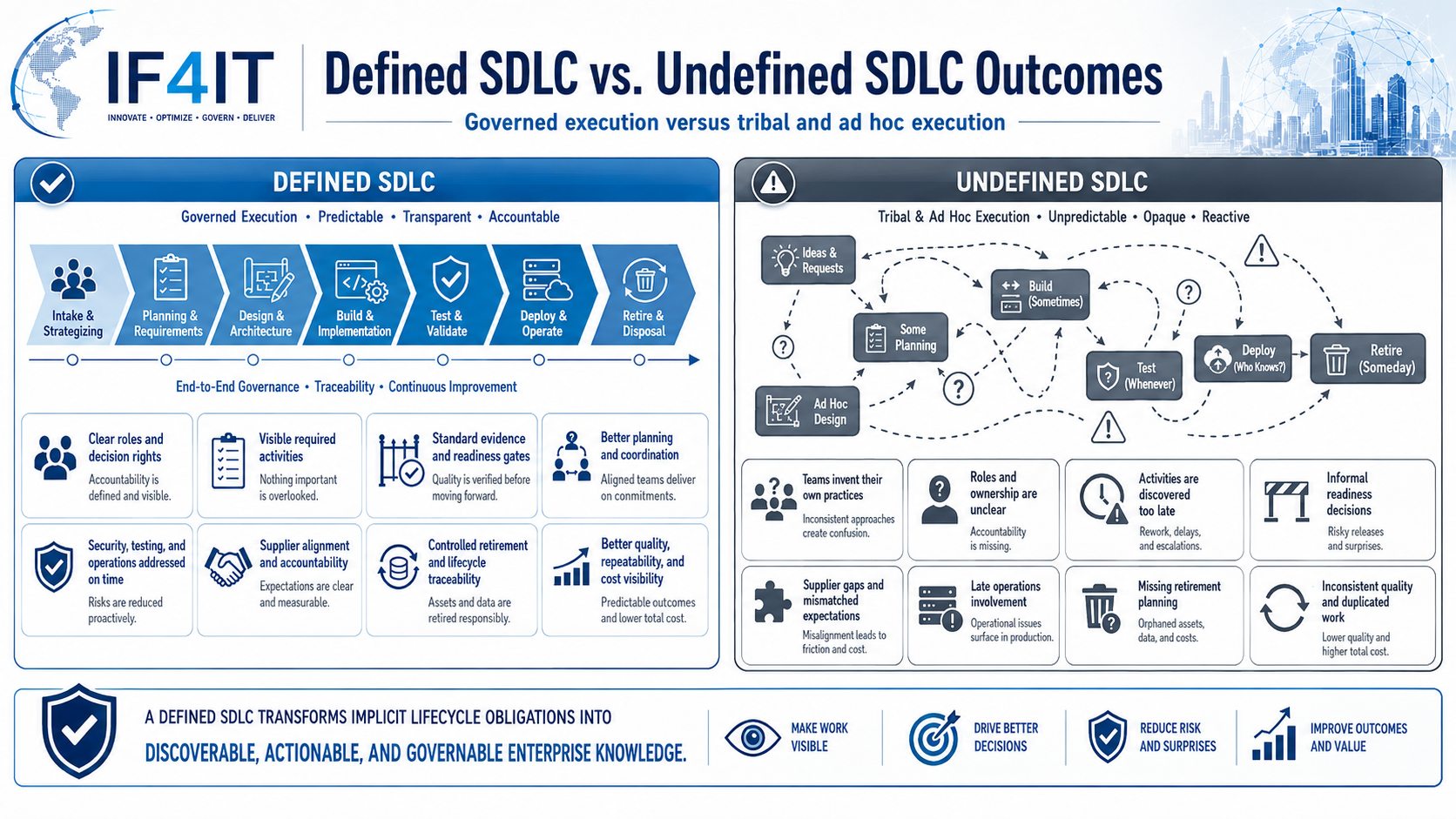
Problems Created by an Undefined SDLC
| Problem | Typical Consequence |
|---|---|
| Teams invent their own lifecycle practices | Delivery quality, evidence, and controls vary substantially. |
| Roles and decision rights are unclear | Work is delayed, duplicated, or left without accountable ownership. |
| Required activities are not visible | Security, privacy, testing, training, support, or retirement work is discovered too late. |
| Readiness criteria are informal | Releases proceed because of schedule pressure or opinion rather than evidence. |
| Supplier processes are accepted without enterprise mapping | Contractual delivery may not satisfy architecture, data, security, testing, or operational obligations. |
| Operations is engaged late | Monitoring, resilience, support, maintenance, and ownership gaps appear after Production. |
| Retirement is not planned | Unsupported systems, abandoned data, residual access, unnecessary costs, and unknown dependencies persist. |
Enterprise Value
A defined SDLC improves knowledge transfer, onboarding, repeatability, cross-team coordination, supplier alignment, delivery quality, cost visibility, and risk control. It also exposes lifecycle costs beyond initial implementation, including Environments, integration, testing, training, operations, maintenance, supplier oversight, compliance evidence, obsolescence, and retirement.
Publication is as important as definition. The lifecycle should be available through an authoritative enterprise knowledge location and link readers to policies, standards, procedures, templates, examples, roles, evidence requirements, Environments, inventories, tools, and approval processes.
Connections to Related IF4IT Practices and Inventories
The IF4IT Enterprise Model, Enterprise Capability Models, and the Capabilities Inventory and Attributes keep this chapter’s decisions and responsibilities connected to enterprise structure, capability ownership, and measurable business outcomes.
For Why Enterprises Need a Clearly Defined Systems Development Lifecycle (SDLC), IT leaders and managers should establish explicit decision rights, accountable ownership, proportional controls, evidence expectations, performance measures, and continuous-improvement feedback tied to enterprise value.
How to cite this page
When referencing this page in academic work, internal standards, or external publications, include the page title, IF4IT as author and publisher (The International Foundation for Information Technology (IF4IT), LLC), the URL, and your access date.
Example (informal web citation):
The International Foundation for Information Technology (IF4IT), LLC. Why Enterprises Need a Clearly Defined Systems Development Lifecycle (SDLC) | Systems Development Lifecycle (SDLC) Best Practices. https://if4it.org/best-practices/systems-development-lifecycle-sdlc/why-enterprises-need-a-clearly-defined-systems-development-lifecycle-sdlc/ (accessed 2026-10-16).
See About Us for content governance and site-wide citation guidance.
Copyright for The International Foundation for Information Technology (IF4IT), LLC: 2008 - Present
Legal Disclaimers