Why the IF4IT Systems Development Lifecycle (SDLC) Uses Detailed Phases - Systems Development Lifecycle (SDLC) Best Practices
Why the IF4IT Systems Development Lifecycle (SDLC) Uses Detailed Phases
(Chapter 3 of Systems Development Lifecycle (SDLC) Best Practices)
Executive Summary: Chapter Overview
IF4ITThe Bottom Line
Core Concepts
| Concept | Definition & Strategic Role |
|---|---|
| Lifecycle Decomposition | The subdivision of broad lifecycle regions into focused phases with distinct purposes and outcomes. |
| Detailed in Definition, Scalable in Implementation | The principle that a comprehensive knowledge model can be implemented with proportionate rigor. |
| Practitioner-Oriented Phase | A lifecycle segment defined with enough precision to guide daily work, evidence, roles, and decisions. |
Quick Q&A
Question: Why does IF4IT use more phases than many models?
Question: Do more named phases require more committees or documents?
Question: Can the IF4IT phases map to shorter external models?
Read More Below
This chapter explains why IF4IT decomposes broad lifecycle regions into 13 focused phases. The additional detail is intended to improve practitioner knowledge, role clarity, delivery quality, cost control, evidence, Environment alignment, and continuous improvement without requiring excessive ceremony.
High-Level Models and Detailed Practitioner Guidance
High-level lifecycle models are valuable for policy, executive communication, broad governance, and framework alignment. Their broad categories, however, may contain materially different work with different owners, evidence, Environments, and readiness conditions.
The IF4IT model expands those abstractions into focused phases because practitioners need actionable guidance, not only conceptual categories. Additional phases do not necessarily mean more bureaucracy; they make responsibilities visible so the enterprise can deliberately determine appropriate rigor.
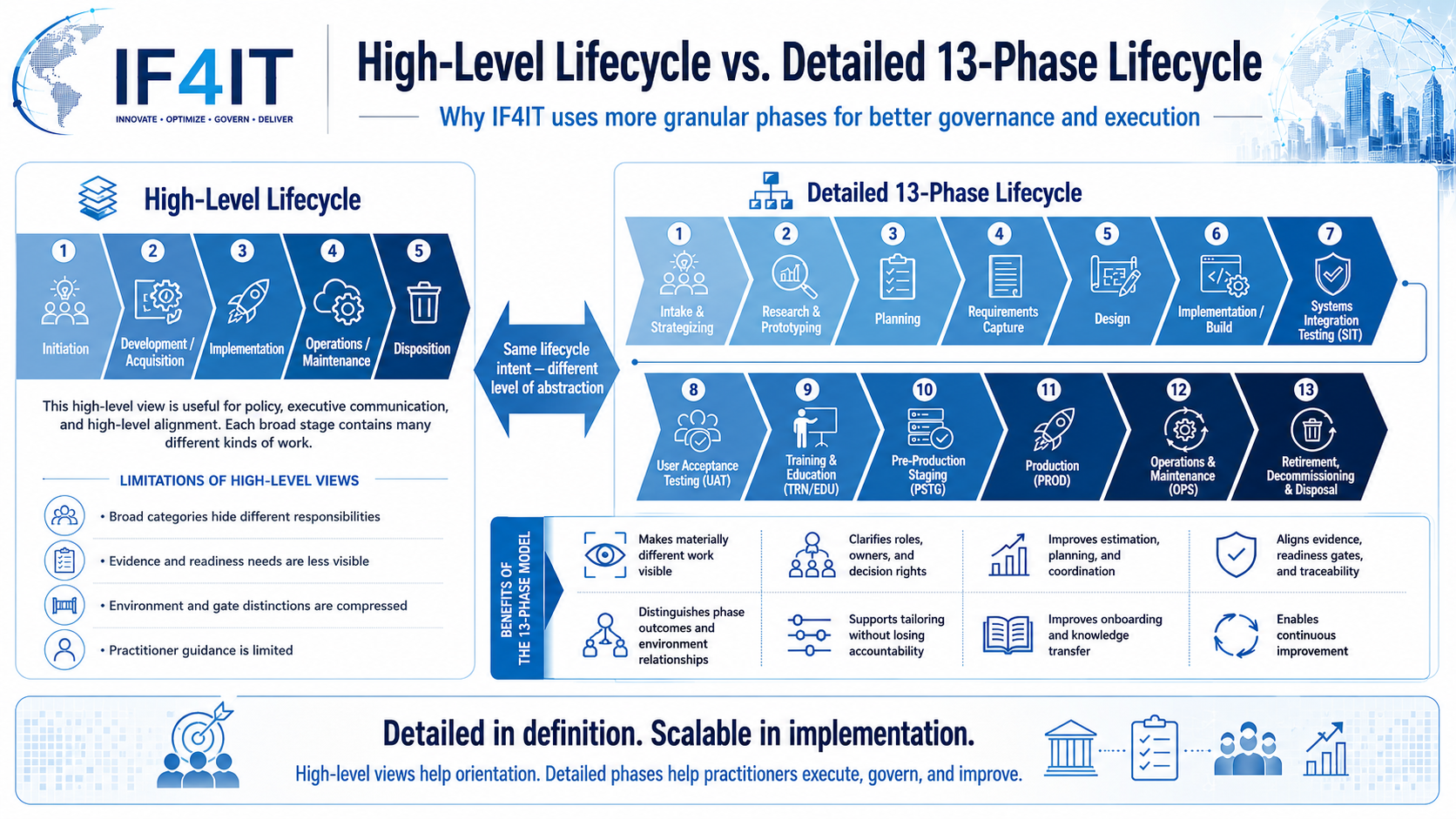
Why 13 Phases Improve Clarity
| Lifecycle Concern | Detailed IF4IT Treatment |
|---|---|
| Need and strategic alignment | Intake & Strategizing |
| Feasibility and uncertainty reduction | Research & Prototyping |
| Delivery preparation | Planning |
| Needs and obligations | Requirements Capture |
| Solution definition | Design |
| Creation or configuration | Implementation/Build |
| Integrated technical behavior | Systems Integration Testing |
| Business and user acceptance | User Acceptance Testing |
| Readiness of people | Training & Education |
| Cutover and operational rehearsal | Pre-Production Staging |
| Deployment and stabilization | Production |
| Continuing service and maintenance | Operations & Maintenance |
| End of useful life | Retirement, Decommissioning & Disposal |
Detailed Does Not Mean Inflexible
The IF4IT SDLC is detailed in definition but scalable in implementation. A Crawl-level enterprise may use combined roles, lightweight templates, manual records, and simplified evidence. A Walk-level enterprise standardizes those same phase distinctions into repeatable templates, publishes phase-specific role expectations, and tracks completion through a shared workflow tool rather than ad hoc records. A Run-level enterprise may use integrated workflows, policy-as-code, automated evidence, and continuous conformance monitoring.
The detail defines the complete knowledge model. Risk, criticality, complexity, sourcing model, and maturity determine how extensively each phase is implemented.
Common Antipatterns
Enterprises should avoid treating a broad lifecycle category as uniform enough to skip phase-level distinctions. A high-level category like “Development” can contain materially different work — Requirements, Design, and Build each have different owners, evidence, and readiness conditions — so treating the broad category as a single undifferentiated block of work hides distinctions that actually matter for governance.
| Antipattern | Why it fails |
|---|---|
| Treating a broad lifecycle category as uniform enough to skip phase-level distinctions | A high-level category like “Development” can contain materially different work with different owners and evidence; treating it as one undifferentiated block hides distinctions that matter for governance. |
Connections to Related IF4IT Practices and Inventories
Apply the IF4IT Enterprise Model, Enterprise Capability Models, and the Capabilities Inventory and Attributes so this chapter’s decisions and responsibilities stay tied to enterprise structure, capability ownership, and measurable business outcomes.
How to cite this page
When referencing this page in academic work, internal standards, or external publications, include the page title, IF4IT as author and publisher (The International Foundation for Information Technology (IF4IT), LLC), the URL, and your access date.
Example (informal web citation):
The International Foundation for Information Technology (IF4IT), LLC. Why the IF4IT Systems Development Lifecycle (SDLC) Uses Detailed Phases | Systems Development Lifecycle (SDLC) Best Practices. https://if4it.org/best-practices/systems-development-lifecycle-sdlc/why-the-if4it-systems-development-lifecycle-sdlc-uses-detailed-phases/ (accessed 2026-08-24).
See About Us for content governance and site-wide citation guidance.
Copyright for The International Foundation for Information Technology (IF4IT), LLC: 2008 - Present
Legal Disclaimers