Balance the technology portfolio across maintain, modernize, and innovate investment categories - Technology Portfolio Management (TPM) Best Practices
Balance the technology portfolio across maintain, modernize, and innovate investment categories
(Chapter 173 of Technology Portfolio Management (TPM) Best Practices)
Executive Summary: Chapter Overview
IF4ITThe Bottom Line
Core Concepts
| Concept | Definition & Strategic Role |
|---|---|
| Balance the technology portfolio across maintain, modernize, and innovate investment categories | Defines the chapter’s primary TPM concern and the disciplined practice needed to govern it consistently across the technology portfolio. |
| Overview | Establishes the ownership, standards, evidence, and decision mechanisms required to turn the guidance into repeatable portfolio governance. |
| Best Practice | Connects the practice to operational action, portfolio transparency, risk reduction, cost control, modernization, and strategic enterprise outcomes. |
Quick Q&A
Question: What is the central guidance in the chapter “Balance the technology portfolio across maintain, modernize, and innovate investment categories”?
Read More Below
Overview
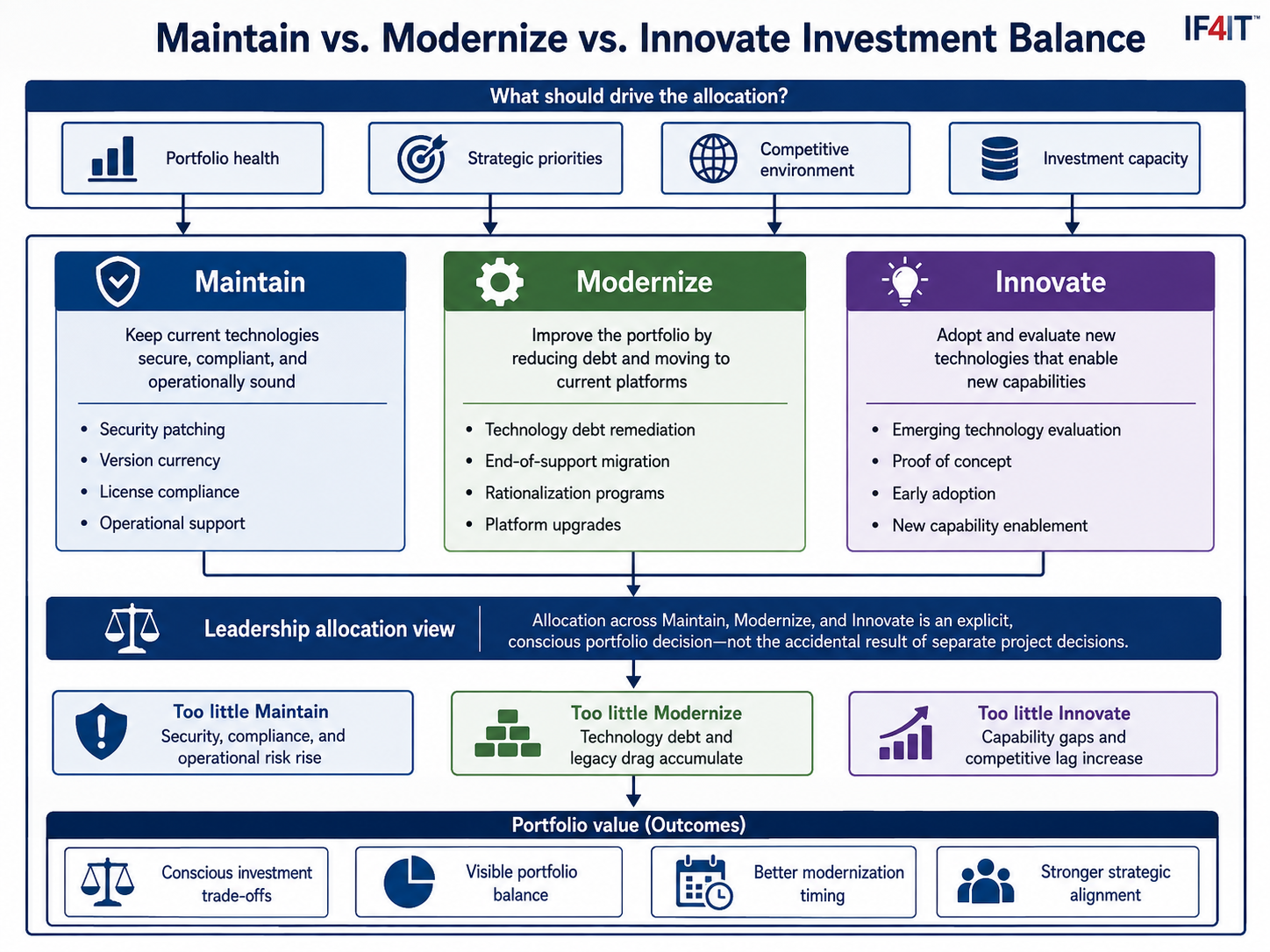
Technology portfolio investment decisions exist in constant tension between three competing demands: the investment required to maintain current technologies in a secure, compliant, and operationally sound state; the investment required to modernize the portfolio by eliminating technology debt, executing lifecycle transitions, and migrating to current platform versions; and the investment required to innovate by adopting emerging technologies that enable new capabilities, competitive differentiation, or operational transformation. All three are legitimate and necessary investment categories. An organization that invests only in maintenance falls further behind on modernization and loses competitive position through innovation deficit. An organization that invests only in innovation without maintaining and modernizing its current portfolio accumulates a legacy estate that eventually constrains its ability to innovate. The right balance is not fixed — it depends on the organization’s current portfolio health, its strategic ambitions, its competitive environment, and the investment capacity available in each planning period.
Best Practice
Use the technology portfolio financial and assessment data to explicitly characterize the current distribution of technology investment across the three categories, and to evaluate whether that distribution reflects the organization’s strategic priorities and portfolio health needs. Maintain investment covers the operational cost and minor enhancement investment required to keep current technologies current: security patching, version currency, license compliance, and operational support. Modernize investment covers the portfolio improvement programs that address accumulated debt, execute lifecycle transitions, and migrate to current platforms: technology debt remediation, end-of-support migration, rationalization programs, and Technology Currency improvements. Innovate investment covers the emerging technology evaluation, proof-of-concept, and early adoption programs that bring new capabilities into the portfolio.
The technology portfolio rationalization roadmap should explicitly categorize each investment program in the roadmap as maintain, modernize, or innovate, and the aggregate investment in each category should be presented to leadership as a portfolio investment allocation that reflects conscious strategic choice rather than the unplanned result of individual investment decisions.
Benefit(s)
Explicit characterization of technology portfolio investment across maintain, modernize, and innovate categories gives leadership the visibility needed to make conscious, strategic investment allocation decisions rather than discovering the allocation after the fact from the aggregate of individual investment decisions. Organizations that are under-investing in modernization relative to the technology debt they are accumulating can see the imbalance and address it before the debt accumulation creates a constraint on their innovation capacity. Organizations that are over-investing in innovation relative to their portfolio maintenance and modernization discipline can see the risk of the accumulating legacy estate that ungoverned innovation adoption creates.
How to cite this page
When referencing this page in academic work, internal standards, or external publications, include the page title, IF4IT as author and publisher (The International Foundation for Information Technology (IF4IT), LLC), the URL, and your access date.
Example (informal web citation):
The International Foundation for Information Technology (IF4IT), LLC. Balance the technology portfolio across maintain, modernize, and innovate investment categories | Technology Portfolio Management (TPM) Best Practices. https://if4it.org/best-practices/technology-portfolio-management-tpm/balance-the-technology-portfolio-across-maintain-modernize-and-innovate-investment-categories/ (accessed 2026-10-26).
See About Us for content governance and site-wide citation guidance.
Copyright for The International Foundation for Information Technology (IF4IT), LLC: 2008 - Present
Legal Disclaimers