Define and operationalize core TPM governance artifacts - Technology Portfolio Management (TPM) Best Practices
Define and operationalize core TPM governance artifacts
(Chapter 4 of Technology Portfolio Management (TPM) Best Practices)
Executive Summary: Chapter Overview
IF4ITThe Bottom Line
Core Concepts
| Concept | Definition & Strategic Role |
|---|---|
| and operationalize core TPM governance artifacts | Defines the chapter’s primary TPM concern and the disciplined practice needed to govern it consistently across the technology portfolio. |
| Overview | Establishes the ownership, standards, evidence, and decision mechanisms required to turn the guidance into repeatable portfolio governance. |
| Best Practice | Connects the practice to operational action, portfolio transparency, risk reduction, cost control, modernization, and strategic enterprise outcomes. |
Quick Q&A
Question: What is the central guidance in the chapter “Define and operationalize core TPM governance artifacts”?
Read More Below
Overview
The Technology Standards Register is one of the most important artifacts produced by TPM, but it is not sufficient by itself. A standards register tells the organization which technologies are approved, tolerated, deprecated, prohibited, or under evaluation. It does not, by itself, explain the full health of the portfolio, the risk exposure associated with each technology, the applications affected by technology decisions, or the work required to move the portfolio toward its target state.
Effective TPM requires a coordinated set of governance artifacts that represent four distinct needs: formal decision records, analytical portfolio views, execution tracking, and leadership reporting. Together, these artifacts make TPM operational. They show what decisions have been made, what those decisions mean, what actions are required, and how the portfolio is changing over time.
Best Practice
Define, maintain, and govern a core set of TPM artifacts that collectively support technology decision-making, portfolio analysis, transition execution, and executive reporting.
At a minimum, TPM should produce and maintain the following artifacts:
| Artifact | Primary Purpose | Artifact Type |
|---|---|---|
| Technology Standards Register | Authoritative record of the organization’s formal governance position on each technology, including Approved, Tolerated, Under Evaluation, Deprecated, and Prohibited statuses. | Governance record |
| Technologies Inventory Family | Governed source-of-truth inventory records for software technologies, hardware technologies, cloud and infrastructure services, intellectual property and standards technologies, open source components, and emerging or experimental technologies. | Governance record / data foundation |
| Technology Lifecycle Dashboard | Portfolio view of technologies by lifecycle stage, showing adoption patterns, obsolescence exposure, transition progress, and lifecycle concentration. | Analytical view |
| Technology Risk Heatmap | Risk-oriented view of technologies by security exposure, end-of-life status, vendor risk, compliance risk, operational criticality, and adoption concentration. | Analytical view |
| Technology Spread Analysis | Analysis of how technologies are distributed across applications, business capabilities, teams, environments, and operational processes. | Analytical view |
| Posture-Disposition Matrix | View of technologies by Rationalization Posture and Strategic Disposition, highlighting alignment, strategic pressure, reassessment signals, and drift. | Analytical view / governance review artifact |
| Technology Transition Pipeline Tracker | Operational tracker for active upgrade, migration, containment, deprecation, and retirement efforts, including scope, sequencing, ownership, dependencies, dates, and progress. | Execution tracker |
| Technology Exception Register | Record of approved exceptions to technology standards, including rationale, approving authority, expiration date, compensating controls, and remediation plan. | Governance record / execution control |
| Technology Portfolio Health Report | Leadership-facing summary of portfolio health, risk, cost, lifecycle exposure, transition progress, and strategic alignment. | Reporting artifact |
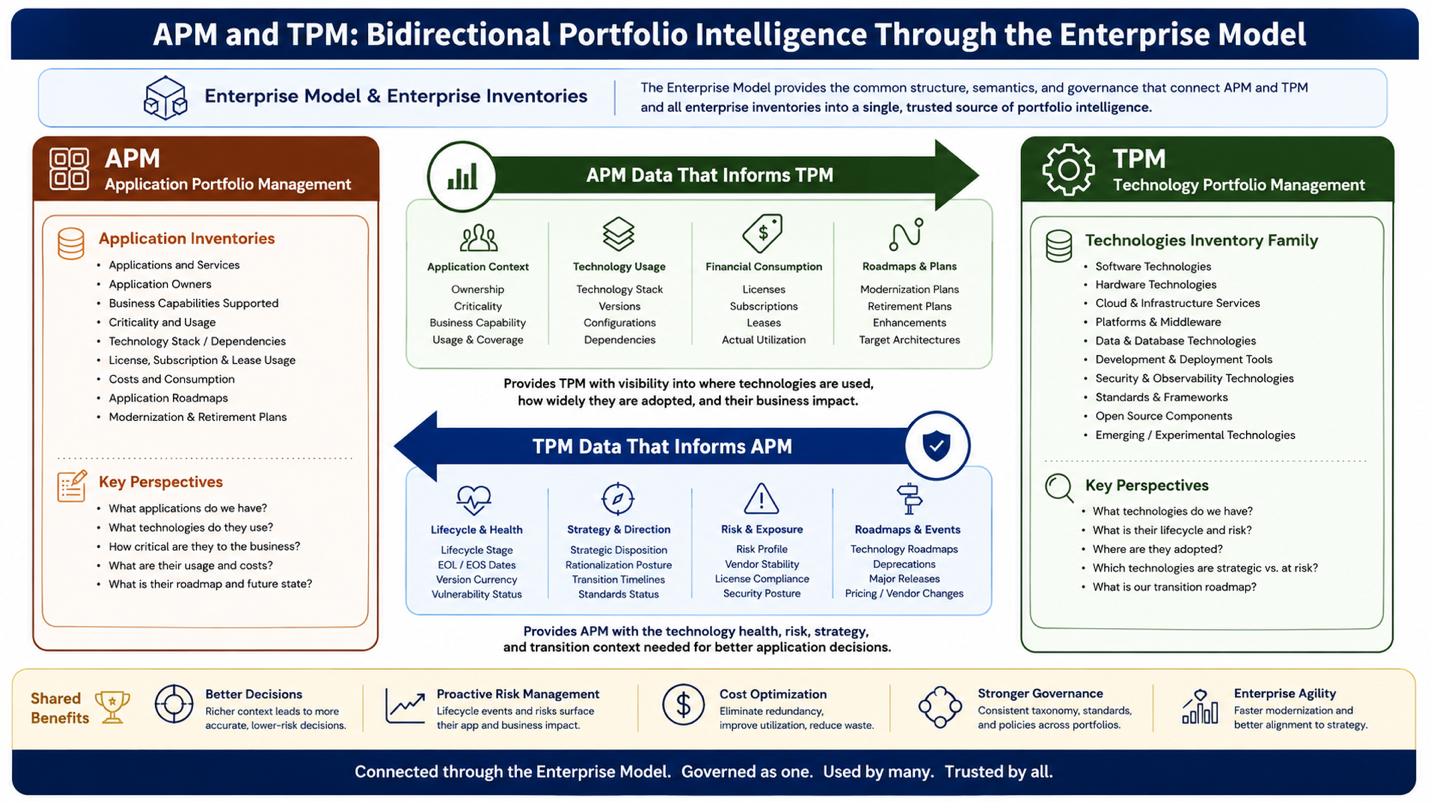
These artifacts should be derived from the underlying Technologies Inventory family wherever possible. Manual artifacts may be necessary early in the maturity journey, but the target state should be dynamically generated views, dashboards, reports, and trackers connected to governed inventory data. This reduces divergence between inventory, standards, risk, and execution views.
Each artifact should also have an owner, update cadence, audience, and governance use. For example, the Technology Standards Register may be reviewed through the Architecture Review Board or Technology Review Board, while the Technology Portfolio Health Report may be reviewed by CIO/CTO leadership on a quarterly or semi-annual basis. The Technology Transition Pipeline Tracker may be maintained more frequently because it governs active execution work.
Benefit(s)
A coordinated set of TPM governance artifacts turns technology governance into an operational capability rather than a static standards exercise. Stakeholders gain visibility into the formal decisions that have been made, the current health of the technology portfolio, the risks that require attention, and the actions underway to change the portfolio.
These artifacts also create a common language for decision-making across Enterprise Architecture, engineering, cybersecurity, procurement, finance, vendor management, application owners, and executive leadership. When the artifacts are connected to the Technologies Inventory family and the broader Enterprise Model, TPM can scale from manual governance to data-driven portfolio intelligence, automated reporting, and more reliable execution tracking.
How to cite this page
When referencing this page in academic work, internal standards, or external publications, include the page title, IF4IT as author and publisher (The International Foundation for Information Technology (IF4IT), LLC), the URL, and your access date.
Example (informal web citation):
The International Foundation for Information Technology (IF4IT), LLC. Define and operationalize core TPM governance artifacts | Technology Portfolio Management (TPM) Best Practices. https://if4it.org/best-practices/technology-portfolio-management-tpm/define-and-operationalize-core-tpm-governance-artifacts/ (accessed 2026-10-26).
See About Us for content governance and site-wide citation guidance.
Copyright for The International Foundation for Information Technology (IF4IT), LLC: 2008 - Present
Legal Disclaimers