Technology Portfolio Management (TPM) Best Practices - Understand the relationship between TPM and the Enterprise Model
Technology Portfolio Management (TPM) Best Practices
Understand the relationship between TPM and the Enterprise Model
Overview
All technology assets governed by TPM ultimately converge within the Enterprise Model, where they are connected to the applications, infrastructure, vendors, contracts, licenses, risks, people, policies, data assets, and business capabilities they affect.
This connection is essential because technologies do not exist in isolation. They support applications, depend on vendors, consume funding, introduce risks, carry license obligations, require skills, and influence business capability delivery. When technology records are connected to the broader Enterprise Model, the organization can understand not only what technologies it has, but what those technologies depend on, what depends on them, and what changes will be affected when technology decisions are made.
The value of TPM is therefore not limited to managing technologies within the technology domain. TPM contributes a governed technology view to the enterprise’s broader system of intelligence. This allows the organization to assess impact, manage risk, plan transitions, rationalize cost, evaluate vendor exposure, and make technology decisions with the context that isolated inventories cannot provide.
Best Practice
Design and govern the Technologies Inventory family as a first-class contribution to the Enterprise Model. Technology records should not be isolated inventory entries; they should be governed Enterprise Model nodes with defined identifiers, ownership, data quality expectations, lifecycle states, Rationalization Postures, Strategic Dispositions, Standards Register statuses, and relationships to the other enterprise inventories they affect.
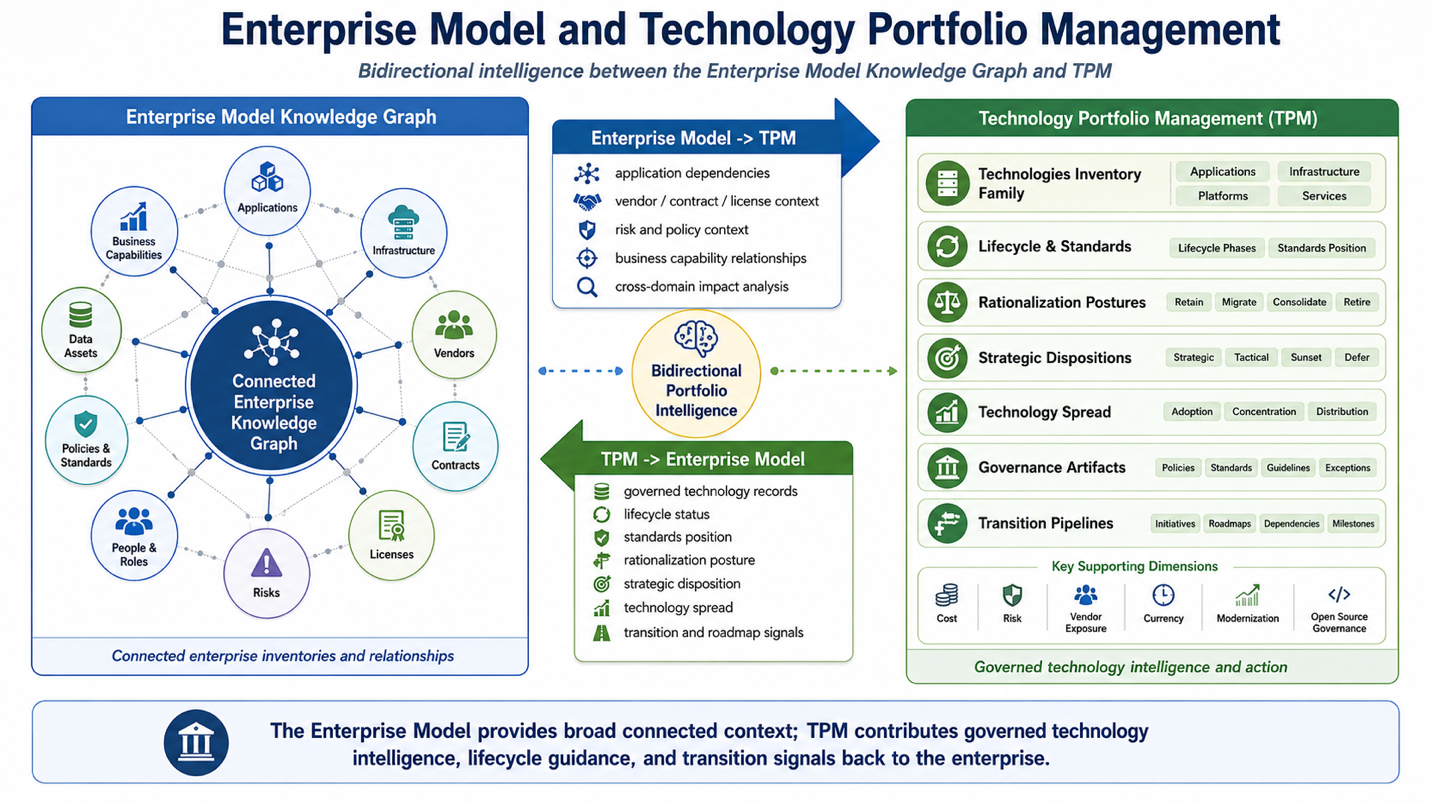
Figure: Key relationships between the Enterprise Model and TPM
At minimum, TPM should satisfy the following Enterprise Model integration requirements:
| Requirement | Description |
|---|---|
| Treat technology records as first-class Enterprise Model nodes | Every governed technology should be represented as a formal Enterprise Model node with clear ownership, lifecycle status, Rationalization Posture, Strategic Disposition, Standards Register status, and review cadence. |
| Use stable semantic identifiers | Each technology record should carry a stable semantic identifier that connects it unambiguously to related records. For example, a technology record such as TECH-SW-LANG-PYTHON can connect to applications that use Python, vendor or community records related to Python, and skills records for people who support Python. |
| Connect technologies to dependent applications | Application records should declare the technologies they use, allowing the Enterprise Model to show which applications depend on which technologies and enabling Technology Spread analysis. |
| Connect technologies to supporting and governing inventories | Technology records should connect to infrastructure, vendors, contracts, licenses, subscriptions, leases, risks, issues, policies, standards, people, teams, skills, data assets, and business capabilities where those relationships exist. |
| Adopt the Enterprise Ontology | TPM should use the broader Enterprise Ontology for relationship definitions rather than creating a separate technology-only relationship model. This allows technology intelligence to be consumed by APM, cybersecurity, FinOps, vendor management, HR and human capital planning, architecture governance, and other disciplines. |
| Preserve governance history and lineage | When a technology record is reclassified, merged, split, renamed, or moved between inventory types, the Enterprise Model should preserve its identifier lineage, relationship history, governance decisions, and lifecycle history. |
| Govern ambiguous assets somewhere | When stakeholders are uncertain whether an asset belongs in the Technologies Inventory, Applications Inventory, Infrastructure Inventory, or another inventory, the asset should still be governed somewhere in the Enterprise Model. Classification can be refined later as evidence accumulates. |
The Technologies Inventory family is a governed contribution to the Enterprise Model, not the Enterprise Model itself. The Enterprise Model is broader than TPM and includes the Applications Inventory, Infrastructure Inventory, Vendors and Suppliers Inventories, Contracts and Agreements Inventories, Software Licenses Inventory, People and Roles Inventory, Risks and Issues Inventories, Policies, Standards, Compliance Inventories, data assets, business capabilities, and other governed enterprise entities.
This distinction is important. No single sub-discipline owns the Enterprise Model. Each sub-discipline contributes governed data to it, draws intelligence from it, and benefits from the connections it maintains to inventories governed by other disciplines.
Benefit(s)
Governing the Technologies Inventory family as first-class Enterprise Model nodes produces technology intelligence that is available to every connected governance discipline rather than siloed within the TPM program. APM portfolio analyses include technology data automatically because the Applications Inventory and Technologies Inventories are connected. Security vulnerability analysis spans from the vulnerability to the technology to every application that uses that technology in a single traversal. FinOps cost analysis attributes technology platform costs to the applications and business capabilities that use them. HR workforce planning identifies the teams with the
Copyright for the International Foundation for Information Technology (IF4IT): 2008 - Present
Legal Disclaimers