Understand why TPM matters to the enterprise — and to leadership - Technology Portfolio Management (TPM) Best Practices
Understand why TPM matters to the enterprise — and to leadership
(Chapter 5 of Technology Portfolio Management (TPM) Best Practices)
Executive Summary: Chapter Overview
IF4ITThe Bottom Line
Core Concepts
| Concept | Definition & Strategic Role |
|---|---|
| why TPM matters to the enterprise — and to leadership | Defines the chapter’s primary TPM concern and the disciplined practice needed to govern it consistently across the technology portfolio. |
| Overview | Establishes the ownership, standards, evidence, and decision mechanisms required to turn the guidance into repeatable portfolio governance. |
| Best Practice | Connects the practice to operational action, portfolio transparency, risk reduction, cost control, modernization, and strategic enterprise outcomes. |
Quick Q&A
Question: What is the central guidance in the chapter “Understand why TPM matters to the enterprise — and to leadership”?
Read More Below
Overview
The consequences of ungoverned technology portfolios are significant, pervasive, and often underestimated. They are underestimated because many of the costs and risks they create are invisible until the organization has the inventory, ownership, assessment, and analytical disciplines required to see them.
An organization that does not know what technologies it runs cannot know what those technologies cost in total. An organization that does not track technology versions cannot know which systems depend on unsupported or vulnerable platforms. An organization that does not maintain visibility into open source components cannot reliably manage license obligations, security exposure, or software supply chain risk. An organization that does not understand where technologies are used cannot accurately plan modernization, vendor exits, deprecations, or retirements.
TPM matters because it makes these hidden dependencies, costs, risks, and obligations visible. It converts fragmented technology usage into governed portfolio intelligence that leadership can use to make better decisions.
Best Practice
Communicate the value of TPM in terms that align to leadership accountability and enterprise outcomes.
At a minimum, position TPM around the following leadership value drivers:
| Leadership Concern | How TPM Helps |
|---|---|
| Cost visibility and optimization | Identifies total technology cost across licenses, subscriptions, infrastructure, operations, integration, training, support, and technology debt. |
| Security and resilience | Surfaces unsupported, unpatched, vulnerable, or poorly governed technologies before they become incidents. |
| Regulatory and license compliance | Supports governance of open source obligations, SBOMs, software supply chain requirements, standards conformance, privacy obligations, and audit evidence. |
| Modernization planning | Shows which applications, business capabilities, teams, and environments are affected by technology upgrades, migrations, deprecations, and retirements. |
| Vendor leverage and concentration risk | Reveals aggregate dependency on vendors, platforms, pricing models, commercial terms, and exit constraints. |
| Technology debt management | Identifies technologies whose outdated versions, unsupported configurations, weak interoperability, or poor portability create recurring cost and risk. |
| Strategic alignment | Connects technology decisions to enterprise strategy, target architecture, capability priorities, and application rationalization roadmaps. |
| Execution confidence | Provides the data required to sequence transition pipelines, estimate impact, assign ownership, track progress, and reduce delivery uncertainty. |
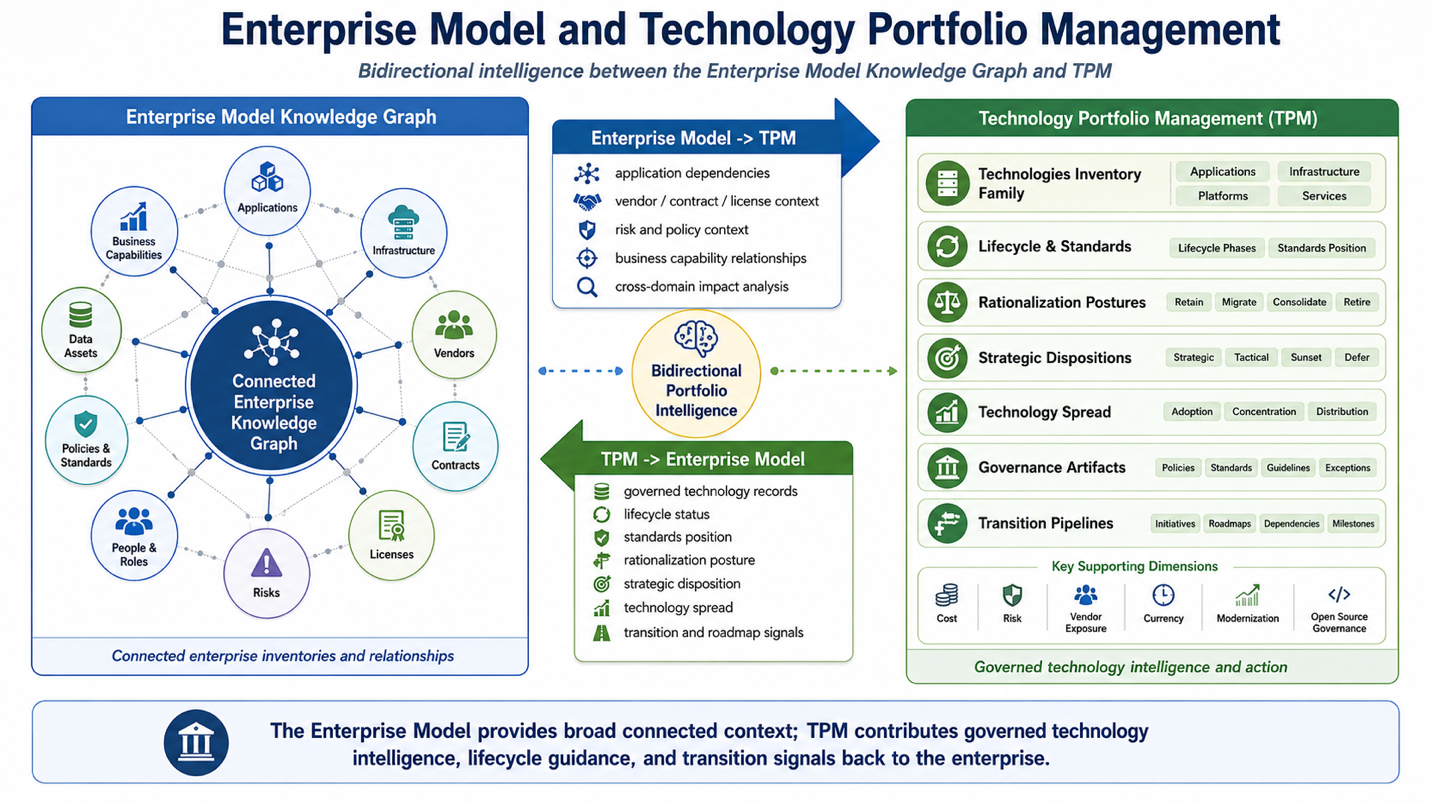
For financial leadership, TPM explains the full cost profile of the technology portfolio and creates opportunities for rationalization, consolidation, and renegotiation. For cybersecurity and compliance leadership, TPM identifies unmanaged exposure and provides evidence that technology risk is being governed deliberately. For technology leadership, TPM creates the visibility required to control technology sprawl, modernization demand, dependency concentration, and lifecycle risk. For business leadership, TPM connects technology decisions to business capability, resilience, cost, and strategic execution.
TPM should therefore be communicated not as an IT documentation exercise, but as a leadership intelligence capability. It gives executives and governance bodies a clearer view of where the enterprise is exposed, where it is over-invested, where it is under-governed, and where technology decisions can produce measurable business value.
Benefit(s)
Organizations that establish effective TPM capabilities discover that technology portfolio governance changes the quality of leadership decision-making. Costs that were previously fragmented become visible. Risks that were previously embedded in local technology choices become measurable. Vendor exposure that was previously negotiated technology by technology becomes visible at portfolio scale. Modernization work that was previously reactive can be sequenced through governed transition pipelines.
These discoveries are not evidence of prior failure. They are the predictable result of introducing a governance capability that did not previously exist. TPM makes the invisible visible and gives leadership the intelligence to act on it.
How to cite this page
When referencing this page in academic work, internal standards, or external publications, include the page title, IF4IT as author and publisher (The International Foundation for Information Technology (IF4IT), LLC), the URL, and your access date.
Example (informal web citation):
The International Foundation for Information Technology (IF4IT), LLC. Understand why TPM matters to the enterprise — and to leadership | Technology Portfolio Management (TPM) Best Practices. https://if4it.org/best-practices/technology-portfolio-management-tpm/understand-why-tpm-matters-to-the-enterprise-and-to-leadership/ (accessed 2026-10-22).
See About Us for content governance and site-wide citation guidance.
Copyright for The International Foundation for Information Technology (IF4IT), LLC: 2008 - Present
Legal Disclaimers