Use TPM maturity models to assess current capability and guide improvement investment - Technology Portfolio Management (TPM) Best Practices
Use TPM maturity models to assess current capability and guide improvement investment
(Chapter 225 of Technology Portfolio Management (TPM) Best Practices)
Executive Summary: Chapter Overview
IF4ITThe Bottom Line
Core Concepts
| Concept | Definition & Strategic Role |
|---|---|
| TPM maturity models to assess current capability and guide improvement investment | Defines the chapter’s primary TPM concern and the disciplined practice needed to govern it consistently across the technology portfolio. |
| Overview | Establishes the ownership, standards, evidence, and decision mechanisms required to turn the guidance into repeatable portfolio governance. |
| Best Practice | Connects the practice to operational action, portfolio transparency, risk reduction, cost control, modernization, and strategic enterprise outcomes. |
Quick Q&A
Question: What is the central guidance in the chapter “Use TPM maturity models to assess current capability and guide improvement investment”?
Read More Below
Overview
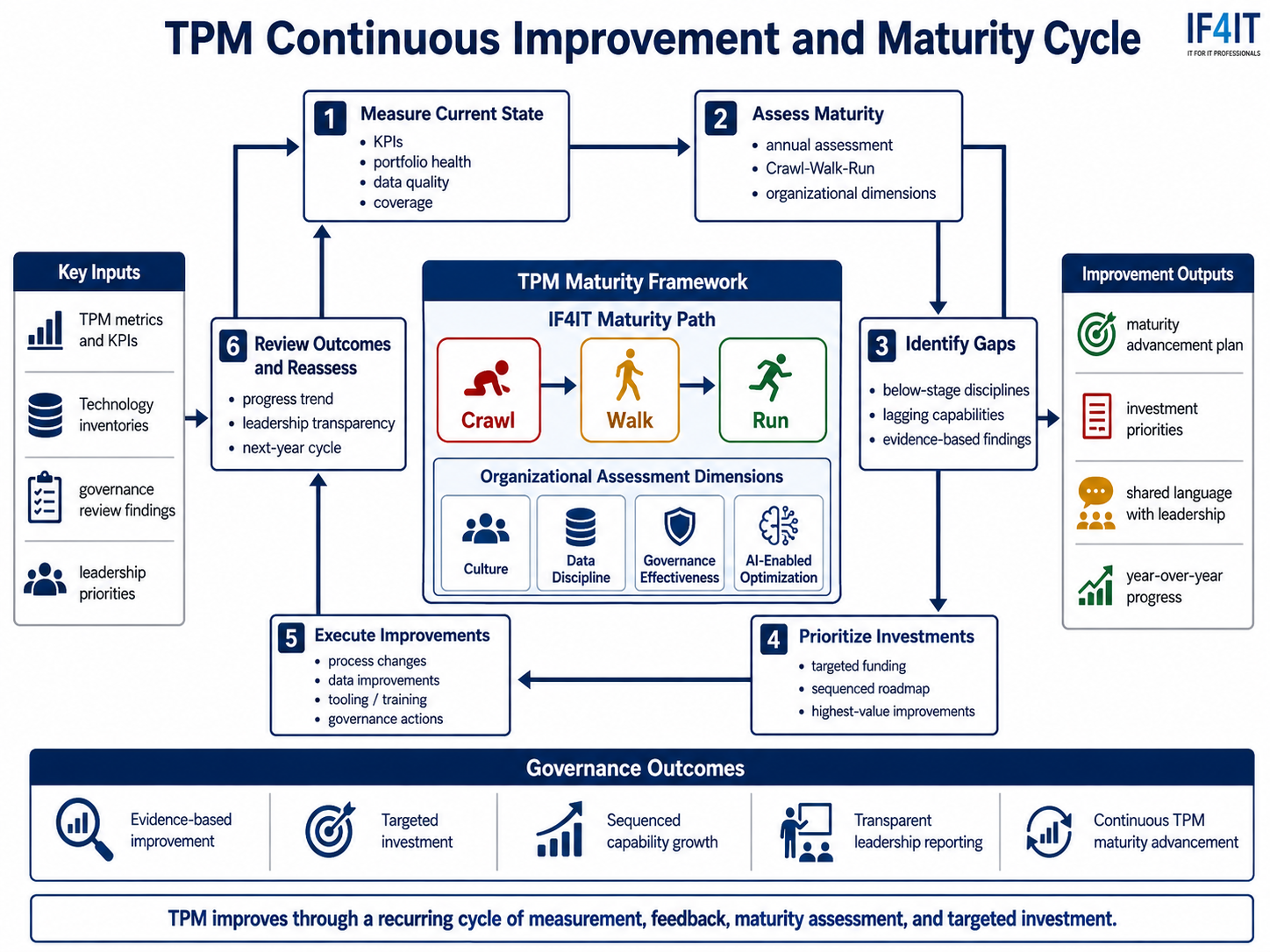
Technology portfolio governance maturity models provide a structured framework for assessing where the organization’s current TPM capability sits relative to a defined progression of governance sophistication, and for identifying the specific capability investments that will advance the organization from its current maturity level to the next. The IF4IT Crawl-Walk-Run maturity model described in the preceding subsection provides the primary maturity framework for the TPM program. Supplementing it with the IF4IT Organizational Assessment Framework — which provides a multi-dimensional maturity assessment across the full range of organizational capabilities including culture, data discipline, governance effectiveness, and AI-enabled optimization — gives the TPM program a comprehensive maturity assessment tool that can identify improvement opportunities across all dimensions of governance capability.
Best Practice
Conduct a formal TPM maturity assessment annually as part of the annual comprehensive review, using the IF4IT Crawl-Walk-Run model to assess current capability against the defined objectives of each maturity stage, and using the IF4IT Organizational Assessment Framework to assess the cultural, organizational enabler, and continuous improvement dimensions of governance maturity that the Crawl-Walk-Run model addresses less explicitly. Use the maturity assessment outputs to: identify the specific governance disciplines where the organization’s maturity is below the level expected for its current stage and direct improvement investment to those disciplines; identify the specific governance disciplines where the organization has advanced beyond its current stage in specific dimensions and leverage those advanced capabilities while advancing the lagging dimensions; and develop the maturity advancement investment plan for the coming year that identifies the specific capability investments required to advance from the current maturity profile to the next stage objectives.
Share the maturity assessment results with IT leadership as a transparent view of the governance program’s current capability and its improvement trajectory. The maturity assessment is not a performance appraisal of the governance team; it is an honest organizational self-assessment that enables leadership to make informed investment decisions about governance capability development. Governance programs that are transparent about their current maturity level and their improvement priorities consistently earn more leadership investment than those that present an artificially complete picture of their capability.
Benefit(s)
Using TPM maturity models to guide improvement investment produces capability development that is sequenced, grounded in evidence, and proportionate to the maturity stage requirements the organization is working toward. Improvement investments are directed to the governance disciplines where the maturity gap is greatest and the organizational readiness to benefit from improvement investment is highest. The maturity assessment creates a shared language between the governance program and leadership for discussing governance capability, investment needs, and development progress that is more productive than discussions about specific governance issues without the maturity framework context. And the annual maturity assessment trend — measuring progress from one year’s assessment to the next — provides the governance program’s most fundamental accountability metric: whether the continuous improvement investment is actually advancing the organization’s TPM governance capability toward the strategic maturity the enterprise requires.
How to cite this page
When referencing this page in academic work, internal standards, or external publications, include the page title, IF4IT as author and publisher (The International Foundation for Information Technology (IF4IT), LLC), the URL, and your access date.
Example (informal web citation):
The International Foundation for Information Technology (IF4IT), LLC. Use TPM maturity models to assess current capability and guide improvement investment | Technology Portfolio Management (TPM) Best Practices. https://if4it.org/best-practices/technology-portfolio-management-tpm/use-tpm-maturity-models-to-assess-current-capability-and-guide-improvement-investment/ (accessed 2026-10-26).
See About Us for content governance and site-wide citation guidance.
Copyright for The International Foundation for Information Technology (IF4IT), LLC: 2008 - Present
Legal Disclaimers