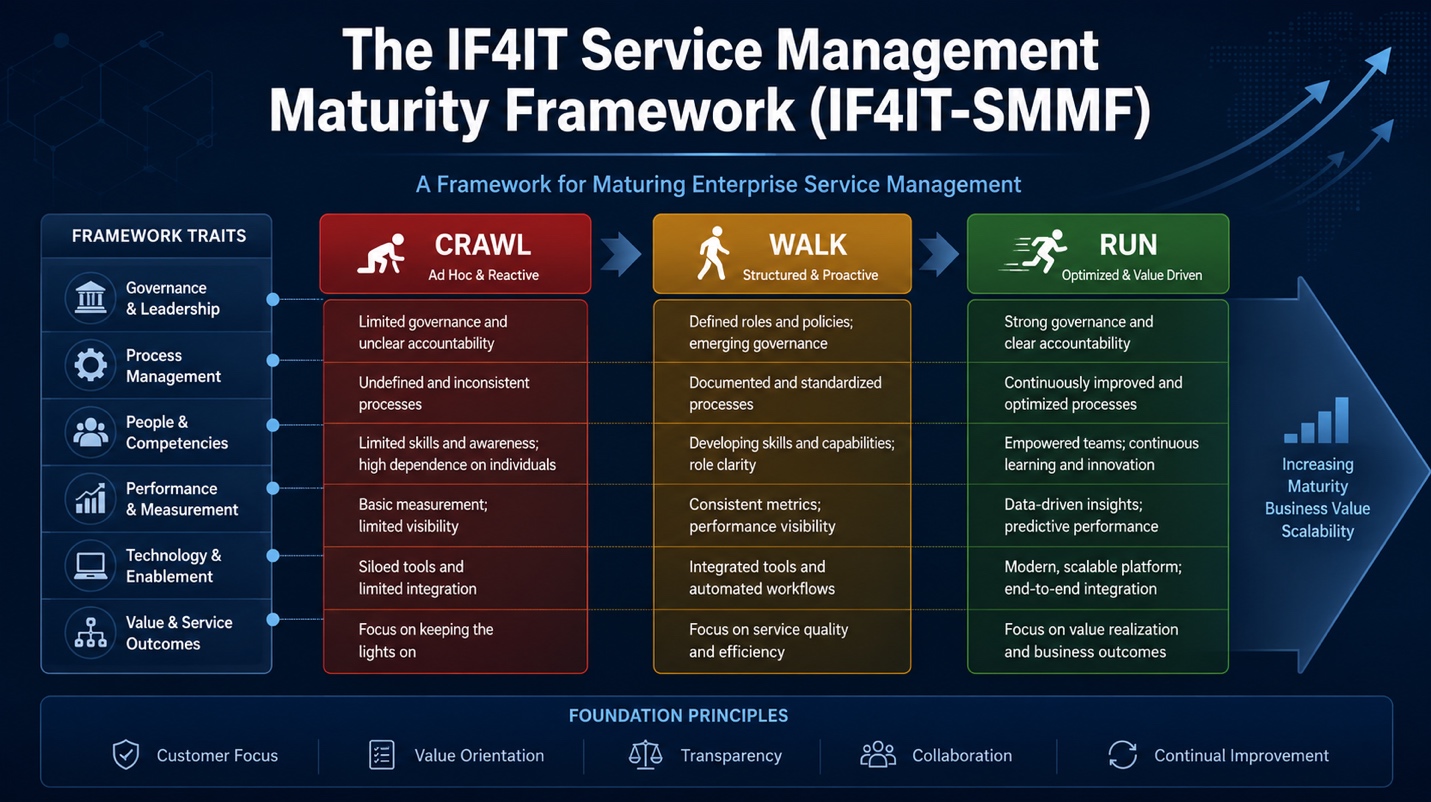
The IF4IT Service Management Maturity Framework (IF4IT-SMMF) for Small, Midsized, and Large Enterprises
Executive Summary: Document Overview
IF4ITThe Bottom Line
The IF4IT Service Management Maturity Framework (IF4IT-SMMF) gives Small, Midsized, and Large Enterprises a rigorous instrument to identify their current Service Management maturity across thirteen traits, prescribe the specific improvements that advance each trait to the next tier, and prevent premature investments that fail at the current tier.
Core Pillars & Document Modules
| Document Pillar / Focus Area | Strategic Business Outcome & Intent |
|---|---|
| Thirteen Traits of Service Management | The framework decomposes Service Management into thirteen distinct traits — from Service Definition through Service Culture — each of which matures independently. Enterprises produce a trait-by-trait maturity profile rather than a single overall rating, exposing uneven maturity that a single rating would obscure. |
| Crawl / Walk / Run Progression | Three defined maturity tiers describe the state of practice, not transition points. Each tier corresponds broadly to Small, Midsized, and Large Enterprises. Advancing to a higher tier is not required — the right tier is the tier whose governance overhead matches the enterprise’s operational scale. |
| Diagnose-Prescribe-Defend Cell Model | Every tier cell contains four labeled sub-sections: What’s Typical (diagnostic), What To Improve (prescriptive), What To Avoid (defensive), and Key Takeaway (synthesis). Combined with an eight-attribute recording structure — Trait, Current Tier, Evidence, Gaps, Recommended Next Moves, Priority, Owner, Target Date — this converts the framework from a reference document into a self-assessment instrument and improvement planning tool. |
Quick Q&A (Macro Executive Reference)
Question: What does the IF4IT-SMMF do that a rating scale or industry benchmark does not?
Answer: The framework produces a trait-by-trait maturity profile with tier-specific prescriptions and guardrails. Rating scales assign a single overall number that obscures the uneven maturity most enterprises actually have. Industry benchmarks describe what other enterprises do, not what a specific enterprise should do next. The IF4IT-SMMF identifies what an enterprise should do next given its current state, and what it should not do at the current tier even when industry pressure suggests otherwise.
Question: When is Run tier the wrong goal for an enterprise?
Answer: Run tier is the wrong goal when the governance overhead required to sustain it exceeds the value it produces at the enterprise’s operational scale. A Midsized Enterprise operating well at Walk tier may correctly conclude that Walk is the appropriate tier and that advancing further would produce more overhead than benefit. The framework treats intentional stops as valid outcomes, not as incomplete maturity.
Read Full Table of Contents Below
Table of Contents
Copyright for The International Foundation for Information Technology (IF4IT), LLC: 2008 - Present