The International Foundation for Information Technology (IF4IT)
  • Home
  • Best Practices & More
  • Articles
  • Dictionary
  • About Us
  • Contact Us
  • Catalog
  • Search
  1. Topics
  2. IT Governance

IT Governance

Share:
Contact Us → Subscribe →
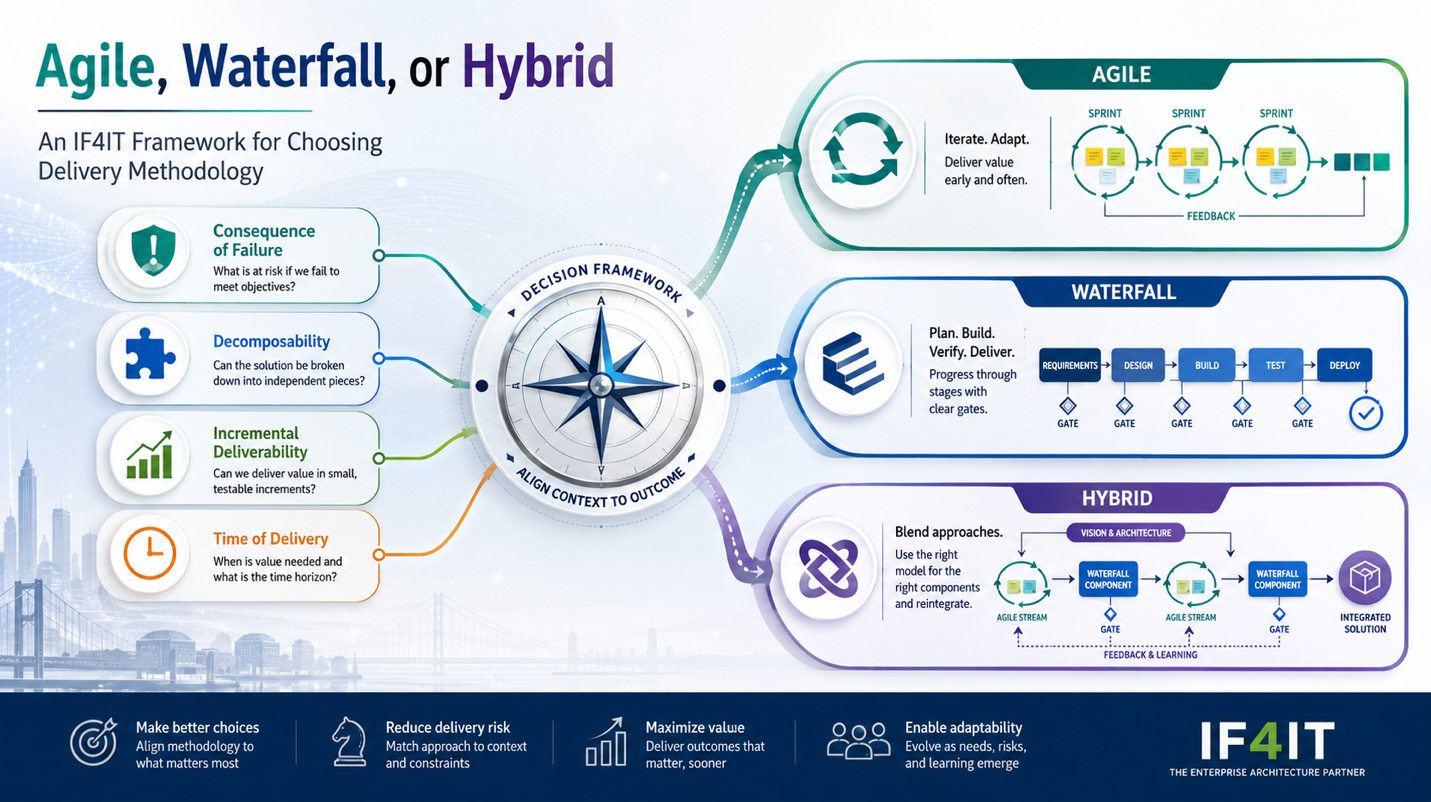
Agile, Waterfall, or Hybrid: An IF4IT Framework for Choosing Delivery Methodology

Best Practice

Agile, Waterfall, or Hybrid: An IF4IT Framework for Choosing Delivery Methodology

Delivery methodology is not an enterprise preference; it is a fit decision determined by the nature of the Product or Service being delivered. When organizations force all work through Agile, Waterfall, or a convenien...

read more
AI Agents Inventory and Attributes

Inventory

AI Agents Inventory and Attributes

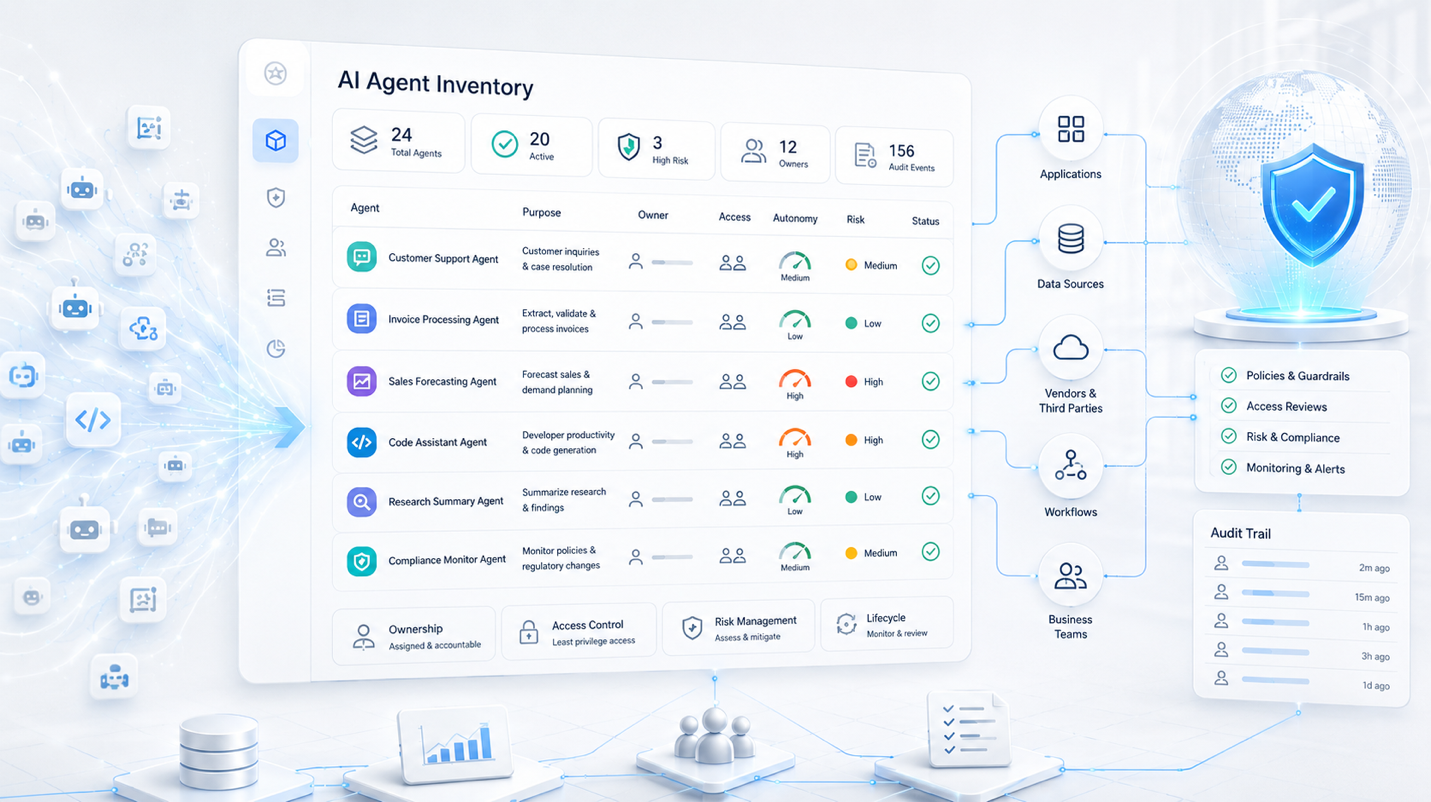
The AI Agents Inventory is the enterprise’s single governed record of the AI agents it builds, buys, or runs — the autonomous, model-driven software actors that take action on systems and data, or communicate with sta...

read more
AI Agents Inventory vs. Registry vs. Catalog: What's the Difference?

Article

AI Agents Inventory vs. Registry vs. Catalog: What's the Difference?

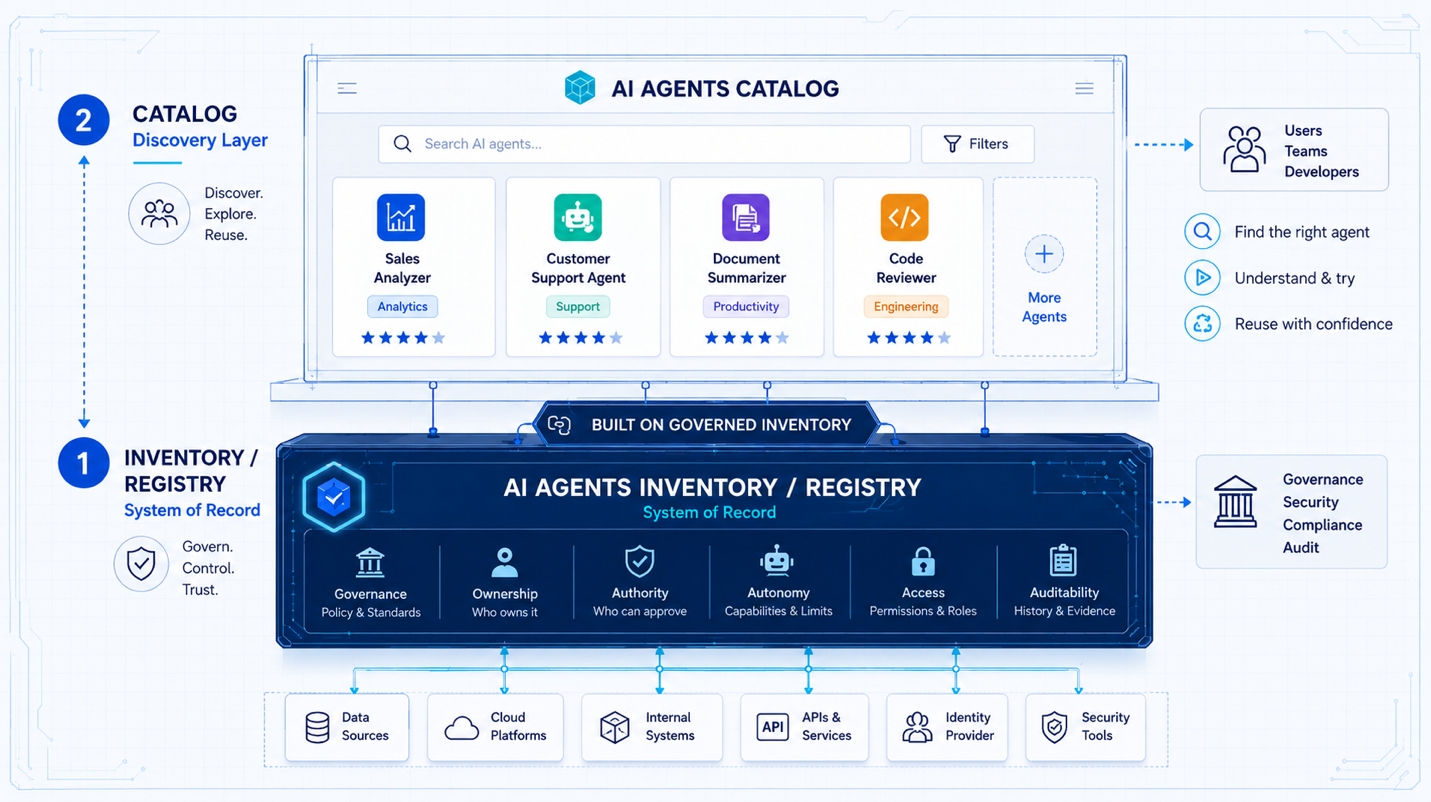
An AI Agents Inventory and an AI Agents Registry are the same thing: a governed record of the AI agents an enterprise has, who owns them, what they can do, and what they can reach. An AI Agents Catalog is different: i...

read more
AI Governance Is an Inventory Problem: Why Enterprise AI Governance Starts With an AI Agent Inventory

Article

AI Governance Is an Inventory Problem: Why Enterprise AI Governance Starts With an AI Agent Inventory

AI governance is not a new discipline. It is inventory governance applied to a new kind of asset. Enterprises struggling to govern Artificial Intelligence (AI) are usually struggling because they cannot see what AI th...

read more
AI Raises the Stakes on Knowing Yourself as an Enterprise

Article

AI Raises the Stakes on Knowing Yourself as an Enterprise

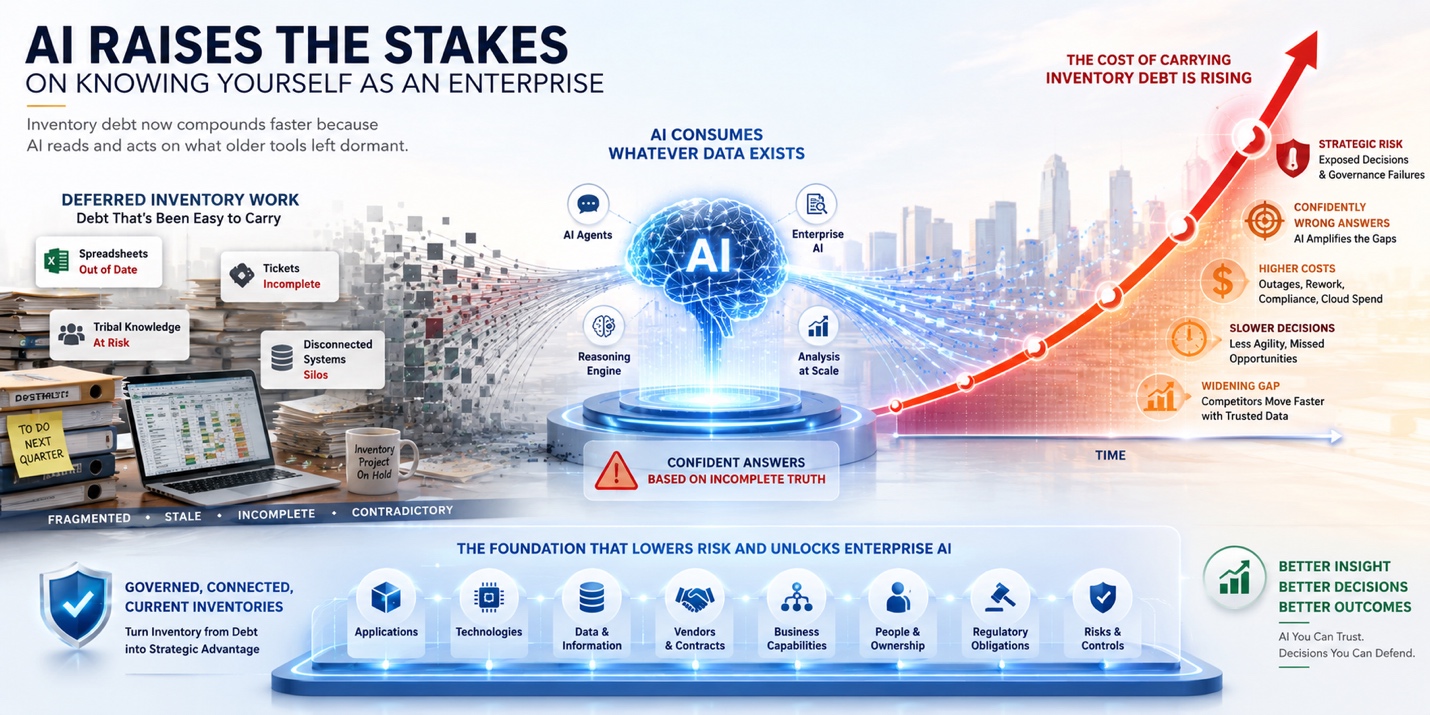
Artificial intelligence sharply increases the cost of carrying incomplete, stale, fragmented, or contradictory enterprise inventory data because AI systems can turn those defects into confident but unreliable answers....

read more
Application Portfolio Management (APM) Best Practices

Best Practice

Application Portfolio Management (APM) Best Practices

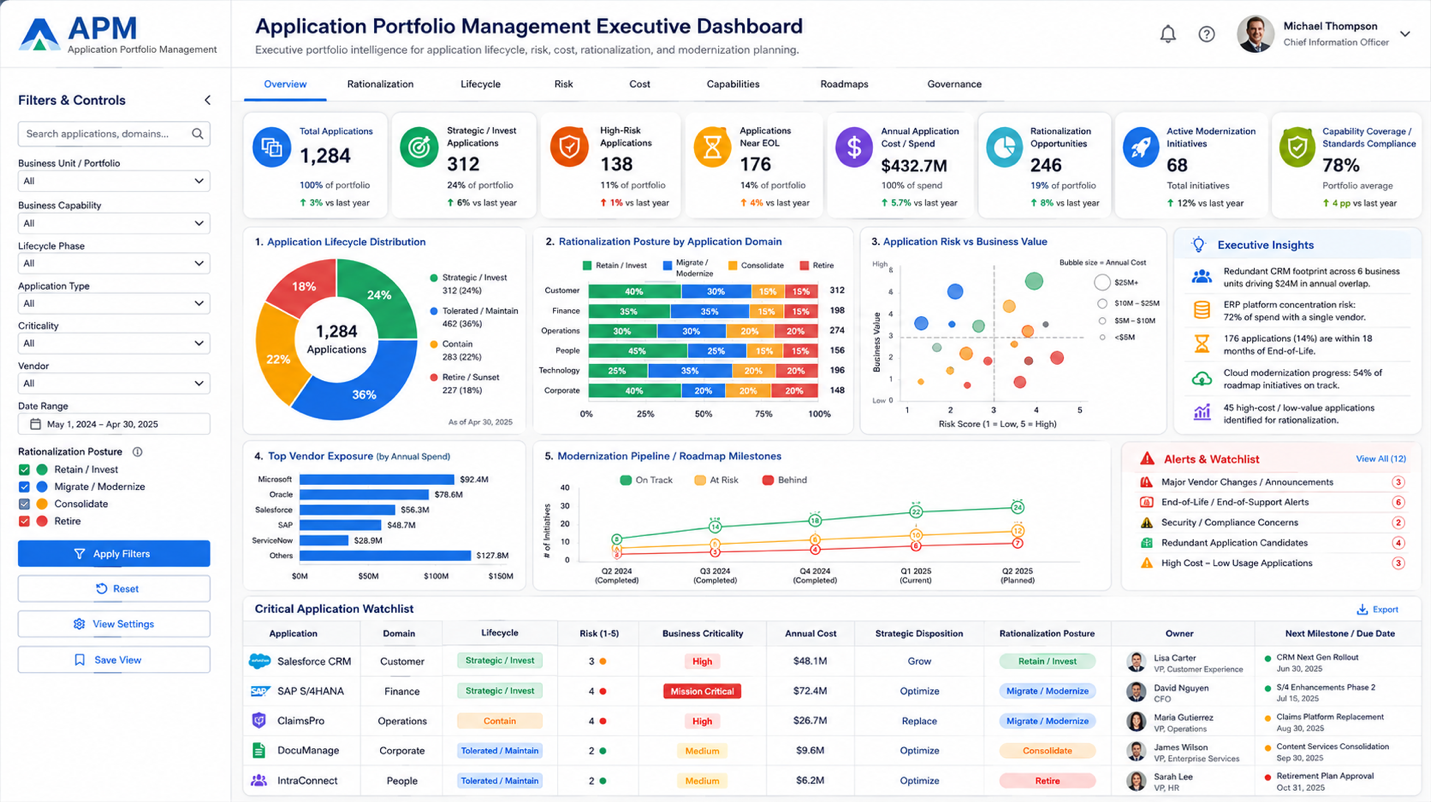
Application Portfolio Management (APM) is not an inventory spreadsheet or a purchased tool; it is the enterprise discipline that governs, funds, rationalizes, and strategically evolves every application the organizati...

read more
Enterprise AI Governance Best Practices

Best Practice

Enterprise AI Governance Best Practices

Enterprise AI Governance is not a standalone tool or committee; it is the enterprise operating discipline that makes artificial intelligence visible, accountable, controlled, evidenced, and improvable across business,...

read more
Enterprise Architecture Value Model

Model

Enterprise Architecture Value Model

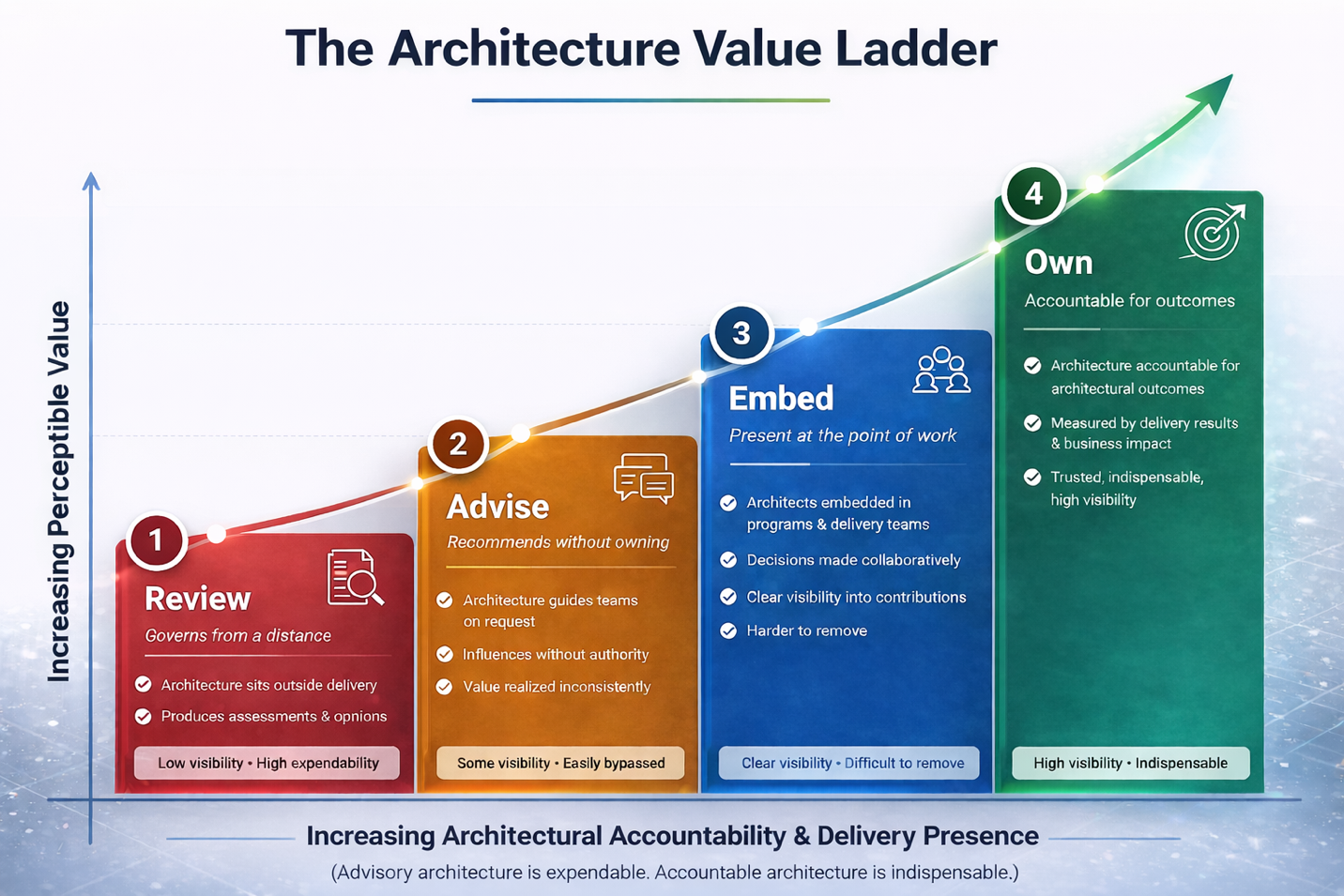
The Enterprise Architecture Value Model explains that an architecture function becomes strategically valuable when it moves beyond review and advice into accountable delivery and ownership. It gives CIOs, CTOs, Chief...

read more
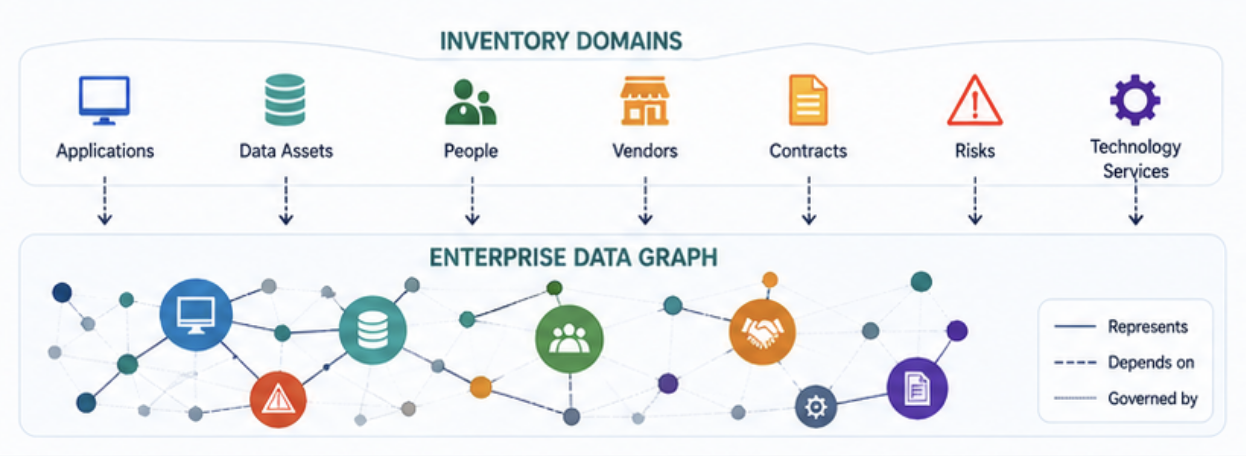
Enterprise Inventory Management Best Practices

Best Practice

Enterprise Inventory Management Best Practices

Enterprise Inventory Management establishes governed, authoritative inventories that collectively form a connected Enterprise Model. The practices in this document help organizations define ownership, improve accuracy...

read more
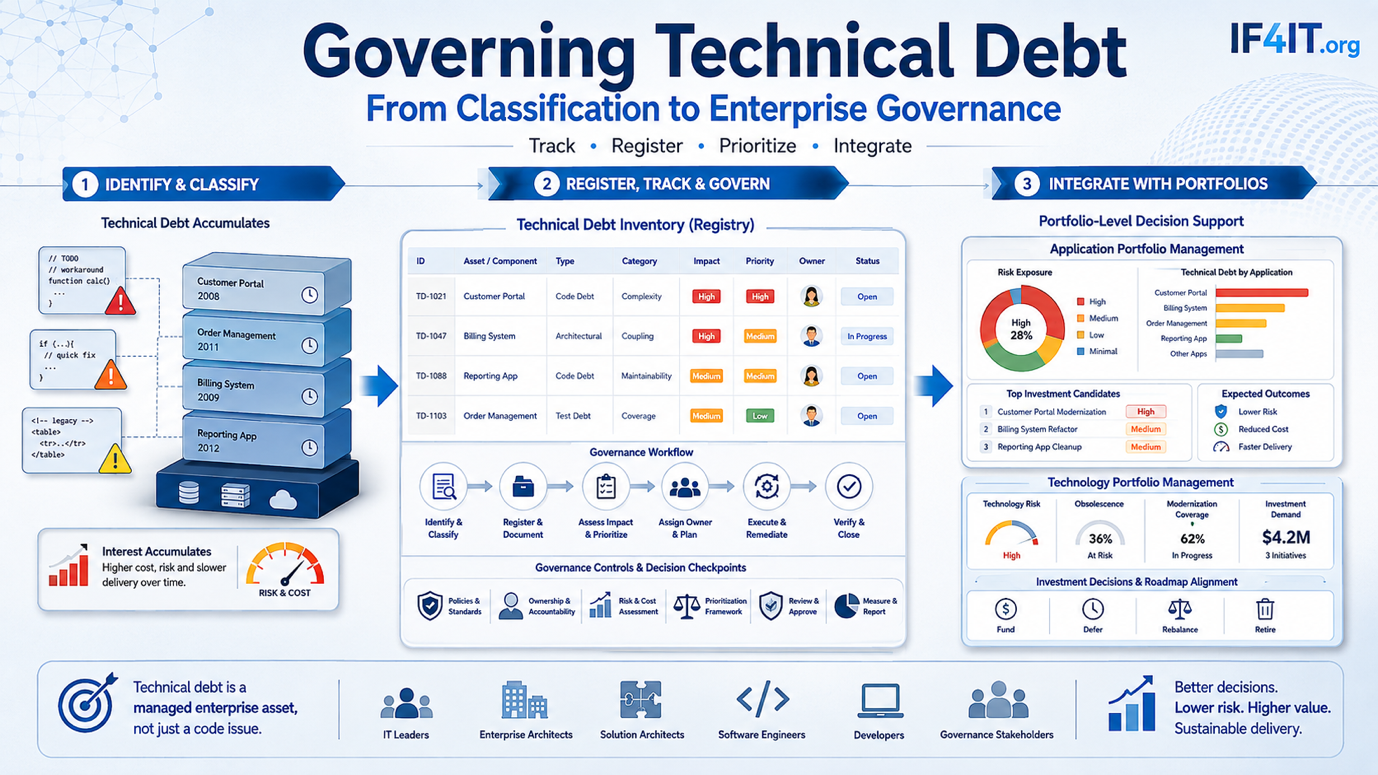
Governing Technical Debt as an Enterprise Discipline — The Framework That Helps IT Leaders Establish Technical Debt Tracking and Governance

Article

Governing Technical Debt as an Enterprise Discipline — The Framework That Helps IT Leaders Establish Technical Debt Tracking and Governance

Technical debt has been extensively classified and discussed for more than three decades, yet most IT organizations still lack a systematic governance framework for managing it as an enterprise management discipline....

read more
GxP Compliance Framework

Framework

GxP Compliance Framework

GxP is not a single regulation to satisfy once — it is a governed family of over twenty \"Good x Practice\" disciplines, each defined by its own regulatory body, spanning an enterprise's product lifecycle from researc...

read more
Integrations Inventory and Attributes

Inventory

Integrations Inventory and Attributes

The Integrations Inventory is the governed record of every data and information flow, making integration complexity, dependency risk, data sensitivity, technology usage, and cross-boundary movement visible across the...

read more
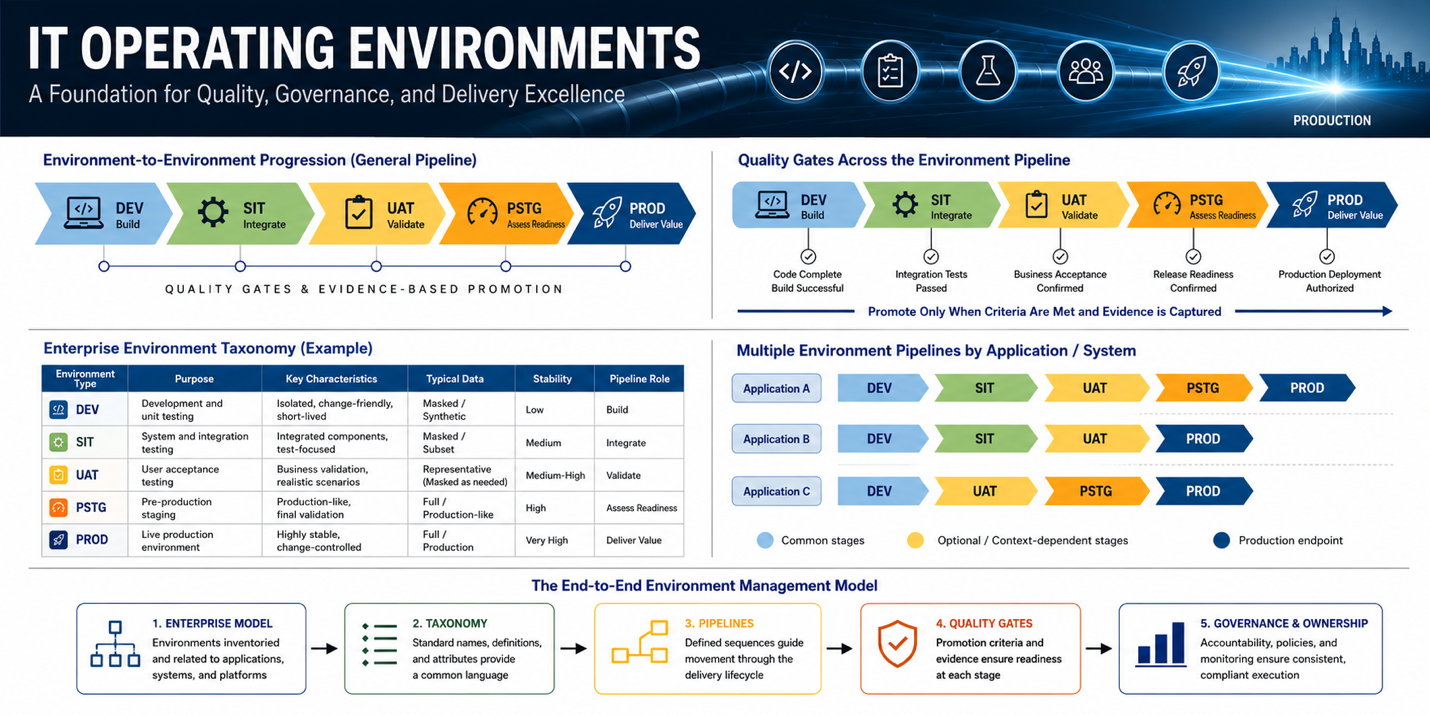
IT Operating Environments Best Practices

Best Practice

IT Operating Environments Best Practices

IT operating environments are not incidental technical spaces; they are governed enterprise control points that determine how reliably, securely, and cost-effectively solutions move from research and development into...

read more
Regulatory Agencies Inventory and Attributes

Inventory

Regulatory Agencies Inventory and Attributes

The Regulatory Agencies Inventory is the governed root of the enterprise compliance hierarchy, identifying every body whose authority, standards, or market-access requirements create formal obligations for the enterpr...

read more
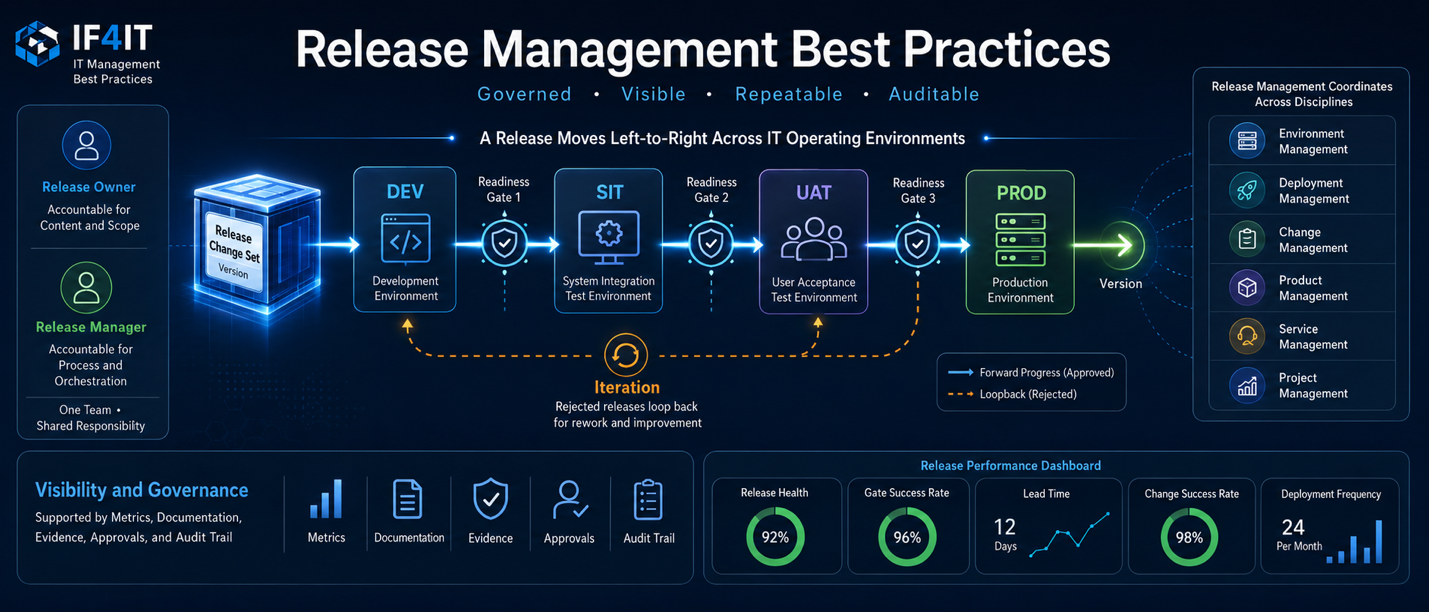
Release Management Best Practices

Best Practice

Release Management Best Practices

Release Management Best Practices defines what a Release is, establishes Release Management as a governance discipline distinct from — but reliant on — its adjacent disciplines (Environment, Deployment, Change, Produc...

read more
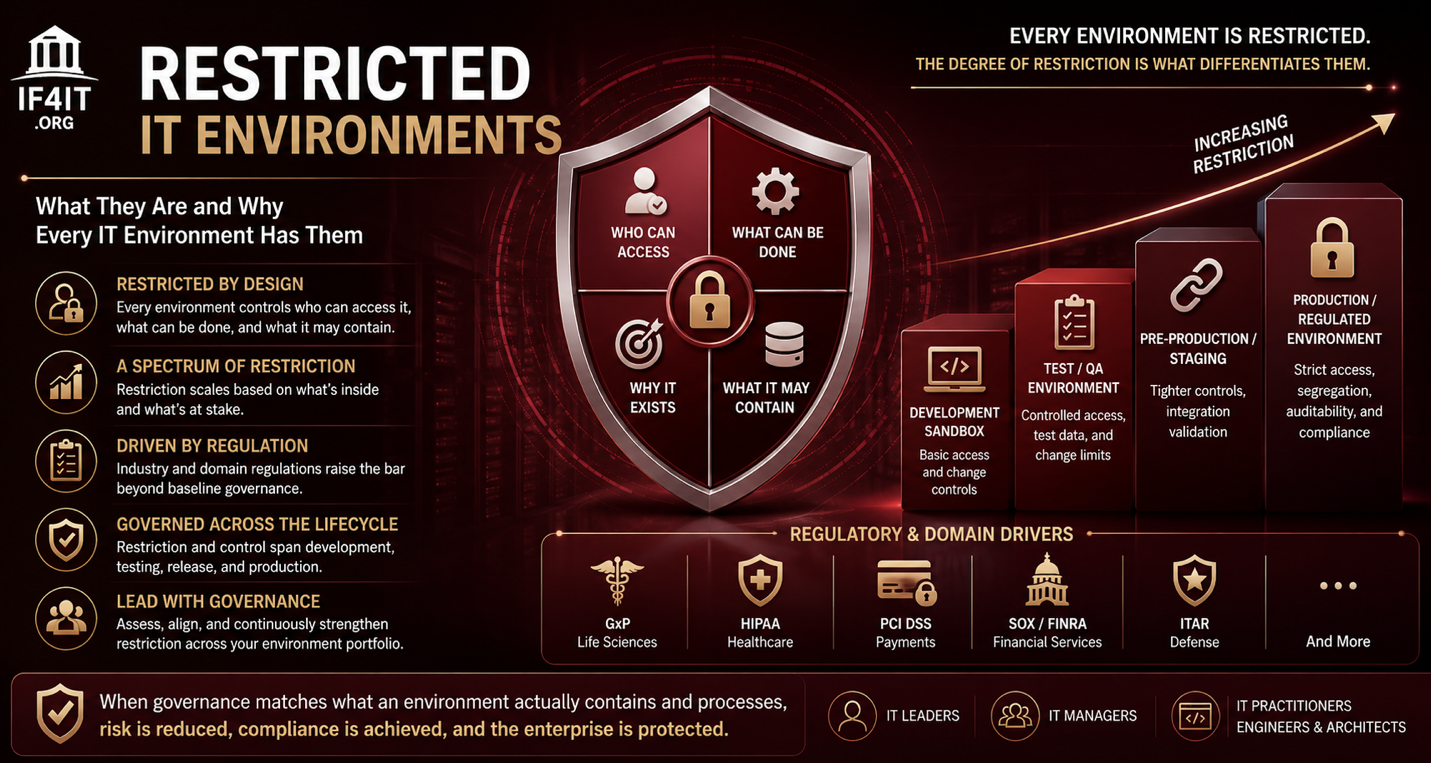
Restricted IT Environments — What They Are and Why Every IT Organization Has Them

Article

Restricted IT Environments — What They Are and Why Every IT Organization Has Them

Every IT environment is restricted by design, controlling who can work within it, what can be done inside it, and what it may contain, so “restricted” is not a special category some environments have and others lack....

read more
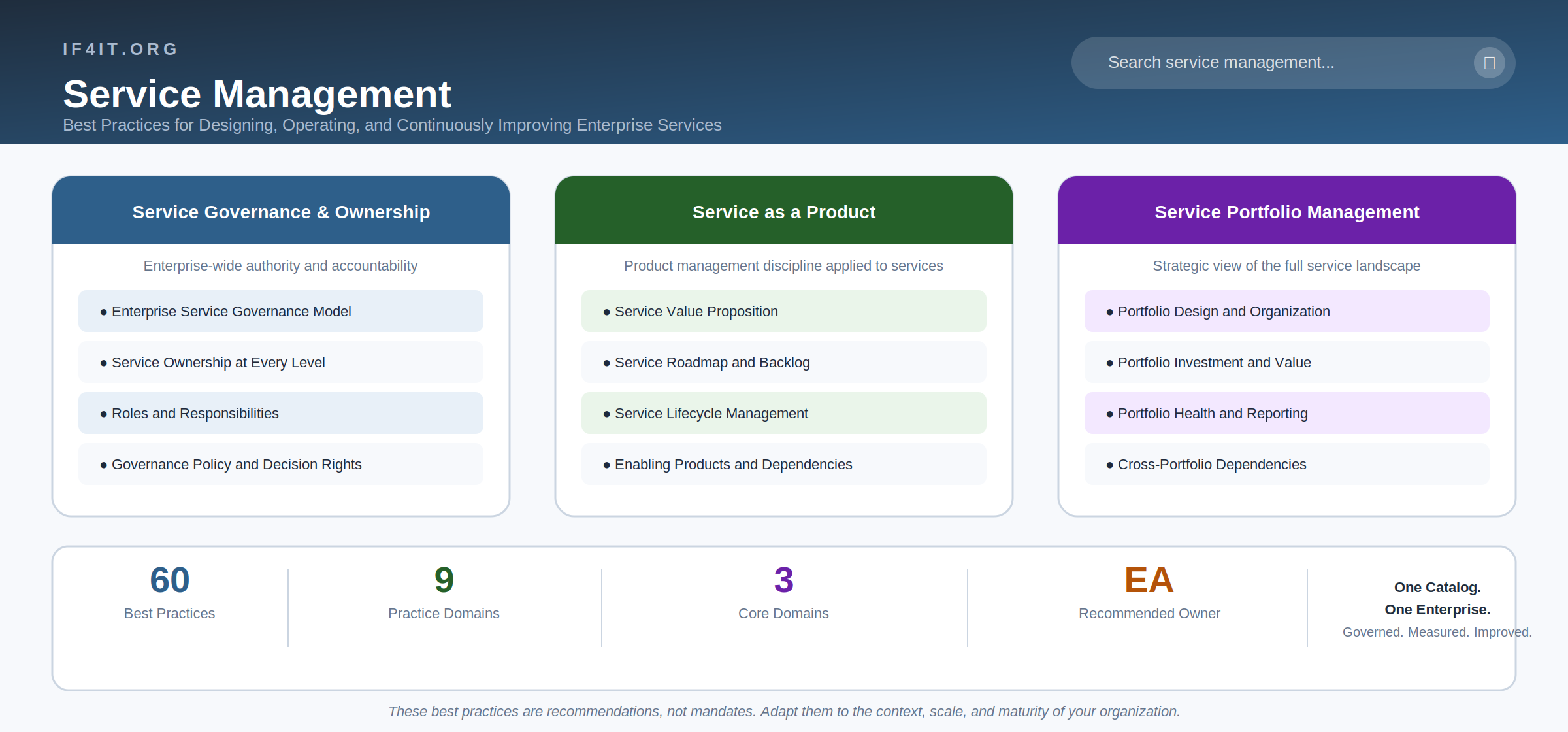
Service Management Best Practices

Best Practice

Service Management Best Practices

Service Management is not a ticketing tool or a help desk queue; it is the enterprise discipline for defining, owning, exposing, fulfilling, measuring, governing, and improving services as managed value-delivery asset...

read more

Services Inventory and Attributes

Inventory

Services Inventory and Attributes

The Services Inventory is not a Service Catalog or a list of request forms; it is the governed enterprise registry of every Service the enterprise has chosen to govern as a managed value-delivery asset across every li...

read more
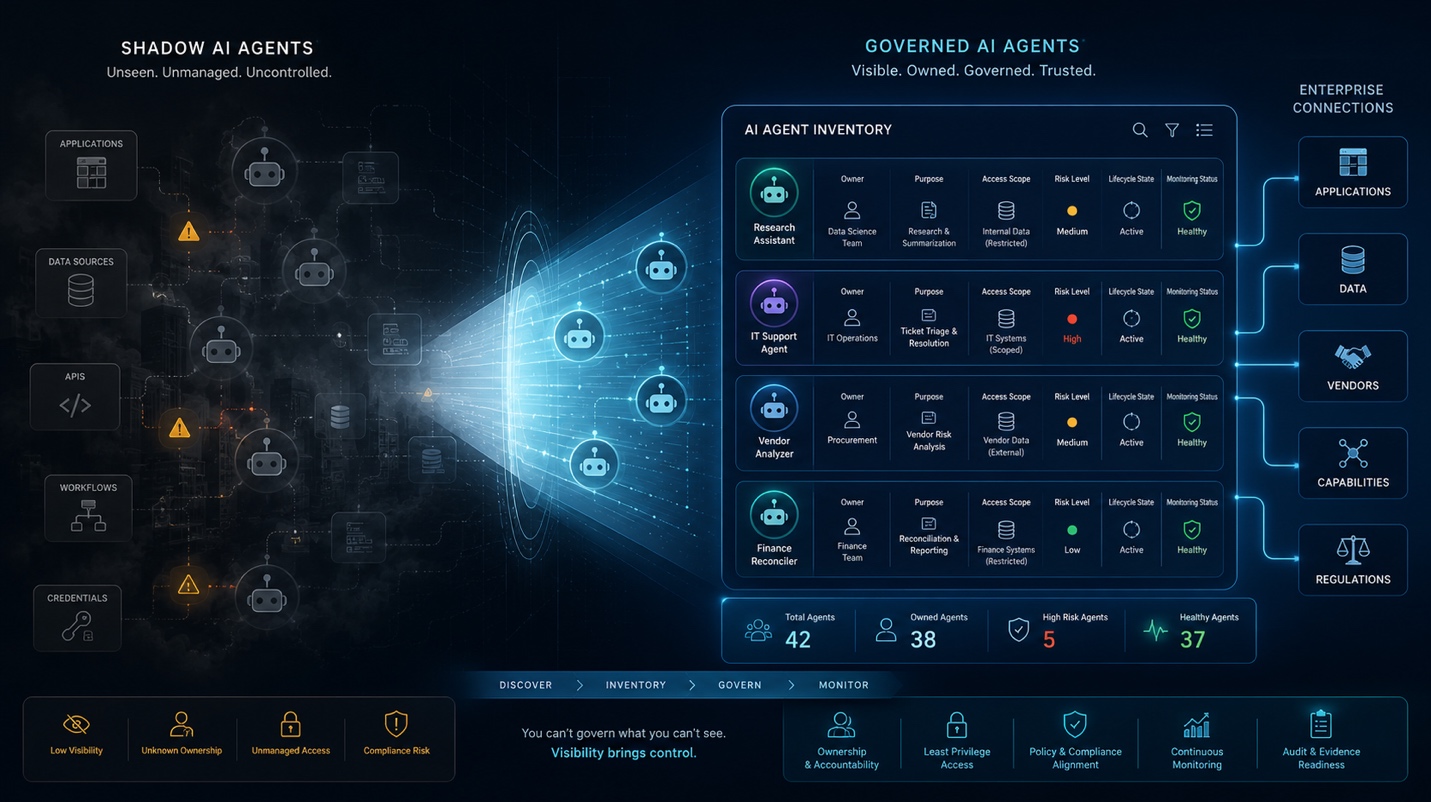
Shadow AI Agents: Why You Can't Govern the Agents You Can't See

Article

Shadow AI Agents: Why You Can't Govern the Agents You Can't See

Shadow AI agents are AI agents running inside an enterprise that no one has recorded, owns, or governs. They are not a new category of problem; they are the AI form of an old one, the ungoverned asset, and they arise...

read more
Technical Debt Management Best Practices

Best Practice

Technical Debt Management Best Practices

Technical Debt Management is the IT Management discipline for governing technical conditions and unresolved obligations that make governed Assets more costly, difficult, risky, or constrained to change, operate, secur...

read more
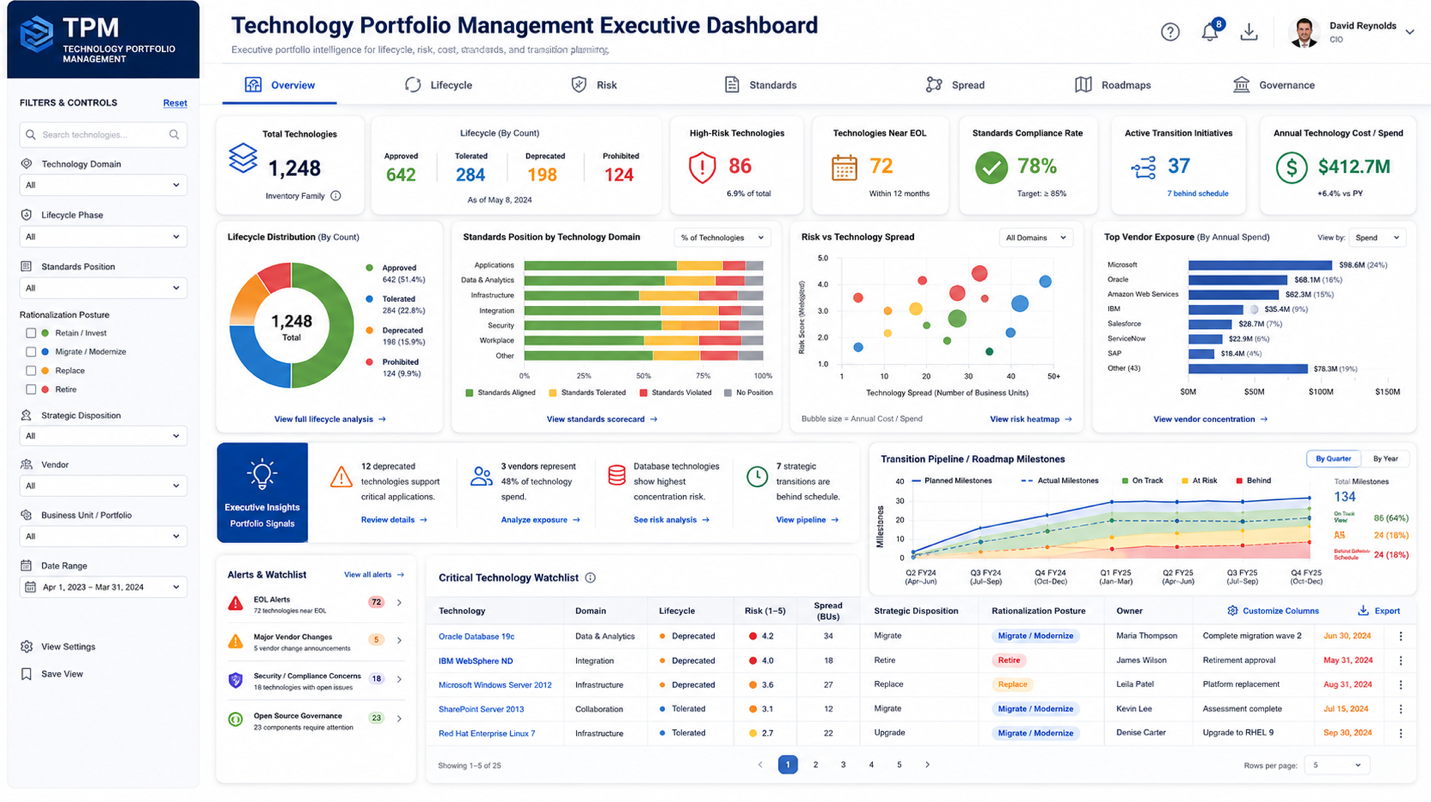
Technology Portfolio Management (TPM) Best Practices

Best Practice

Technology Portfolio Management (TPM) Best Practices

Technology Portfolio Management is the enterprise discipline for governing technologies as strategic assets through connected inventories, explicit ownership, lifecycle and standards controls, evidence-based assessmen...

read more
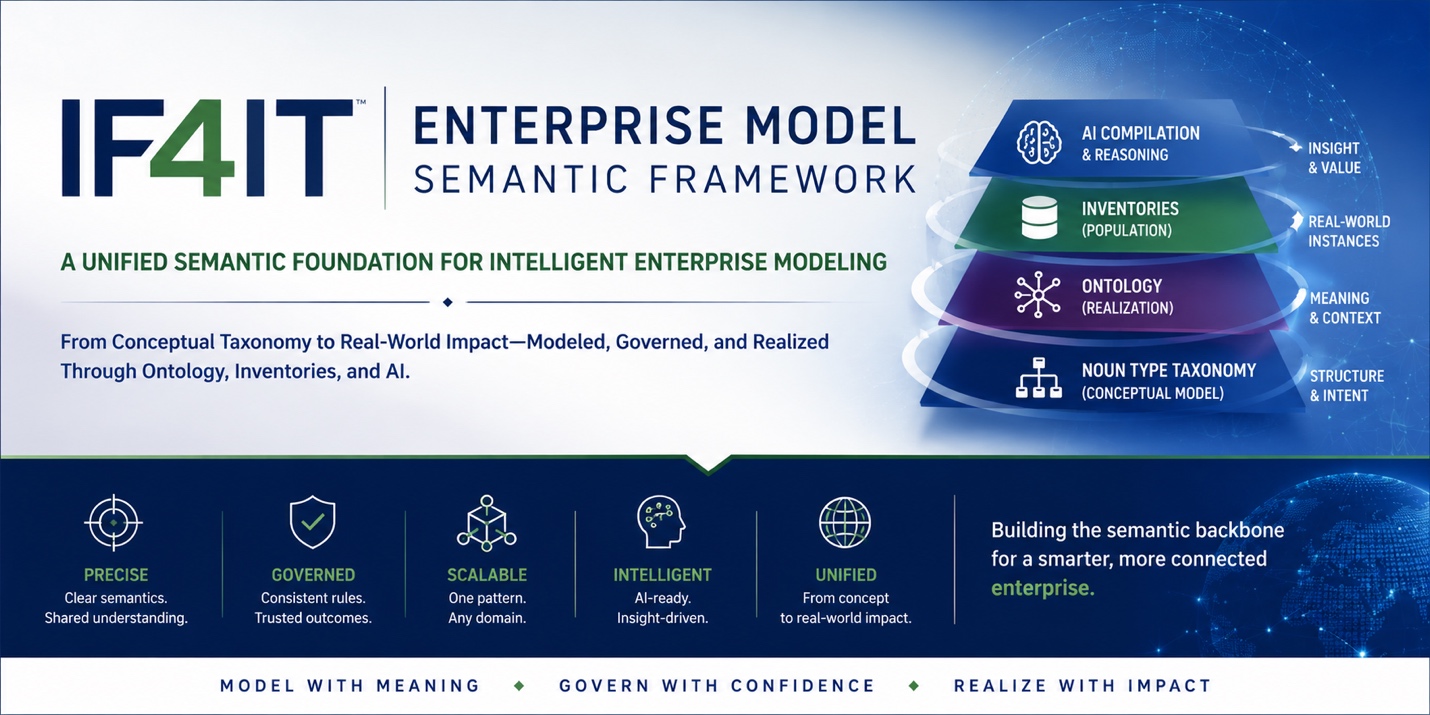
The IF4IT Enterprise Model and Modeling Best Practices

Best Practice

The IF4IT Enterprise Model and Modeling Best Practices

The IF4IT Enterprise Model and Modeling Best Practices explains how enterprises can design, govern, and use an AI-consumable semantic Enterprise Model that represents what the enterprise has, how those things relate,...

read more
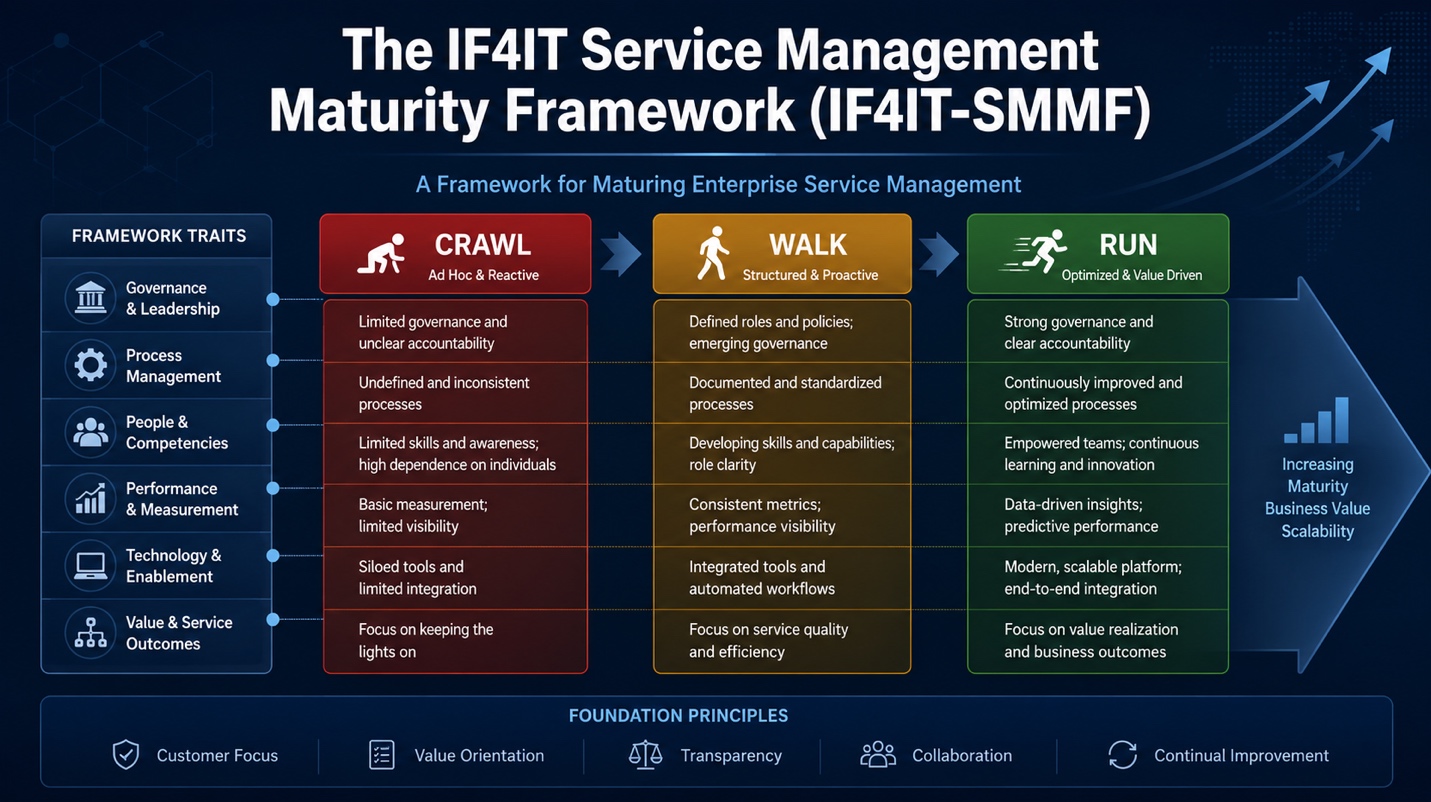
The IF4IT Service Management Maturity Framework (IF4IT-SMMF) for Small, Midsized, and Large Enterprises

Framework

The IF4IT Service Management Maturity Framework (IF4IT-SMMF) for Small, Midsized, and Large Enterprises

The IF4IT Service Management Maturity Framework (IF4IT-SMMF) gives Small, Midsized, and Large Enterprises a rigorous instrument to identify their current Service Management maturity across thirteen traits, prescribe t...

read more
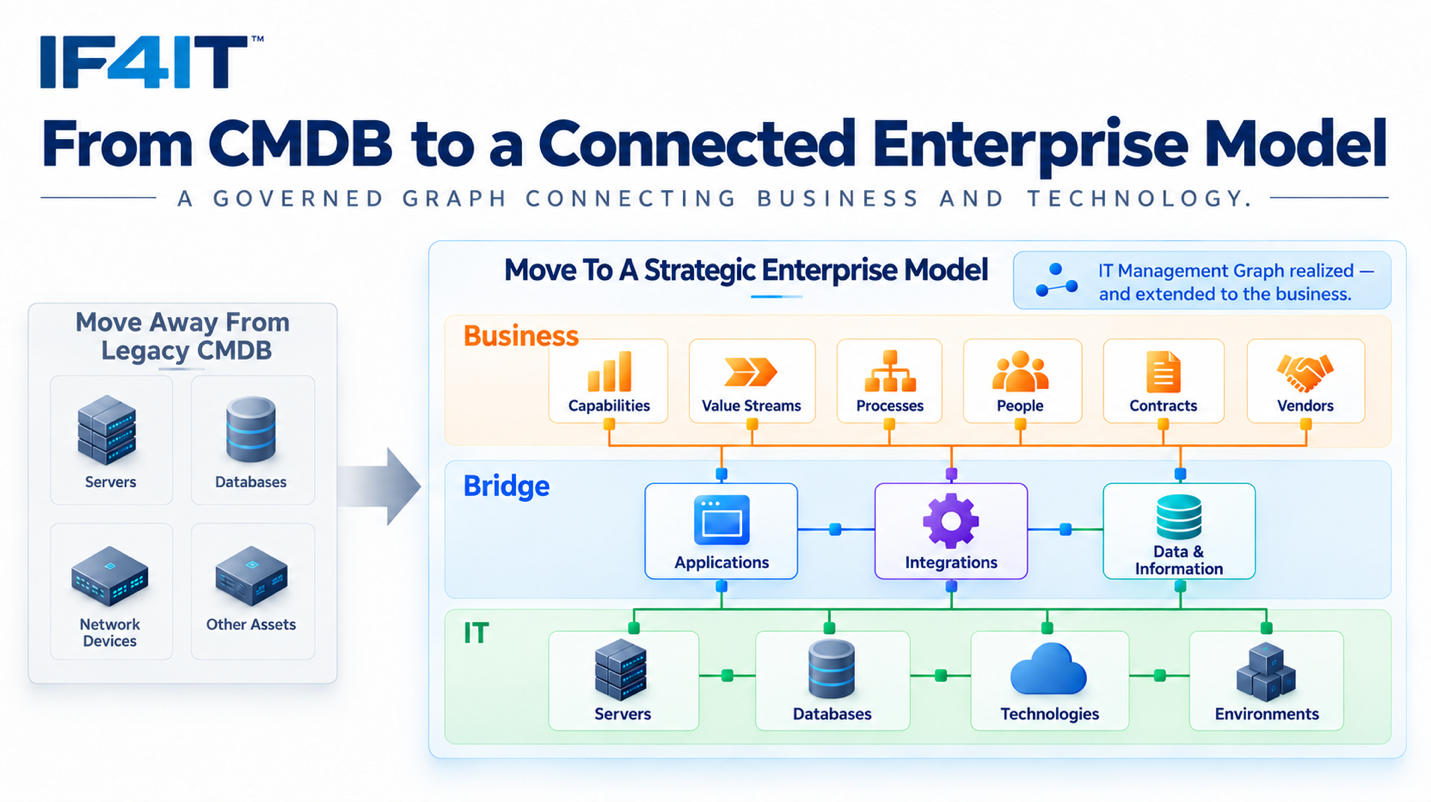
The IT Management Graph — How an Enterprise Model Delivers What the CMDB Never Could

Article

The IT Management Graph — How an Enterprise Model Delivers What the CMDB Never Could

CMDB implementations have a well-documented history of failure, predominantly because the bridge between discovered assets and the business is rarely built, and Forrester has declared the CMDB term dead in favor of an...

read more
Vendors Inventory and Attributes

Inventory

Vendors Inventory and Attributes

The Vendors Inventory is the governed enterprise record of third-party organizations that provide technology, services, data, or capabilities to the enterprise. Without a reliable Vendors Inventory, leaders cannot con...

read more
AI Agents Inventory vs. Registry vs. Catalog: What's the Difference?

Article

AI Agents Inventory vs. Registry vs. Catalog: What's the Difference?

An AI Agents Inventory and an AI Agents Registry are the same thing: a governed record of the AI agents an enterprise has, who owns them, what they can do, and what they can reach. An AI Agents Catalog is different: i...

read more
AI Governance Is an Inventory Problem: Why Enterprise AI Governance Starts With an AI Agent Inventory

Article

AI Governance Is an Inventory Problem: Why Enterprise AI Governance Starts With an AI Agent Inventory

AI governance is not a new discipline. It is inventory governance applied to a new kind of asset. Enterprises struggling to govern Artificial Intelligence (AI) are usually struggling because they cannot see what AI th...

read more
AI Raises the Stakes on Knowing Yourself as an Enterprise

Article

AI Raises the Stakes on Knowing Yourself as an Enterprise

Artificial intelligence sharply increases the cost of carrying incomplete, stale, fragmented, or contradictory enterprise inventory data because AI systems can turn those defects into confident but unreliable answers....

read more
Governing Technical Debt as an Enterprise Discipline — The Framework That Helps IT Leaders Establish Technical Debt Tracking and Governance

Article

Governing Technical Debt as an Enterprise Discipline — The Framework That Helps IT Leaders Establish Technical Debt Tracking and Governance

Technical debt has been extensively classified and discussed for more than three decades, yet most IT organizations still lack a systematic governance framework for managing it as an enterprise management discipline....

read more
Restricted IT Environments — What They Are and Why Every IT Organization Has Them

Article

Restricted IT Environments — What They Are and Why Every IT Organization Has Them

Every IT environment is restricted by design, controlling who can work within it, what can be done inside it, and what it may contain, so “restricted” is not a special category some environments have and others lack....

read more
Shadow AI Agents: Why You Can't Govern the Agents You Can't See

Article

Shadow AI Agents: Why You Can't Govern the Agents You Can't See

Shadow AI agents are AI agents running inside an enterprise that no one has recorded, owns, or governs. They are not a new category of problem; they are the AI form of an old one, the ungoverned asset, and they arise...

read more
The IT Management Graph — How an Enterprise Model Delivers What the CMDB Never Could

Article

The IT Management Graph — How an Enterprise Model Delivers What the CMDB Never Could

CMDB implementations have a well-documented history of failure, predominantly because the bridge between discovered assets and the business is rarely built, and Forrester has declared the CMDB term dead in favor of an...

read more
Agile, Waterfall, or Hybrid: An IF4IT Framework for Choosing Delivery Methodology

Best Practice

Agile, Waterfall, or Hybrid: An IF4IT Framework for Choosing Delivery Methodology

Delivery methodology is not an enterprise preference; it is a fit decision determined by the nature of the Product or Service being delivered. When organizations force all work through Agile, Waterfall, or a convenien...

read more
Application Portfolio Management (APM) Best Practices

Best Practice

Application Portfolio Management (APM) Best Practices

Application Portfolio Management (APM) is not an inventory spreadsheet or a purchased tool; it is the enterprise discipline that governs, funds, rationalizes, and strategically evolves every application the organizati...

read more
Enterprise AI Governance Best Practices

Best Practice

Enterprise AI Governance Best Practices

Enterprise AI Governance is not a standalone tool or committee; it is the enterprise operating discipline that makes artificial intelligence visible, accountable, controlled, evidenced, and improvable across business,...

read more
Enterprise Inventory Management Best Practices

Best Practice

Enterprise Inventory Management Best Practices

Enterprise Inventory Management establishes governed, authoritative inventories that collectively form a connected Enterprise Model. The practices in this document help organizations define ownership, improve accuracy...

read more
IT Operating Environments Best Practices

Best Practice

IT Operating Environments Best Practices

IT operating environments are not incidental technical spaces; they are governed enterprise control points that determine how reliably, securely, and cost-effectively solutions move from research and development into...

read more
Release Management Best Practices

Best Practice

Release Management Best Practices

Release Management Best Practices defines what a Release is, establishes Release Management as a governance discipline distinct from — but reliant on — its adjacent disciplines (Environment, Deployment, Change, Produc...

read more
Service Management Best Practices

Best Practice

Service Management Best Practices

Service Management is not a ticketing tool or a help desk queue; it is the enterprise discipline for defining, owning, exposing, fulfilling, measuring, governing, and improving services as managed value-delivery asset...

read more
Technical Debt Management Best Practices

Best Practice

Technical Debt Management Best Practices

Technical Debt Management is the IT Management discipline for governing technical conditions and unresolved obligations that make governed Assets more costly, difficult, risky, or constrained to change, operate, secur...

read more
Technology Portfolio Management (TPM) Best Practices

Best Practice

Technology Portfolio Management (TPM) Best Practices

Technology Portfolio Management is the enterprise discipline for governing technologies as strategic assets through connected inventories, explicit ownership, lifecycle and standards controls, evidence-based assessmen...

read more
The IF4IT Enterprise Model and Modeling Best Practices

Best Practice

The IF4IT Enterprise Model and Modeling Best Practices

The IF4IT Enterprise Model and Modeling Best Practices explains how enterprises can design, govern, and use an AI-consumable semantic Enterprise Model that represents what the enterprise has, how those things relate,...

read more
GxP Compliance Framework

Framework

GxP Compliance Framework

GxP is not a single regulation to satisfy once — it is a governed family of over twenty \"Good x Practice\" disciplines, each defined by its own regulatory body, spanning an enterprise's product lifecycle from researc...

read more
The IF4IT Service Management Maturity Framework (IF4IT-SMMF) for Small, Midsized, and Large Enterprises

Framework

The IF4IT Service Management Maturity Framework (IF4IT-SMMF) for Small, Midsized, and Large Enterprises

The IF4IT Service Management Maturity Framework (IF4IT-SMMF) gives Small, Midsized, and Large Enterprises a rigorous instrument to identify their current Service Management maturity across thirteen traits, prescribe t...

read more
AI Agents Inventory and Attributes

Inventory

AI Agents Inventory and Attributes

The AI Agents Inventory is the enterprise’s single governed record of the AI agents it builds, buys, or runs — the autonomous, model-driven software actors that take action on systems and data, or communicate with sta...

read more
Integrations Inventory and Attributes

Inventory

Integrations Inventory and Attributes

The Integrations Inventory is the governed record of every data and information flow, making integration complexity, dependency risk, data sensitivity, technology usage, and cross-boundary movement visible across the...

read more
Regulatory Agencies Inventory and Attributes

Inventory

Regulatory Agencies Inventory and Attributes

The Regulatory Agencies Inventory is the governed root of the enterprise compliance hierarchy, identifying every body whose authority, standards, or market-access requirements create formal obligations for the enterpr...

read more
Services Inventory and Attributes

Inventory

Services Inventory and Attributes

The Services Inventory is not a Service Catalog or a list of request forms; it is the governed enterprise registry of every Service the enterprise has chosen to govern as a managed value-delivery asset across every li...

read more
Vendors Inventory and Attributes

Inventory

Vendors Inventory and Attributes

The Vendors Inventory is the governed enterprise record of third-party organizations that provide technology, services, data, or capabilities to the enterprise. Without a reliable Vendors Inventory, leaders cannot con...

read more
Enterprise Architecture Value Model

Model

Enterprise Architecture Value Model

The Enterprise Architecture Value Model explains that an architecture function becomes strategically valuable when it moves beyond review and advice into accountable delivery and ownership. It gives CIOs, CTOs, Chief...

read more
© The International Foundation for Information Technology (IF4IT) 2008 - Present
Legal Disclaimers